
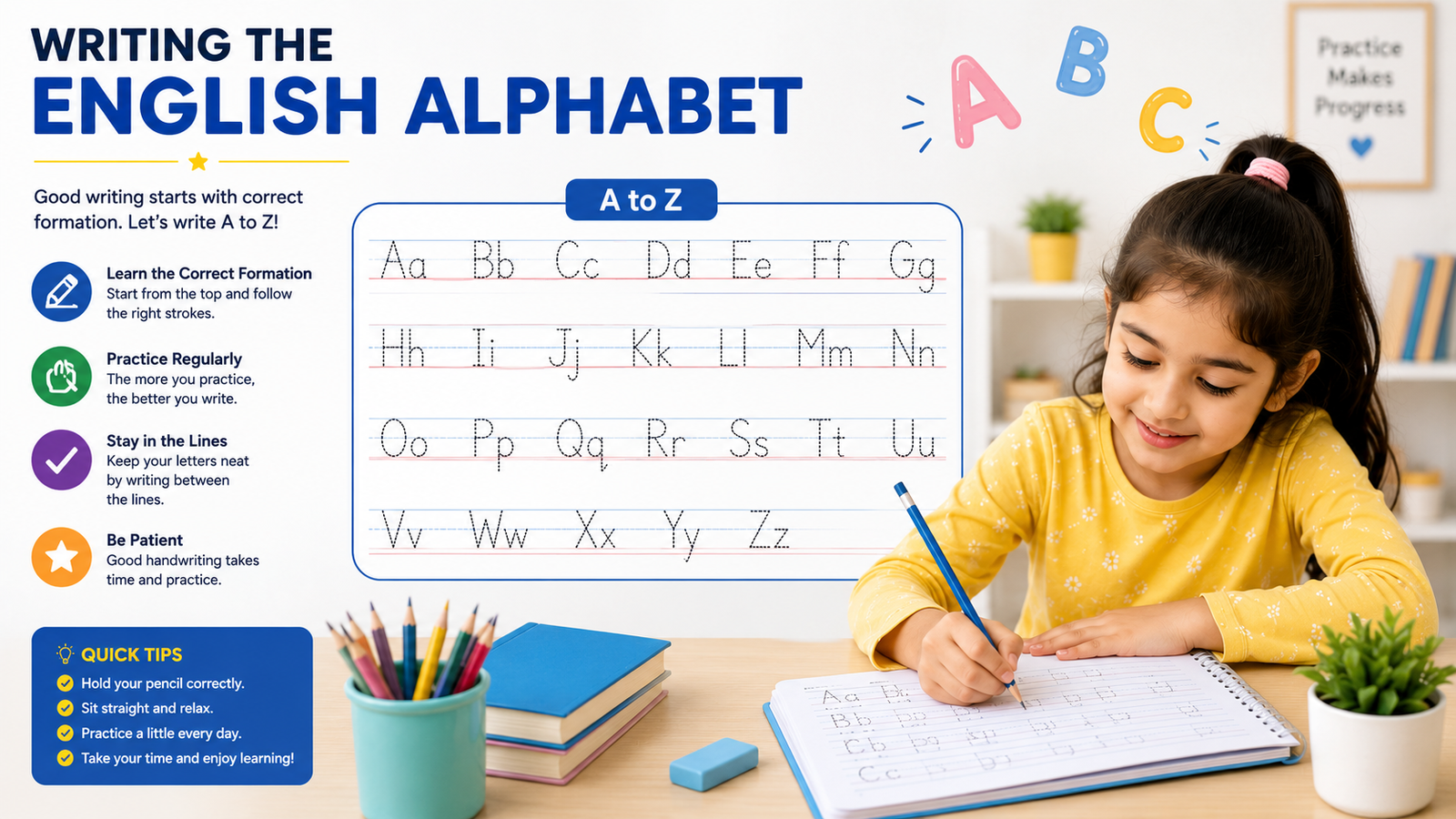
Writing the English Alphabet: Learn to Write Capital and Small Letters Correctly

Introduction
Learning to write the English alphabet is one of the most important steps in becoming confident in English. Every word, sentence, and paragraph begins with letters. When you can write the alphabet correctly, you build a strong foundation for spelling, reading, writing, and communication.
Many beginners focus only on recognising letters while reading, but writing them is equally important. Writing each letter by hand helps you remember its shape, improves your handwriting, and makes it easier to recognise words when reading. The more you practise writing, the more natural it becomes.
The English alphabet has twenty-six letters. Every letter has two forms: a capital letter, also called an uppercase letter, and a small letter, also called a lowercase letter. Both forms are used in everyday English, so it is important to learn how to write each one neatly and correctly.
In this lesson, you will learn the English alphabet, understand when to use capital and small letters, and practise writing them with confidence. By developing good writing habits from the beginning, you will make future English learning much easier.
Learning Objectives
After completing this lesson, you will be able to:
- Write all 26 letters of the English alphabet correctly.
- Recognise the difference between capital and small letters.
- Understand when to use uppercase and lowercase letters.
- Develop neat and readable handwriting.
- Build confidence in writing simple English words.
The English Alphabet
The English alphabet contains twenty-six letters. These letters are the building blocks of every English word. Whether you are writing your name, completing homework, sending a message, or writing an email, you use these same twenty-six letters.
Every letter has an uppercase form and a lowercase form. Learning both forms is essential because they appear together in books, newspapers, websites, classrooms, and everyday writing.
| Capital Letter | Small Letter |
|---|---|
| A | a |
| B | b |
| C | c |
| D | d |
| E | e |
| F | f |
| G | g |
| H | h |
| I | i |
| J | j |
| K | k |
| L | l |
| M | m |
| N | n |
| O | o |
| P | p |
| Q | q |
| R | r |
| S | s |
| T | t |
| U | u |
| V | v |
| W | w |
| X | x |
| Y | y |
| Z | z |
What Are Capital Letters?
Capital letters, also called uppercase letters, are larger versions of the alphabet. They are used at the beginning of sentences and for important words such as names of people, cities, countries, schools, months, and days of the week.
Using capital letters correctly makes your writing clear and professional. They help readers understand where a sentence begins and identify proper nouns quickly.
Examples
- My name is Ali.
- I live in Pakistan.
- Monday is the first day of my course.
- She studies at City School.
- English is an international language.
What Are Small Letters?
Small letters, also known as lowercase letters, are used for most words in English writing. After the first capital letter of a sentence, the remaining words are usually written using small letters unless another capital letter is required.
You will use lowercase letters much more often than capital letters. Therefore, practising them regularly will improve both your handwriting speed and accuracy.
Examples
- apple
- book
- computer
- student
- teacher
- language
When Should You Use Capital Letters?
Knowing when to use capital letters is just as important as knowing how to write them. English has clear rules for using uppercase letters, and following these rules makes your writing easier to understand.
Use Capital Letters For
- The first word of every sentence.
- Your name and other people's names.
- Countries, cities, and nationalities.
- Days of the week and months.
- Schools, companies, and organisations.
- The pronoun I whenever it refers to yourself.
Whenever you finish one sentence and begin another, remember to start the new sentence with a capital letter. This simple habit makes your writing look organised and correct.
Writing Practice
Carefully write each pair of letters in your notebook. Focus on writing neatly rather than writing quickly.
A a B b C c D d E e
F f G g H h I i J j
K k L l M m N n O o
P p Q q R r S s T t
U u V v W w X x Y y Z z
Write each letter five times. Pay attention to its shape, size, and spacing. Good handwriting develops through careful and consistent practice rather than speed.
How to Write Letters Correctly
Writing English letters neatly takes practice and patience. Every letter has a specific shape, size, and direction. When you learn to write each letter correctly from the beginning, your handwriting becomes easier to read and more attractive.
Many beginners try to write quickly before they have learned the correct letter shapes. This often leads to messy handwriting and letters that are difficult to recognise. Instead of focusing on speed, concentrate on writing each letter carefully. As your confidence grows, your writing speed will improve naturally.
Always start by observing the letter carefully. Notice where the pencil begins, how it moves, and where it finishes. Repeating the same movement several times helps your hand remember the correct shape.
Practise One Letter at a Time
Learning all twenty-six letters in one day can feel overwhelming. A better approach is to practise a small group of letters every day. This allows your brain and your hand to become familiar with each letter before moving on to the next one.
Daily Practice Plan
- Day 1: A, B, C, D, E
- Day 2: F, G, H, I, J
- Day 3: K, L, M, N, O
- Day 4: P, Q, R, S, T
- Day 5: U, V, W, X, Y, Z
After learning one group of letters, review them before starting the next group. Regular revision helps you remember the alphabet for a long time.
Correct Letter Size and Spacing
Good handwriting is not only about forming letters correctly. It also depends on keeping letters the right size and leaving enough space between words. If letters are too close together, words become difficult to read. If they are too far apart, sentences look untidy.
When writing on lined paper, try to keep your letters sitting neatly on the line. Capital letters are usually taller than small letters, while lowercase letters should remain consistent in height.
Writing Rules
- Write letters neatly and clearly.
- Leave a small space between words.
- Keep letters the same size whenever possible.
- Do not make letters overlap.
- Write slowly until your handwriting improves.
Writing Simple Words
After practising individual letters, the next step is to combine them into words. This helps you understand how letters work together and improves your spelling at the same time.
Practice Words
- Apple
- Ball
- Book
- Cat
- Dog
- Fish
- Hand
- House
- School
- Teacher
Copy each word into your notebook at least three times. Focus on writing every letter clearly rather than finishing quickly. Consistent practice develops muscle memory, making handwriting smoother over time.
Copy Writing Practice
Copy writing is one of the best exercises for improving handwriting. Choose a short sentence, read it carefully, and then copy it exactly as it appears. Pay attention to capital letters, small letters, spaces, and punctuation marks.
Copy These Sentences
My name is Ali.
I like learning English.
This is my notebook.
We practise every day.
Good handwriting makes writing easy to read.
Repeat these sentences several times until you can write them smoothly without looking at every letter.
Common Handwriting Mistakes
Every learner makes handwriting mistakes in the beginning. The good news is that these mistakes become less common with regular practice. By paying attention to your writing habits, you can improve much faster.
| Common Mistake | Better Practice |
|---|---|
| Writing too fast | Write slowly and carefully. |
| Mixing capital and small letters | Use capitals only where needed. |
| Uneven letter size | Keep letters similar in height. |
| No space between words | Leave a small gap after each word. |
| Untidy handwriting | Practise one line every day. |
Build Good Handwriting Habits
Good handwriting is a skill that develops through regular practice. You do not need expensive notebooks or special pens to improve. What matters most is writing a little every day with care and attention. As you practise, your hand becomes more comfortable forming letters, and your writing becomes smoother and easier to read.
Before you begin writing, sit comfortably at a desk with good lighting. Hold your pencil or pen in a relaxed grip instead of squeezing it tightly. Keep your notebook straight and maintain a comfortable posture. These simple habits reduce hand fatigue and help you write more neatly.
Remember that every learner improves at a different pace. Do not compare your handwriting with others. Focus on making your own writing a little better each day.
Practice Writing Everyday Words
After learning to write individual letters, start writing simple English words. This helps you remember the alphabet while improving your spelling and handwriting at the same time. Begin with short words and gradually move to longer ones.
Practice Words
- Boy
- Girl
- Book
- School
- Table
- Chair
- Water
- Window
- Family
- Friend
- Teacher
- Student
Write each word at least five times. Pay attention to the shape of every letter, the spacing between letters, and the space between words.
Writing Complete Sentences
Once you feel confident writing words, begin writing short sentences. A sentence starts with a capital letter and ends with a full stop. This is an excellent way to practise both handwriting and basic English grammar.
Sentence Practice
My name is Sara.
I enjoy learning English.
My teacher is very kind.
We read and write every day.
Practice makes perfect.
Copy each sentence carefully into your notebook. Then try writing the same sentence again without looking at the example. This activity strengthens both your memory and your writing skills.
Daily Handwriting Routine
A short daily practice routine is one of the best ways to improve your handwriting. Even ten to fifteen minutes each day can produce excellent results over time.
15-Minute Practice Plan
- Write all capital letters from A to Z.
- Write all small letters from a to z.
- Practise ten simple English words.
- Copy three short sentences.
- Review your work and correct any mistakes.
Following this routine regularly will improve your handwriting, increase your confidence, and make writing English feel more natural.
Mini Quiz
Check your understanding by answering the following questions.
- How many letters are there in the English alphabet?
- What is another name for capital letters?
- What is another name for small letters?
- What should every English sentence begin with?
- Why is daily handwriting practice important?
Answers
- There are 26 letters in the English alphabet.
- Capital letters are also called uppercase letters.
- Small letters are also called lowercase letters.
- Every sentence should begin with a capital letter.
- Daily practice improves handwriting, letter formation, confidence, and writing speed.
Lesson Summary
In this lesson, you learned how to write the English alphabet using both capital and small letters. You explored when to use uppercase and lowercase letters, practised writing individual letters, combined them to form words, and learned how to write complete sentences correctly.
You also discovered that neat handwriting comes from consistent practice rather than writing quickly. Paying attention to letter shape, size, spacing, and posture helps you develop clear and readable handwriting.
As you continue learning English, writing will become an important part of your daily communication. Whether you are completing schoolwork, writing notes, sending messages, or preparing for exams, strong handwriting skills will make your writing easier to understand and more professional.
Keep practising every day, stay patient with yourself, and remember that every page you write brings you closer to becoming a confident English writer.
Final Writing Tip
Carry a small notebook wherever you go and spend a few minutes writing English letters, words, or sentences whenever you have free time. Regular daily practice is the fastest way to improve your handwriting. Small improvements made consistently will lead to excellent writing skills over time.