
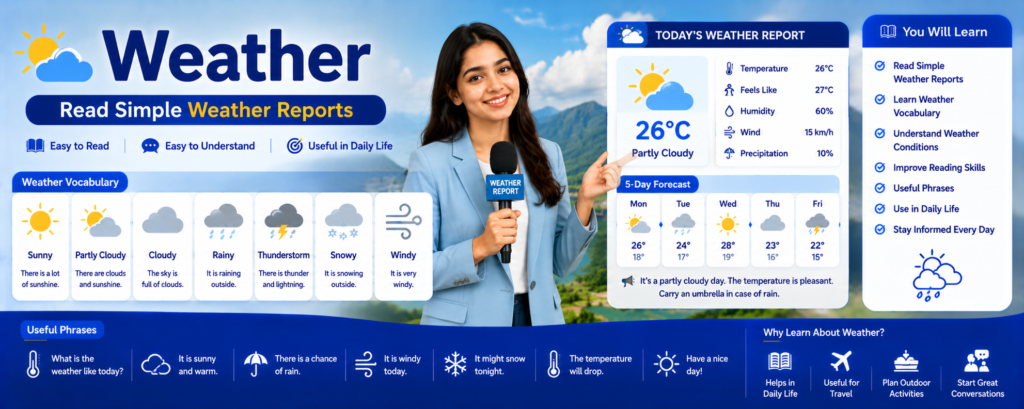
The Universal Language of the Skies
Learn practical English for weather vocabulary, temperatures, atmospheric conditions, forecasts, severe weather, idioms, and real-world weather reports.
Introduction: The Universal Language of the Skies
Weather is perhaps the most universally discussed topic in human history. Whether you are planning your morning commute, deciding what clothes to pack for a journey, or simply breaking the ice in a casual conversation, talking about the weather is a daily social habit across the globe. Mastering weather vocabulary and reading simple weather reports allows you to understand meteorological forecasts, interpret temperature scales, and describe atmospheric conditions with precision and ease.
This comprehensive, long-format lesson is written entirely in English to immerse you fully in the language. We will systematically explore temperature metrics, atmospheric conditions, precipitation types, wind dynamics, severe weather phenomena, forecasting phrases, and realistic weather reports. Let us dive into the everyday language of the skies.
Phase 1: Temperature and Thermal Metrics
Temperature dictates how warm or cold our environment feels. Understanding thermal terminology is the first step in interpreting any weather report.
When stating temperatures in English, we use the verb "to be" combined with the degree value and scale. For example, we say, "The temperature is twenty-two degrees Celsius" or "It is seventy-five degrees Fahrenheit." Notice how adjectives like chilly and freezing describe subjective physical sensations, while exact numbers provide objective meteorological data.
Phase 2: Basic Atmospheric Conditions (Sunny, Cloudy, Clear)
The visual appearance of the sky dictates the general character of the day. These foundational terms describe the amount of sunlight and cloud cover.
When describing sky conditions in a sentence, English speakers typically use the pronoun "It" as an impersonal subject followed by the verb "is" and an adjective (It is sunny today, It is overcast). This grammatical construction is standard for weather reporting across all English-speaking regions.
Phase 3: Precipitation (Rain, Snow, and Storms)
Precipitation refers to any form of water falling from the clouds to the Earth's surface. Knowing these terms helps you decide whether to carry an umbrella.
Precipitation can function as both nouns and verbs. For example, you can say "It is raining" (Present Continuous verb tense describing an ongoing action) or "There is heavy rain* forecasted for this afternoon"* (Noun form). Understanding this morphological shift is essential when transitioning from casual observations to formal meteorological reports.
Phase 4: Wind and Atmospheric Pressure
Wind adds movement and physical force to the weather. Describing wind speed and direction requires specific vocabulary and descriptive modifiers.
Adjectives ending in -y are frequently formed from noun bases in meteorology (wind becomes windy, cloud becomes cloudy, rain becomes rainy). These adjectives describe the prevailing atmospheric state of a given day. When describing wind direction, English uses directional prepositions, such as "A gentle breeze blowing from the north."
Phase 5: Seasonal Weather Patterns
Weather changes cyclically throughout the year. Each of the four seasons brings distinct temperature trends, precipitation types, and ecological transformations.
When discussing seasonal weather, English speakers use prepositions of time such as "in" (in the spring, in winter). Notice the distinction between weather (temporary, day-to-day atmospheric conditions) and climate (long-term regional patterns over decades), which is a common point of confusion for language learners.
Phase 6: Weather Instruments and Meteorology
Behind every weather report lies scientific observation. Meteorologists use specialized instruments and terminology to measure and predict atmospheric changes.
Technical meteorological terms elevate your vocabulary from casual small talk to scientific literacy. Notice how nouns like meteorology and barometer derive from Greek roots, providing a consistent etymological framework that makes them easy to recognize across European languages.
Phase 7: Real-World Weather Report 1 (Morning Local Forecast)
Let us examine a typical morning weather report broadcast on radio or television, demonstrating standard reporting structure and phrasing.
Weather reports follow a predictable chronological structure: current conditions, daytime progression, high/low temperature expectations, and precipitation probability. Notice the use of future time framing ("expect temperatures to climb," "There is zero chance of rain") to project conditions forward across the coming hours.
Phase 8: Real-World Weather Report 2 (Severe Weather Alert)
When severe weather approaches, reports shift tone to become urgent, instructive, and precautionary, utilizing specific safety terminology.
Severe weather reports utilize imperative verbs (stay indoors, secure objects, avoid travel) and formal nouns (warning, bulletin, torrential rain) to convey urgency. Notice how adjectives like severe and torrential intensify the descriptive weight of the meteorological data, signaling potential danger to the listener.
Phase 9: Weather Idioms and Everyday Expressions
English is rich with colorful idiomatic expressions derived from weather phenomena. These phrases carry metaphorical meanings used widely in daily conversation.
Idiomatic expressions decouple weather terms from literal meteorological reporting, converting them into powerful cultural metaphors. For example, telling someone you are feeling "under the weather" has nothing to do with atmospheric pressure; it simply means you have a cold or feel fatigued. Recognizing these phrases allows you to interpret figurative speech smoothly.
Phase 10: Narrative Integration (Planning Around the Skies)
To conclude our lesson, we integrate all weather vocabulary, temperature metrics, reporting structures, and idiomatic expressions into a cohesive narrative text depicting a practical day shaped by meteorological conditions.
This final passage demonstrates the seamless integration of temperature scales (fourteen degrees Celsius), sky conditions (clear, sunny, clouds), precipitation types (showers), seasonal context (autumn, winter), and idiomatic expressions (save for a rainy day, every cloud has a silver lining). By mastering these ten phases, you are fully equipped to read weather reports and discuss atmospheric conditions in fluent English with total confidence.