
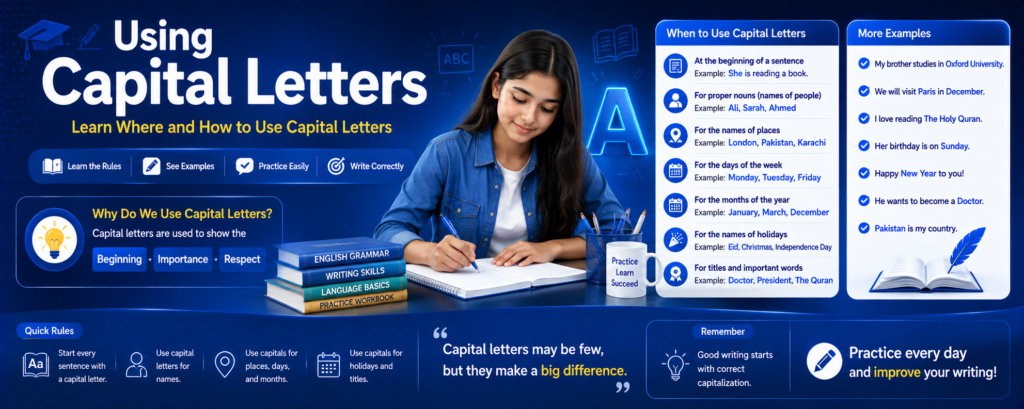
Basic: Using Capital Letters
Learn when and how to use capital letters correctly in English writing, communication, website content, and everyday sentences.
01 Introduction
Capital letters are the road signs of written English. They signal to the reader where a sentence begins, highlight important names, and bring order to text. Without them, writing looks messy, unprofessional, and difficult to read.
This comprehensive lesson covers all the essential rules, guidelines, and practical examples you need to master capital letters for your writing, website content, and everyday communication.
02 The Core Golden Rule
Start Every Sentence with a Capital Letter
The most fundamental rule of capitalization is that the very first word of every new sentence must start with a capital letter. This tells your reader a new thought or idea is beginning.
The sun shines bright today.
We love learning English.
Are you coming with us?
03 The Power of "I" and "O"
In English, the pronoun used to refer to yourself — I — must always be capitalized, no matter where it appears in a sentence. Additionally, the poetic or formal interjection O is always capitalized.
Example 1: When I arrived, everyone was already there.
Example 2: My friends and I went to the park.
Example 3: Hear us, O Lord, in our time of need.
04 Capitalizing Proper Nouns
Common nouns refer to general items such as dog, city, school, while proper nouns refer to specific, unique people, places, or things. Proper nouns always require a capital letter.
A. Names of People and Titles
Capitalize the specific names of individuals, as well as titles that come directly before their names.
- People: Sarah, Alex Johnson, Muhammad
- Titles: President Lincoln, Doctor Smith, Professor Ali
B. Geographic and Place Names
Capitalize cities, countries, states, rivers, mountains, and specific regions.
- Cities & Countries: Paris, Tokyo, Pakistan, Canada
- Landmarks & Bodies of Water: Mount Everest, the Atlantic Ocean, the Nile River
C. Days, Months, and Holidays
The days of the week, months of the year, and official holidays must always be capitalized.
Note: Seasons — spring, summer, autumn, winter — are generally lowercase unless they start a sentence or are part of a proper title.
- Days & Months: Monday, Friday, January, October
- Holidays: Easter, Christmas, Eid, New Year's Day
05 Titles of Books, Movies, Articles, and Websites
When writing the title of a book, movie, song, or website page, capitalize the first word, the last word, and all important words in between — nouns, pronouns, verbs, adjectives, and adverbs.
Small words like and, but, or, in, of, the are usually kept lowercase unless they begin the title.
06 Acronyms and Initials
When every letter in a word stands for another word, it forms an acronym. Acronyms are written entirely in capital letters.
07 Quick Reference Table
| Category | Lowercase (General) | Capitalized (Specific / Proper) |
|---|---|---|
| Person | a boy, a doctor | John, Doctor Smith |
| Place | a city, a country | London, Japan |
| Day / Month | a day, a month | Tuesday, November |
| Language | english, spanish | English, Spanish |
08 Common Capitalization Mistakes
Do not capitalize ordinary common nouns just because they are important in the sentence.
I went to the Store to buy some Books.
I went to the store to buy some books.
Languages and nationalities must begin with capital letters.
She is learning french and likes chinese food.
She is learning French and likes Chinese food.
Conclusion
Capital letters keep your writing organized, clear, and professional. By applying these straightforward rules to sentences, proper nouns, and titles, you ensure your message is communicated accurately every time.