
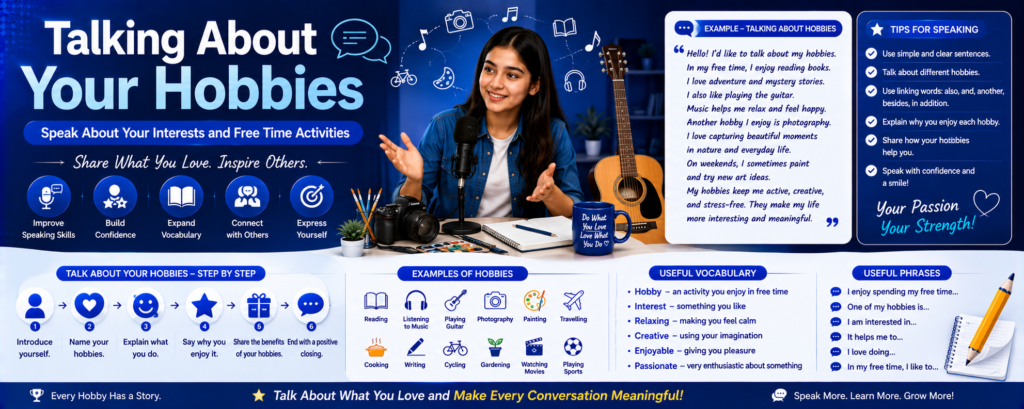
Talking About Your Hobbies
Speak About Your Interests and Free Time Activities with Absolute Confidence
Learn how to talk naturally about your hobbies, interests, and free-time activities using simple English sentences, useful vocabulary, and practical speaking patterns.
Introduction: Why Your Hobbies Unlock English Fluency
When you meet someone new—whether in an online chat, a classroom, or a casual conversation—one of the most delightful and common questions you will encounter is: "What do you do in your free time?" or "What are your hobbies?"
For a beginner English learner, this question is an incredible opportunity. Unlike discussing politics, economics, or complex scientific theories, your hobbies belong to you.
You already know what you love doing. You know how it feels to read a good book, code a website, listen to music, or go for an evening walk. Your interests are authentic, personal, and full of emotion.
When you learn how to talk about your hobbies in English, you shift the conversation from stressful grammar tests to joyful self-expression. By using short, meaningful sentences, basic present-tense verbs, and enthusiastic vocabulary, you can share your world with anyone on the planet.
This comprehensive masterclass is designed specifically for beginners. We will break down how to talk about your interests, explore essential hobby vocabulary, master simple sentence patterns, build connected paragraphs, and practice speaking with unshakeable confidence.
The Core Grammar Formula for Hobbies
To talk about what you like and do in your free time, you only need a few reliable grammar structures. As a beginner, keeping your sentences structured correctly prevents confusion and builds instant clarity.
Formula 1: Stating What You Like — Preferences
When expressing general enjoyment, use simple verbs like like, love, or enjoy followed by an action word ending in -ing or a simple noun.
Example 1
I like reading books.
Subject: I | Verb: like | Activity: reading books
Example 2
I love coding websites.
Example 3
I enjoy listening to music.
Formula 2: Stating Habitual Free-Time Actions
When describing what you regularly do during your leisure hours, use the Present Simple Tense.
Example 1
I take photographs of nature.
Example 2
I play cricket on weekends.
Example 3
I explore new recipes in the kitchen.
Essential Hobby Vocabulary for Beginners
Hobbies can be categorized into different lifestyle areas. Reviewing these lists will give you the exact words you need to build your personal description.
💻 Creative and Digital Hobbies
- Coding: Writing code to build web applications and digital tools.
- Writing: Crafting short stories, essays, or journal entries.
- Photography: Taking pictures of landscapes, architecture, or everyday objects.
- Designing: Creating visual layouts, graphics, or user interfaces.
📚 Relaxing and Indoor Hobbies
- Reading: Enjoying novels, historical books, or educational articles.
- Listening to Music: Exploring different genres or relaxing with calm instrumental tracks.
- Watching Documentaries: Learning about history, science, or nature through video.
- Cooking: Experimenting with new ingredients and preparing meals.
🌳 Active and Outdoor Hobbies
- Walking / Hiking: Exploring parks, nature trails, or neighborhood streets.
- Cycling: Riding a bicycle to stay active and enjoy fresh air.
- Gardening: Planting flowers, vegetables, or maintaining home plants.
- Playing Sports: Engaging in friendly games like football, cricket, or badminton.
Expressing Degrees of Enthusiasm
Not all hobbies carry the exact same weight. Sometimes you just like doing something, while other times you are truly passionate about it. Using different intensity phrases makes your English sound natural and expressive.
Casual Interest
- I like to...
- Example: I like to read before bed.
- I sometimes enjoy...
- Example: I sometimes enjoy sketching.
Strong Interest
- I really love...
- Example: I really love learning new languages.
- I spend a lot of my free time...
- Example: I spend a lot of my free time building web pages.
Deep Passion
- I am very passionate about...
- Example: I am very passionate about digital creation and education.
- Nothing makes me happier than...
- Example: Nothing makes me happier than walking in nature with my camera.
Step-by-Step Construction: Building Your Hobby Paragraph
Let us watch how individual short sentences about hobbies combine into a smooth, cohesive paragraph. We will follow a logical three-part structure:
Step 1 — Introduction
State what free time means to you and name your primary hobby.
"Having free time is wonderful, and I love using mine to pursue activities that spark my creativity."
Step 2 — Details / Action
Explain how and when you practice your hobby.
"One of my absolute favorite hobbies is reading books and writing short articles. Whenever I have a quiet afternoon, I sit by my window with a warm cup of tea and immerse myself in a good story. I also enjoy coding small web pages and exploring new digital tools."
Step 3 — Conclusion / Feeling
Describe how the hobby makes you feel or why it matters to you.
"These activities keep my mind sharp, relieve stress, and bring immense joy to my everyday life."
The Complete Combined Paragraph
Different Contexts: Tailoring Your Hobby Talk
Depending on who you are talking to or where you are writing, you can adjust your hobby description for different settings.
A. Casual Social Introduction
Friendly & Warm
"Hi! In my free time, I love watching historical documentaries and taking long walks in the park. It helps me unwind after a busy week of work."
B. Professional / Portfolio Profile
Focused & Purposeful
"Outside of my professional work in education and web development, I am deeply interested in creative writing, UI design, and continuous language learning."
C. Beginner Language Learner
Simple & Direct
"My name is Ali. In my free time, I like learning English, reading simple stories, and spending time with my family. It makes me very happy."
Speaking With Confidence: Tips for Beginners
Talking about your hobbies out loud should feel like sharing something you love with a friend. Use these practical strategies to boost your spoken English confidence.
Smile While You Speak
Smiling changes the tone of your voice, relaxes your facial muscles, and makes you sound warm and approachable.
Use Hand Gestures
When talking about reading a book or walking outside, use natural hand movements to keep your energy high.
Embrace Pauses
You do not need to rush through your sentences. Pause briefly between thoughts.
Practice With a Mirror
Describe your favorite hobby out loud to your reflection for two minutes every day.
Practical Practice Exercise
Take out your notebook or open a text editor. Use the template below to write your own personal paragraph about your hobbies.
✍️ My Personal Hobby Template
- In my free time, I really love and .
- I usually practice this hobby on (weekends / evenings / every day).
- My favorite thing about this activity is that it helps me .
- Whenever I do this, I feel and .
🎓 Conclusion
Talking about your hobbies is one of the most rewarding milestones in your English learning journey. By using simple sentence patterns, expressing genuine enthusiasm, and connecting your thoughts into smooth paragraphs, you can share your passions with absolute clarity and confidence.
Embrace what you love, practice your sentences every day, and let your authentic voice shine through in English!