
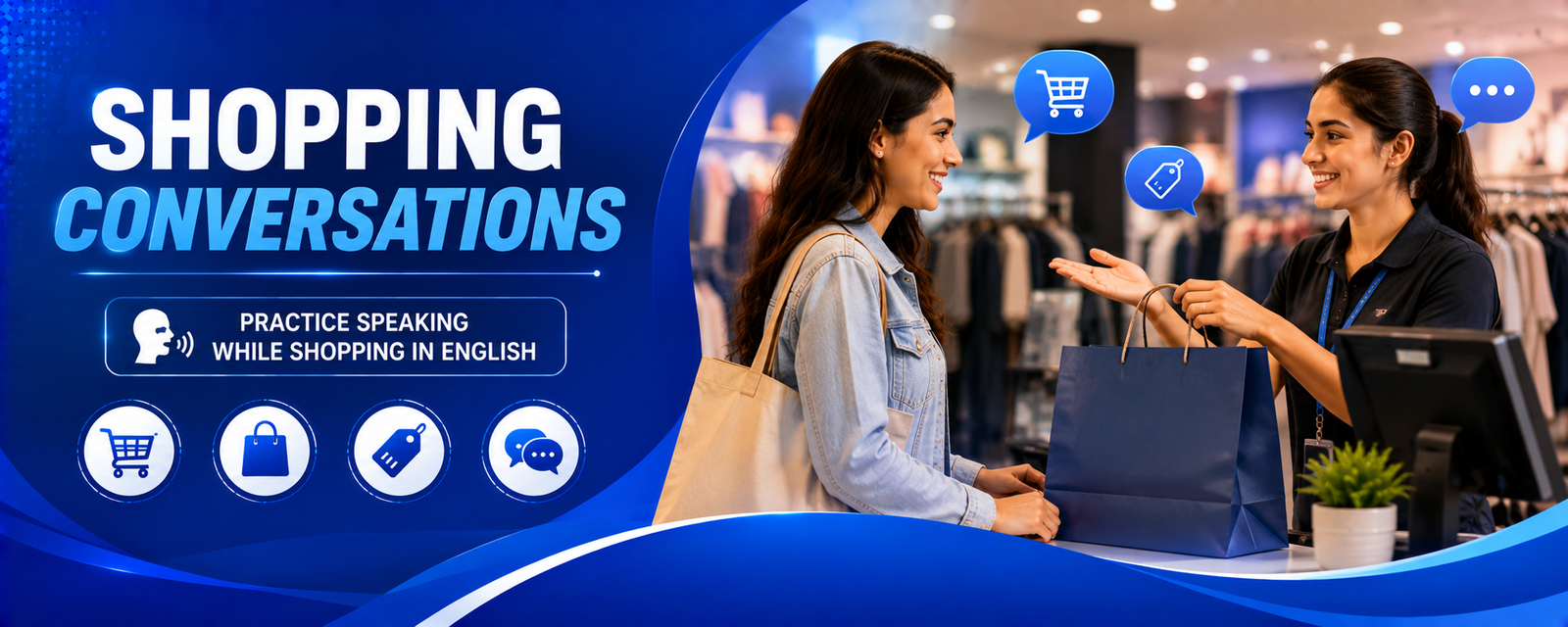
Beginner Mastery: Comprehensive Shopping Conversations in English
A Masterclass in Real-World Retail Communication for Beginner Learners
Stepping into a store, marketplace, supermarket, or specialty boutique in an English-speaking environment is one of the most exciting, practical, and immersive ways to test your language skills.
For a beginner English learner, retail interactions can sometimes feel intimidating. You might worry about finding the right words to ask for a specific size, inquiring about a price, or navigating the checkout process without feeling confused.
However, shopping conversations follow reliable, highly predictable patterns. Retail staff are trained to be helpful, polite, and patient, and cashiers follow standard operational scripts everywhere in the world. By mastering a foundational toolkit of polite greetings, clear questions, and transactional phrases, you can transform every shopping trip into a successful conversational practice session.
This exhaustive, long-form masterclass is designed specifically for beginner learners. We will break down the shopping experience into distinct chronological phases, examine essential vocabulary and sentence structures, provide extensive real-world dialogues, and equip you with actionable strategies to speak with absolute confidence.
1. The Anatomy of a Shopping Journey: Four Core Phases
A successful shopping trip is not a single chaotic event; it is a structured journey consisting of four clear phases. Understanding what happens in each phase allows you to anticipate interactions and respond naturally.
- Phase 1: Entering and Browsing (The Initial Contact): Acknowledging greetings, declaring assistance preferences, and locating departments.
- Phase 2: Product Inspection and Asking Questions (The Discovery): Inquiring about physical attributes, fitting rooms, pricing, and sales.
- Phase 3: Decision Making and Evaluation (The Choice): Confirming quality, availability, expressing preferences, or polite declination.
- Phase 4: The Checkout and Transaction (The Conclusion): Interacting with the cashier, choosing payment methods, and handling bags/receipts.
2. Phase 1: Entering, Greeting, and Browsing
When you cross the threshold of a retail establishment, the first interaction usually comes from a sales associate or greeter. Knowing how to manage this initial exchange sets a comfortable tone for your entire visit.
A. Staff Greetings and Your Natural Responses
Sales staff will almost always welcome you with standard hospitality phrases. Here is how you can respond:
Sales Assistant: "Hello! Welcome in. Can I help you find anything today?"
Response A (If you want to look alone): "Hello! No, thank you. I am just browsing for now."
Response B (If you have a specific goal): "Hello! Yes, please. I am looking for a warm winter jacket."
Response C (If you are waiting for someone): "Hi there! I am just waiting for my friend, thank you."
B. Asking for Store Layouts and Locations
If you cannot find the department or shelf you need, avoid wandering aimlessly. Use these short, direct, and polite questions:
- "Excuse me, where can I find the shoe department?"
- "Do you sell notebooks and pens here?"
- "Where is the electronics section, please?"
- "Excuse me, is there a restroom in this store?"
3. Phase 2: Interacting with Products, Sizes, and Prices
Once you locate an item of interest, you will need to gather details. This phase requires precise descriptive vocabulary and simple interrogative structures.
A. Asking About Sizes and Variations
- "Do you have this shirt in a medium size?"
- "Is this jacket available in a large?"
- "Do you have this shoe in a size nine?"
- "Do you have this in a different color, like navy blue or black?"
B. Using the Fitting Room
- "Can I try this shirt on, please?"
- "Where are the fitting rooms located?"
- "Is there a limit on how many items I can take into the fitting room?" (Staff reply: "Yes, a maximum of five items at a time, please.")
C. Inquiring About Prices and Discounts
- "Excuse me, how much does this cost?"
- "How much is this red sweater?"
- "Is this item currently on sale or clearance?"
- "Does this come with a warranty?"
4. Phase 3: Making Decisions and Expressing Preferences
After examining the item, trying it on, or checking its price, you must make a decision. Here is how to express your thoughts clearly in simple English:
A. Positive Decisions (When You Want to Buy)
- "This fits me perfectly. I love the color, and I will take it."
- "This is exactly what I was looking for."
- "The price is great, and the quality feels wonderful."
B. Negative Decisions (When You Do Not Want to Buy)
- "It is a bit too tight. Do you have an extra-large?"
- "It is slightly more expensive than I planned, so I think I will pass today. Thank you!"
- "I like the style, but the color is not quite right for me."
5. Phase 4: The Checkout Counter and Transaction
The final step of your shopping trip is the checkout process. This is a highly structured interaction between you and the cashier.
Cashier: "Did you find everything you were looking for today?"
Customer: "Yes, thank you. Everything was easy to find."
Cashier: "Wonderful. Let's ring these up for you. That will be $45.80, please. Will you be paying with cash or card?"
Customer (Card): "I will pay by card, please." (Cashier: "Go ahead and tap or insert your card into the machine. Enter your PIN if prompted.")
Customer (Cash): "Here is fifty dollars." (Cashier: "Thank you. Here is your change of $4.20.")
Cashier: "Would you like a paper bag today?"
Customer: "Yes, please." OR "No, thank you, I brought my own bag."
Cashier: "Here is your receipt. Have a wonderful rest of your day!"
Customer: "Thank you so much. You too! Goodbye."
6. Comprehensive Realistic Dialogues
Dialogue A: Buying Winter Clothing in a Department Store
Sales Associate: "Hello! Welcome to TrendStore. Can I help you find anything specific today?"
Customer: "Hello! Yes, please. I am looking for a warm sweater for the winter season."
Sales Associate: "Certainly! Our men's sweater section is right over here on the second aisle. Let me show you."
Customer: "Thank you very much."
Sales Associate: "We have wool sweaters in gray, navy, and dark green. What size do you normally wear?"
Customer: "I usually wear a medium. Can I see the gray one in a medium?"
Sales Associate: "Here it is. We also have fitting rooms right behind the cash counter if you would like to try it on."
Customer: "That would be great, thank you." (Tries on sweater)
Customer: "It fits very well, and it is very comfortable. How much does it cost?"
Sales Associate: "That model is currently on sale for $35.00."
Customer: "That is a great price. I will buy it."
Sales Associate: "Awesome! Follow me to the register, and we will get that rung up for you."
Cashier: "Hello! Did you find everything you needed?"
Customer: "Yes, just this sweater."
Cashier: "Perfect. That is $35.00 plus tax, making it $37.45 total. Cash or card?"
Customer: "Card, please."
Cashier: "Just tap your card on the reader here. All approved! Would you like a bag?"
Customer: "Yes, please include a bag."
Cashier: "Here is your receipt and your bag. Have a wonderful day!"
Customer: "Thank you for your excellent help. Goodbye!"
Dialogue B: Buying Stationery and Books in a Specialty Shop
Customer: "Excuse me? Good afternoon."
Shopkeeper: "Good afternoon! Welcome to City Books & Stationery. How can I assist you today?"
Customer: "I am looking for a beginner's guide to English grammar and a lined notebook."
Shopkeeper: "Ah, excellent choice! Our language learning section is located on the back wall near the window. Let's walk over together."
Customer: "Thank you. I want something that has clear examples and practice exercises."
Shopkeeper: "This book right here, English Grammar Made Simple, is our bestseller for students. It includes short lessons and answer keys."
Customer: "That sounds perfect. How much is the book and the notebook together?"
Shopkeeper: "The book is $14.50, and the notebook is $3.00. The total before tax will be $17.50."
Customer: "I will take both of them, please."
Shopkeeper: "Wonderful. Let's head to the front counter. Cash or card for this transaction?"
Customer: "I will pay with cash. Here is a twenty-dollar bill."
Shopkeeper: "Thank you. Twenty dollars received. Your change is $2.50, plus your receipt."
Customer: "Thank you so much. Have a great afternoon."
Shopkeeper: "Thank you for shopping with us! Enjoy your studies. Goodbye!"
7. Essential Retail Vocabulary Reference Table
| English Term | Part of Speech | Clear Definition / Meaning | Practical Example Sentence |
|---|---|---|---|
| Browsing | Verb / Adjective | Looking at goods without an immediate intent to purchase. | "I am just browsing the shelves, thank you." |
| Fitting Room | Noun Phrase | A private booth designated for trying on garments. | "Where is the fitting room located?" |
| Receipt | Noun | A printed document providing proof of payment. | "Please keep your receipt in case you need to return it." |
| Cashier | Noun | The employee who processes payments at the register. | "The cashier was exceptionally polite and fast." |
| Discount / Sale | Noun | A reduction in the usual price of an item or service. | "Is this winter jacket currently on sale?" |
| Size | Noun | Dimensions indicating how large or small an item is. | "Do you carry this shirt in a large size?" |
| Exchange | Noun / Verb | Swapping a purchased item for a different size or color. | "Can I exchange this shirt for a smaller size?" |
| Refund | Noun / Verb | Receiving your money back after returning an item. | "Do you offer cash refunds on sale items?" |
8. Practical Speaking Strategies for Beginners
1. Lead with Politeness
Always anchor your interactions with warm opening words like "Hello," "Excuse me," or "Please." Politeness instantly establishes a friendly atmosphere.
2. Utilize Pointing and Gestures
If you cannot remember the exact English name for an item, point to it gracefully and say: "Excuse me, could you please hand me that item right there?"
3. Do Not Fear Clarification
If staff speak too quickly, smile and say: "I am so sorry, English is my second language. Could you please repeat that more slowly for me?"
4. Practice Solo Role-Play
Before visiting a store, practice both sides of the conversation out loud to train your mouth muscles and neural pathways for real-world execution.
9. Comprehensive Practice Exercise
Personalized Shopping Script Exercise
Scenario: Imagine you are entering a local coffee shop or a grocery store to buy your favorite snack or beverage. Write a 4-step conversational script containing:
- The Greeting: How you respond when the clerk says hello.
- The Inquiry: How you ask for your specific item and check its price.
- The Decision: How you confirm your purchase.
- The Checkout: How you pay (cash or card) and say goodbye politely.
Conclusion
Shopping in English is no longer an intimidating obstacle; it is an enjoyable, highly structured, and rewarding way to put your language skills into practice. By understanding the four phases of a retail trip, mastering polite greetings, asking direct questions about sizes and prices, and navigating the checkout counter with ease, you can walk into any store in the world with total confidence. Keep your sentences short and clear, practice your dialogues daily, and enjoy speaking English everywhere you go!