
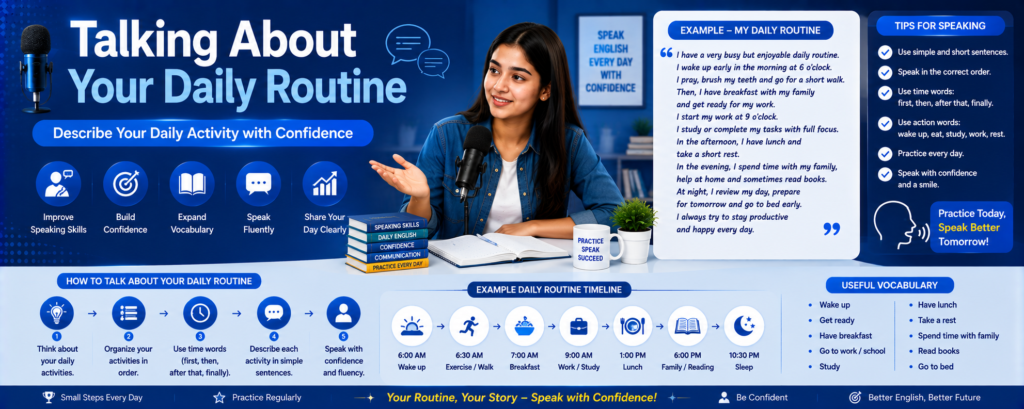
Talking About Your Daily Routine with Confidence
A Step-by-Step Guide to Speaking and Writing About Your Everyday Life in Simple English
Introduction: Why Your Daily Routine is Your Best Starting Point
When you start learning English, one of the most common questions you will hear is: "What do you do every day?"
At first, this question can feel a bit scary. You might worry about making grammar mistakes or forgetting the right words. But here is a secret that will change how you view English: your daily routine is the easiest and most powerful topic to master.
Why? Because your daily life happens every single day! You already know the actions—waking up, brushing your teeth, eating breakfast, working, studying, and sleeping. You do not need to invent a complicated story. You just need to learn how to put those familiar actions into short, clear, and confident English sentences.
This comprehensive lesson is designed specifically for beginners. We will break down your day piece by piece, learn the exact words you need, practice simple sentence patterns, and build your confidence so you can talk about your day naturally.
The Secret Grammar Rule: The Present Simple Tense
Before we look at daily activities, we need to understand when these actions happen. Because a daily routine is something you repeat every day—a habit or a fact—we use a very special grammar tool called the Present Simple Tense.
How the Present Simple Works for Beginners
When you talk about yourself using the pronoun I, the formula is wonderfully simple:
- I wake up.
- I eat breakfast.
- I work on my computer.
- I sleep early.
Notice how easy that is? You do not need complicated endings or confusing past-tense rules. You just take the action word (verb) and put it right after I.
Breaking Down the Day: Essential Vocabulary
To describe your day clearly, it helps to divide your day into four main parts:
🌅 Morning
Waking up, cleaning up, eating breakfast, and starting work.
☀️ Afternoon
Working, studying, having lunch, and taking breaks.
🌇 Evening
Returning home, relaxing, and spending time with family.
🌙 Night
Preparing for bed, reading, and sleeping.
Part A: The Morning Routine
Part B: The Afternoon Routine
Part C: The Evening Routine
Part D: The Night Routine
The Power of Time-Transition Words
If you say all your sentences together without any connection, your speech or writing will feel jumpy.
Choppy Example
I wake up. I brush my teeth. I eat breakfast. I go to work.
To make your English flow smoothly like a native speaker, you need transition words. These are small bridge words that tell the listener what happens next.
Essential Transition Words for Beginners
Step-by-Step Construction: Building Your Complete Daily Routine
Let us watch how individual short sentences and transition words combine to form a complete, beautiful paragraph about a daily routine.
Step 1: The Morning Setup
"I usually wake up early at 6:00 AM. First of all, I turn off my alarm, get out of bed, and freshen up. Then, I drink a glass of water and eat a healthy breakfast with my family."
Step 2: The Afternoon Productivity
"In the morning and afternoon, I focus on my work. At 8:30 AM, I sit at my desk, check my daily schedule, and begin my tasks. I spend my hours writing educational content and building web applications. At 1:00 PM, I take a well-deserved break for lunch."
Step 3: The Evening Relaxation and Bedtime
"In the evening, I wrap up my work and spend quality time with my family. Before going to bed at 10:30 PM, I always read a few pages of a book to relax my mind."
The Complete Combined Paragraph
"I usually wake up early at 6:00 AM. First of all, I turn off my alarm, get out of bed, and freshen up. Then, I drink a glass of water and eat a healthy breakfast with my family. At 8:30 AM, I sit at my desk, check my daily schedule, and begin my tasks. I spend my hours writing educational content and building web applications. At 1:00 PM, I take a well-deserved break for lunch. In the evening, I wrap up my work and spend quality time with my family. Before going to bed at 10:30 PM, I always read a few pages of a book to relax my mind."
Speaking With Confidence: Tips for Beginners
Writing your routine down is the first step. Speaking it out loud with confidence is where the real magic happens. Follow these four confidence boosters:
Do Not Rush
Speak slowly. Pronounce every word clearly. English is not a race; clarity is much more important than speed.
Practice in Front of a Mirror
Stand in front of a mirror and talk about your morning routine out loud. Watch your facial expressions and gestures.
Use Short Sentences
If you feel stuck, stop the sentence, use a full stop, and start a new short sentence.
Record Your Voice
Use your smartphone to record yourself speaking about your day for one minute and listen afterward.
Practical Practice Exercise: Fill in Your Own Routine
Now it is your turn to build your own daily routine. Copy the template below into your notebook or text editor, and fill in the blanks with your real life:
My Personal Daily Routine Template
Conclusion
Talking about your daily routine is the ultimate stepping stone to English fluency. By sticking to short, meaningful sentences, using the Present Simple tense, and connecting your thoughts with simple transition words, you can describe your entire day with absolute confidence. Practice your routine every single day, and watch your English speaking and writing skills blossom!