
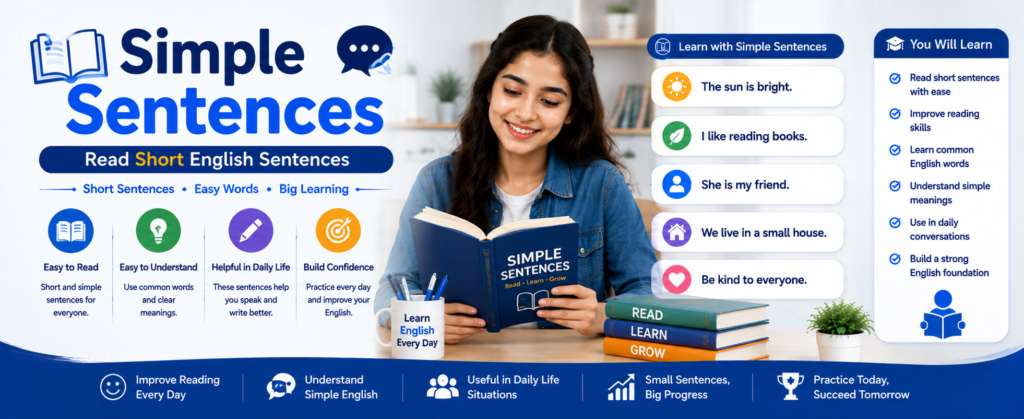
The Journey of Language Acquisition
A structured ten-phase progression from simple English sentences to complex narrative structures and confident language use.
Introduction: The Journey of Language Acquisition
Learning a new language is a transformative endeavor that requires patience, structured progression, and consistent immersion. The human brain absorbs language most effectively when complex concepts are broken down into digestible, foundational units. By starting with simple, short English sentences, learners build a sturdy psychological and cognitive foundation. This methodology reduces cognitive overload, prevents frustration, and instills a deep sense of confidence.
As we embark on this comprehensive, ten-phase lesson, each stage will systematically expand your vocabulary, refine your grammatical understanding, and elevate your reading comprehension. Every phase is crafted entirely in English to immerse you fully in the linguistic environment, fostering natural intuition and direct conceptual translation without relying on a native intermediary language. Let us begin this structured progression toward English fluency.
Phase 1: The Foundation of Being (Subject and State)
- The cat is small.
- The dog is big.
- I am a student.
- You are a friend.
- He is a teacher.
- She is a doctor.
- It is a book.
- We are happy.
- They are ready.
- The sky is blue.
Detailed Linguistic Analysis
In this foundational phase, we establish the core relationship between a subject and its state of being using the verb "to be." The structure **Subject + Verb + Complement** is the absolute bedrock of English syntax. Notice how the pronouns (*I, you, he, she, it, we, they*) and nouns (*cat, dog, sky*) pair with their respective auxiliary forms (*am, is, are*). Master this simple arrangement, as every complex sentence in the English language ultimately stems from this basic atomic unit of grammar.
Phase 2: Expressing Possession and Identity
- I have a pen.
- You have a car.
- He has a house.
- She has a bicycle.
- We have a garden.
- They have a dog.
- The book has pages.
- My friend has a camera.
- The cat has green eyes.
- Our school has many rooms.
Detailed Linguistic Analysis
Transitioning from states of being to relationships of ownership, Phase 2 introduces the verbs **have** and **has**. Understanding the morphological shift between first/second/third-person plural (*have*) and third-person singular (*has*) is crucial here. This phase also introduces simple possessive adjectives (*my, our*) and basic descriptive attributes, allowing you to begin categorizing the world around you in terms of belongings, physical traits, and structural components.
Phase 3: Daily Actions in the Present
- I walk to school.
- You run very fast.
- He reads a book.
- She writes a letter.
- We eat healthy food.
- They drink cold water.
- Birds fly in the sky.
- Fish swim in the river.
- Children play outside.
- Workers build houses.
Detailed Linguistic Analysis
Here, we enter the realm of dynamic action through the **Simple Present Tense**. This tense is utilized to describe habits, general truths, and regular routines. Observe the verb inflection: plural subjects and the pronouns *I, you, we, they* take the base form of the verb (*walk, run, eat*), whereas singular third-person subjects (*he, she, birds*, or individual nouns) require an **-s** or **-es** suffix (*reads, writes, flies*). This morphological rule is one of the most vital gatekeepers of natural English grammar.
Phase 4: Navigating Space and Time (Prepositions)
- The cat is on the table.
- The book is under the chair.
- The keys are in the drawer.
- The picture is on the wall.
- The ball is behind the door.
- The lamp is beside the bed.
- We walk in the park.
- They sit under the tree.
- The bird flies above the roof.
- The train goes through the tunnel.
Detailed Linguistic Analysis
Language requires spatial awareness to describe where objects and beings exist relative to one another. Phase 4 introduces fundamental prepositions of place and direction (*on, under, in, behind, beside, above, through*). By anchoring subjects to specific spatial coordinates, your descriptive capabilities multiply exponentially. Notice how these prepositions bridge nouns together to create vivid, localized mental images within the reader's mind.
Phase 5: Describing Qualities and Attributes (Adjectives)
- The red car is fast.
- The old man walks slowly.
- A cold wind blows today.
- The sweet apple tastes good.
- Dark clouds bring heavy rain.
- The bright sun warms the earth.
- Tall trees shade the ground.
- Quiet students listen carefully.
- Fresh flowers smell wonderful.
- Long rivers flow to the sea.
Detailed Linguistic Analysis
To move beyond basic identification, language employs **adjectives** to modify nouns and give them texture, color, temperature, and dimension. In English, adjectives almost always precede the nouns they modify (*red car, old man, cold wind*). This phase also subtly introduces foundational adverbs (*slowly, carefully*) which modify verbs to explain *how* an action is performed. This dual layer of descriptive enhancement transforms flat, clinical statements into rich, sensory expressions.
Phase 6: Expanding Context with Questions and Negatives
- I do not like cold weather.
- You do not play tennis.
- He does not drink coffee.
- She does not watch television.
- Do you know the answer?
- Does he speak English well?
- Where do you live now?
- What do they want here?
- Why do birds migrate south?
- How do you solve this problem?
Detailed Linguistic Analysis
Communication is inherently interactive, relying heavily on inquiry and negation. Phase 6 introduces the auxiliary verb **do / does** combined with **not** for negation, as well as inversion structures for interrogative sentences (Yes/No questions and Wh- questions: *Where, What, Why, How*). Notice how the auxiliary verb absorbs the tense marker in negative and question forms for the third-person singular (*does not*, *Does he...*), leaving the main verb in its bare infinitive form. Mastering this mechanism is essential for fluid conversational proficiency.
Phase 7: Recalling the Past (Simple Past Tense)
- I walked to the store yesterday.
- You watched a great movie.
- He lived in London last year.
- She painted a beautiful picture.
- We played soccer on Saturday.
- They traveled to France in June.
- The sun shone brightly yesterday.
- The rain stopped an hour ago.
- The phone rang very loudly.
- The wind blew through the trees.
Detailed Linguistic Analysis
Time is not linear in our expression; we constantly recount past experiences, historical events, and completed actions. The **Simple Past Tense** is dedicated to this purpose. This phase demonstrates both regular verbs, which form the past tense by adding **-ed** or **-d** (*walked, watched, lived, painted*), and irregular verbs, which undergo internal phonetic changes (*shone, rang, blew*). Time markers like *yesterday*, *last year*, and *ago* act as chronological anchors for these completed actions.
Phase 8: Anticipating Tomorrow (Future Intentions)
- I will travel to Japan next year.
- You will learn many new words.
- He will finish his work soon.
- She will bake a cake tomorrow.
- We will meet at the library.
- They will start a new project.
- The weather will change tonight.
- Technology will advance rapidly.
- Someone will help you shortly.
- Tomorrow will bring new opportunities.
Detailed Linguistic Analysis
Human consciousness constantly looks forward, planning, predicting, and speculating about upcoming events. Phase 8 introduces the modal auxiliary verb **will** to construct the **Simple Future Tense**. The beauty of using *will* lies in its structural simplicity: the modal remains invariant across all grammatical persons, and the main verb always retains its base, uninflected form. Combined with future time indicators (*next year, tomorrow, soon*), this phase equips you to articulate future plans, promises, and predictions with clarity and precision.
Phase 9: Complex Actions and Continuity (Continuous Tenses)
- I am reading an interesting book.
- You are listening to music now.
- He is writing an important email.
- She is cooking dinner in the kitchen.
- We are studying English grammar together.
- They are playing basketball outside.
- The baby is sleeping peacefully upstairs.
- It is raining heavily at the moment.
- The chef is preparing a special meal.
- The musicians are tuning their instruments.
Detailed Linguistic Analysis
Actions in real life are rarely instantaneous snapshots; they often possess duration, unfolding across a specific span of time. The **Present Continuous Tense**, formulated by combining the present tense of the verb *to be* (*am, is, are*) with a present participle main verb ending in **-ing**, captures actions happening right at the moment of speech. This grammatical structure conveys fluidity, immediacy, and ongoing engagement with the physical environment, bridging static existence with active participation.
Phase 10: Mastery of Narrative Integration
- Although the morning was cold, the sun eventually warmed the quiet village.
- The dedicated student who practices every single day will undoubtedly achieve fluency.
- When the heavy rain finally stopped, children ran outside to play in the fresh air.
- She opened the old wooden door and discovered a room full of forgotten treasures.
- Because he studied diligently for months, he passed the difficult examination with ease.
- While the musician played a gentle melody, the audience listened in total silence.
- They planted colorful flowers in the spring so the garden would bloom all summer.
- Even though the mountain climb was exhausting, reaching the summit felt truly rewarding.
- Whenever the phone rang late at night, everyone in the house felt nervous.
- By combining short, simple sentences with connecting words, complex thoughts emerge naturally.
Detailed Linguistic Analysis
We arrive at the culmination of our ten-phase journey. Phase 10 transitions from isolated, elementary sentences to integrated, complex narrative structures. By employing subordinating conjunctions and relative clauses (*although, who, when, because, while, even though, whenever*), multiple simple clauses fuse together into sophisticated, cohesive thoughts. This final stage proves that advanced English proficiency is not an unreachable mystery, but rather the systematic accumulation and combination of the very simple building blocks you mastered in Phase 1.