

Similarities Between British and American English
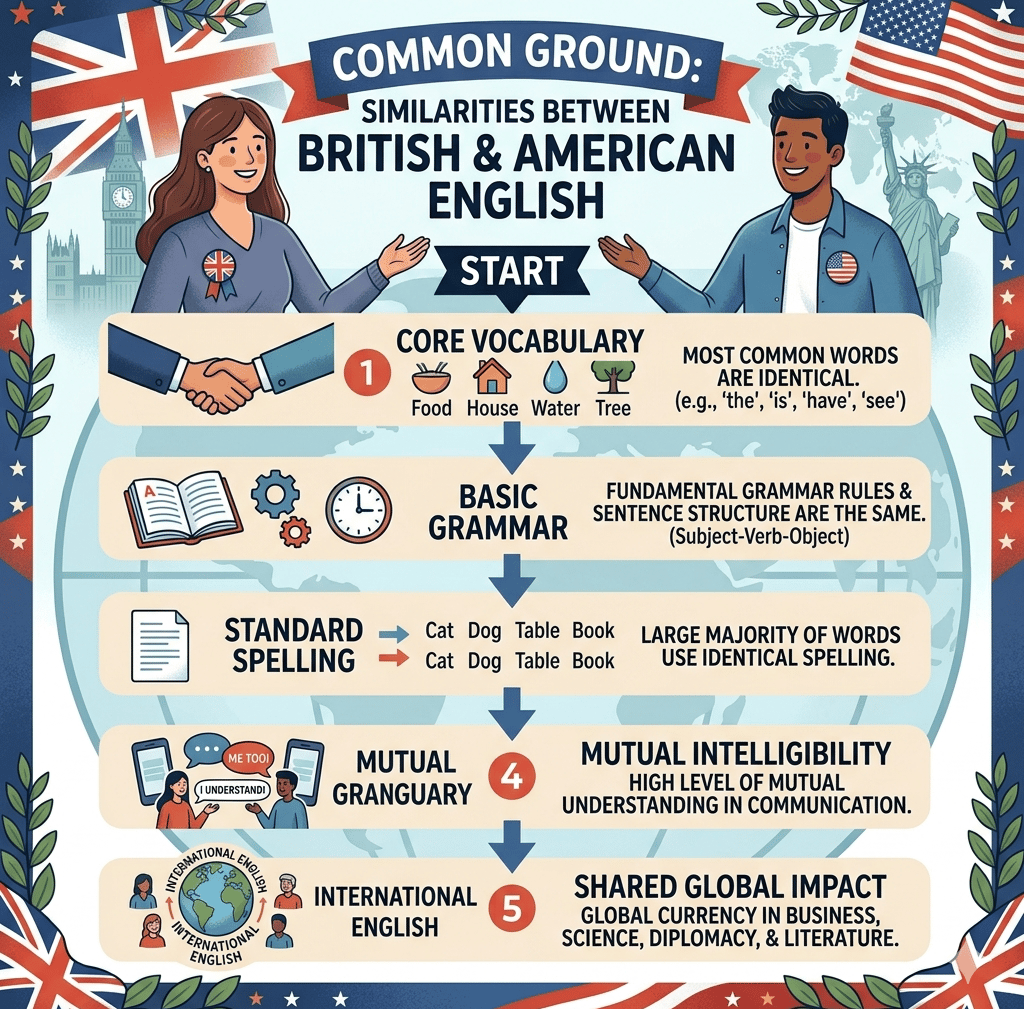
British and American English share many similarities, including the same basic grammar rules, vocabulary, and communication purpose. Both forms help people around the world understand and connect with each other easily
6/17/2026
Similatities Between British and Amrican English
English is an international language that is spoken in many nations across the globe. Nevertheless, English is not always uniform across different regions. The two predominant varieties of English are British English and American English. Although the two varieties share some common aspects and are easy to understand by everyone, there are differences in the way things are written, pronounced, and used.
One important difference between British and American English is the way words are spelled. There are various differences in the spelling of certain words between the two forms. British English spells words such as 'colour', 'favourite', and 'centre' whereas American English has 'color', 'favorite', and 'center'. Also, words that have "-ise" such as 'organise' in British English have "-ize" as in 'organize' in American English. It is important to be aware of spelling differences for academic writing, business communication, and exams.
Another difference between British and American English is in their pronunciation. Differences exist not only in accent but also in pronunciation. One example of this is that 'schedule' is pronounced "shed-yool" in British English and "sked-jool" in American English. Differences also exist in how vowels are pronounced along with differences in the pronunciation of the letter 'r'. In most British accents, the 'r' at the end of words is silent in most cases.
Vocabulary is yet another aspect of language where British English and American English differ. Some common words have completely different spellings in the two languages. For example, while Americans use the word 'elevator,' the British use 'lift.' Another example is the British word 'flat' and its equivalent in American English, 'apartment.' There are others like 'lorry' and 'truck,' 'holiday' and 'vacation,' or 'petrol' and 'gasoline.' Understanding these vocabulary differences is important for effective communication with speakers of other nations.
Apart from these differences in spelling and pronunciation, there are also differences in grammar. For example, whereas the British use the present perfect tense a lot more frequently, the Americans would prefer using the past tense instead. So whereas the former would be more likely to say, "I have just eaten," the latter would simply say, "I just ate." The use of collective nouns also differs from one language to another. Whereas collective nouns can take both a singular and plural verb form in British English, as in "The team are playing well," the American English version would be "The team is playing well."
However, despite the variations, the basics of grammar rules and structures in British and American English are similar. People speaking one type or the other can comprehend each other fairly easily. The students of English language are free to choose between British and American English according to their goals, location, or preferences. However, it is essential to be consistent while writing and speaking.
Conclusion
In summary, British and American English are two major types of the language that vary in spelling, pronunciation, vocabulary, and grammar. Both types are equally valid and recognized throughout the world. Knowing the differences between them would benefit from increased skills in using the language, communication, and cultural knowledge. Whatever the choice between the two varieties is, learners should always be consistent when using English.