
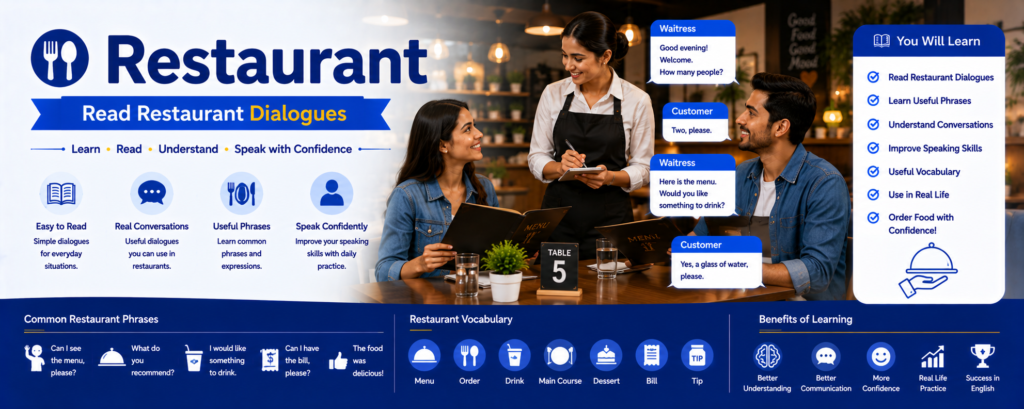
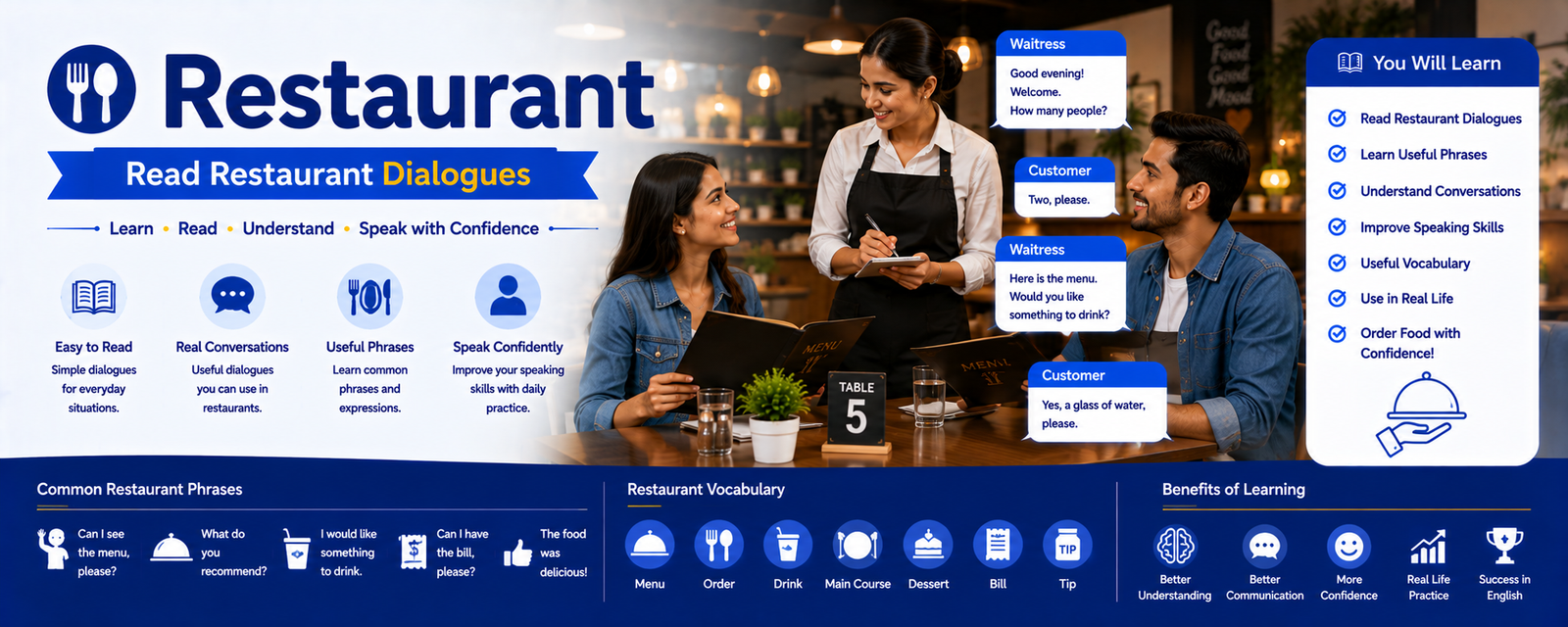
The Culinary Language of Hospitality
Learn practical English for restaurants, reservations, ordering food, dietary needs, customer service, payment, tipping, and real-world dining conversations.
Introduction: The Culinary Language of Hospitality
Dining out is one of the most pleasurable and universal cultural experiences across the globe. Whether you are enjoying a casual meal at a local café, ordering takeout, or celebrating a special occasion at a fine-dining restaurant, navigating food service interactions in English is an essential life skill. Restaurant conversations require politeness, specific vocabulary regarding food preparation and dietary preferences, and familiarity with the distinct dialogue stages between customers and hospitality staff.
This comprehensive, long-format lesson is written entirely in English to immerse you fully in the language. We will systematically explore restaurant areas, personnel roles, reservation phrases, ordering vocabulary, payment etiquette, and realistic dialogues. Let us master the everyday language of culinary hospitality.
Phase 1: Restaurant Staff and Physical Zones
Before sitting down to eat, it helps to understand the physical layout of a dining establishment and the roles of the professionals who keep it running smoothly.
Understanding the roles of restaurant personnel ensures you direct your questions to the right person. For example, you ask the host for a table, the server for food recommendations, and the chef is rarely spoken to directly unless you have severe allergy concerns that require a manager or kitchen consultation. Prepositions of location are vital here: you sit "at" a table "in" the dining room or "on" the patio.
Phase 2: Making Reservations and Arriving
Many popular restaurants require advance planning. Knowing how to secure a table or announce your arrival sets the tone for a smooth dining experience.
When making a reservation, English speakers use formulaic structures involving prepositions of time ("at" seven o'clock) and possession ("under the name..."). Notice how polite modal verbs ("Could we have...", "Do you have...") soften inquiries, ensuring you sound courteous when speaking to the host or hostess.
Phase 3: Navigating the Menu and Dietary Needs
The menu is divided into logical courses. Knowing how to interpret menu sections and express dietary requirements is crucial for a comfortable meal.
When inquiring about ingredients or restrictions, English speakers rely on direct questions starting with "Does this dish contain..." or "Is this suitable for..." (e.g., "Does the soup contain dairy?"). Adjectives like vegetarian, vegan, and gluten-free act as vital descriptive modifiers to protect health and match personal preferences.
Phase 4: Placing Your Order (Dialogue and Verbs)
When the server approaches your table, it is time to order. This stage involves specific verbs of choice, preference, and politeness.
When ordering, native speakers frequently use the modal phrase "I'll have..." (short for I will have) or "I would like..." as polite formulas. Notice how requests for modifications use modal verbs like "Could I substitute..." to make adjustments sound courteous and cooperative rather than demanding.
Phase 5: During the Meal and Requesting Assistance
Sometimes things happen during a meal—you might need extra napkins, more water, or condiments. Knowing how to flag down your server politely is invaluable.
Politeness remains key if an error occurs. When pointing out a mistake, native speakers use gentle phrases like "Pardon me, I think there is a small mistake" rather than aggressive accusations. Similarly, servers check on tables using polite conversational formulas like "How is everything tasting so far?"
Phase 6: Settling the Bill and Tipping Etiquette
At the conclusion of the meal, you must handle the financial transaction. Payment terminology and tipping customs vary, but English phrasing remains standard.
When asking for the bill in American English, the word "check" is most common, whereas British English typically uses "bill." When deciding how to pay with friends, stating "We're paying separately" or "Let's split the bill evenly" clarifies financial expectations before the card machine arrives.
Phase 7: Real-World Dialogue 1 (Casual Café Lunch)
Let us examine a complete, realistic conversation between a customer and a server at a casual daytime café.
This casual dialogue illustrates the relaxed, welcoming pacing typical of daytime cafés. Notice how the server confirms the substitution immediately ("a side of fruit instead of chips. Not a problem at all") to reassure the customer that the special request was noted correctly by the kitchen.
Phase 8: Real-World Dialogue 2 (Fine Dining Dinner)
Now let us examine a more formal interaction between a party of two and a server at an upscale evening restaurant.
This fine-dining dialogue showcases advanced service interactions, including food recommendations by the chef, meat preparation specifications ("medium-rare"), and allergy accommodations ("lactose intolerant," "dairy-free version"). The tone is highly formal, professional, and attentive.
Phase 9: Restaurant Idioms and Food Metaphors
English is rich with idiomatic expressions and metaphors derived from food, dining, and kitchen culture.
Idioms transform literal culinary concepts into abstract cultural metaphors. For example, describing a task as a "piece of cake" has nothing to do with dessert; it signifies absolute ease. Recognizing these expressions allows you to interpret figurative speech smoothly during social meals and conversations.
Phase 10: Narrative Integration (An Evening Out)
To conclude our lesson, we integrate all restaurant vocabulary, seating etiquette, ordering phrases, payment terms, and conversational patterns into a cohesive narrative text depicting a delightful evening dining experience.
This final passage demonstrates the seamless integration of restaurant zones (host stand, dining room), personnel (server), ordering choices (medium-rare, vegetarian), billing terms (check, split the bill, tip), and idiomatic expressions (piece of cake). By mastering these ten phases, you are fully equipped to navigate any dining scenario in fluent English with total confidence and grace.