
Mastering Punctuation Basics
Master the Full Stop, Comma, and Question Mark
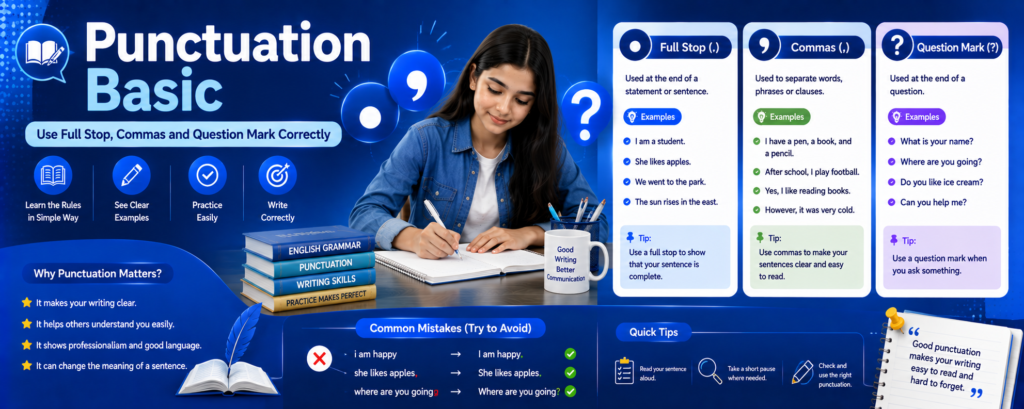
Why Punctuation Matters
Punctuation marks are the traffic signs of written language. They tell the reader when to pause, when to stop, and what tone of voice to use.
Without proper punctuation, a paragraph becomes a confusing wall of words, making it nearly impossible to understand the author's intent.
This comprehensive lesson covers the three most fundamental punctuation marks in English: the full stop, the comma, and the question mark.
The Full Stop
The full stop, also known as a period in American English, is the strongest stop sign in writing. It marks the absolute end of a complete thought or sentence.
Core Rules for the Full Stop
- End of a Statement: Use a full stop at the conclusion of any declarative statement or command that is not a direct question or exclamation.
- Spacing: Leave one space after a full stop before starting the next sentence.
- Abbreviations: Use full stops for certain common abbreviations, although modern styling often drops them for acronyms like NASA or HTML.
The Comma
The comma represents the shortest pause in a sentence. It helps separate ideas, items, and clauses so the reader can breathe and process information without losing track of the sentence structure.
Core Rules for the Comma
- Separating Items in a List: Use commas to separate three or more words or phrases in a series. The final comma before "and" is called the Oxford comma.
- Joining Two Sentences with Conjunctions: When linking two complete sentences with a coordinating conjunction such as and, but, or, so, place a comma before the conjunction.
- After Introductory Words: Use a comma after introductory transition words or short phrases at the beginning of a sentence.
- Direct Address: Use commas to set off the name of a person you are directly speaking to.
The Question Mark
The question mark is used exclusively at the end of a direct inquiry or question. It signals to the reader that an answer is expected.
Core Rules for the Question Mark
- Direct Questions: Always place a question mark at the end of a direct interrogative sentence.
- Indirect Questions: Do not use a question mark after an indirect question embedded inside a larger statement.
Summary Reference Table
Use this quick reference table whenever you need to review the basic punctuation rules.
| Punctuation Mark | Symbol | Primary Purpose | Example |
|---|---|---|---|
| Full Stop | . | Ends a complete sentence or statement. | She loves writing code. |
| Comma | , | Creates a short pause or separates items. | Red, blue, and green. |
| Question Mark | ? | Marks the end of a direct question. | What time is it? |
📝 Practical Practice Exercise
Read the unpunctuated text below and see how punctuation brings the sentence to life.
are you ready for the test ali asked because he wanted to study together
"Are you ready for the test?" Ali asked, because he wanted to study together.
Conclusion
Mastering the full stop, comma, and question mark gives your writing clarity and rhythm.
Practice applying these three punctuation marks daily, and your English sentences will become clear, readable, and professional.