
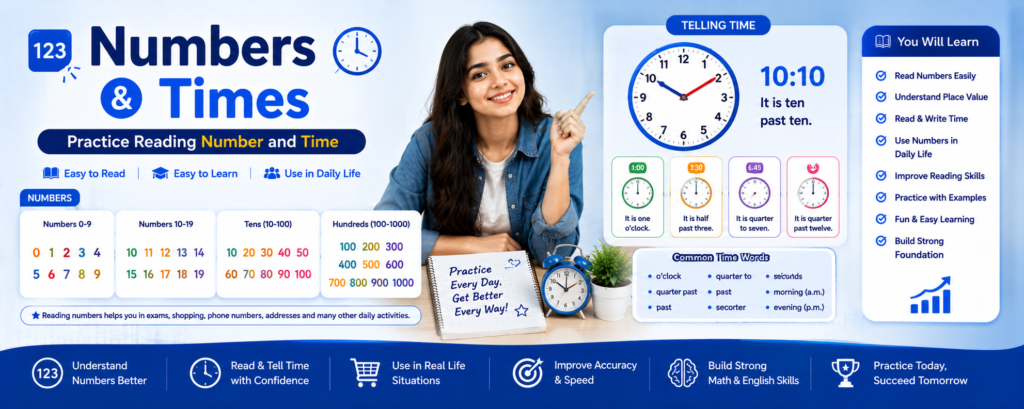
The Architecture of Numbers and Time
Master cardinal and ordinal numbers, mathematical expressions, telling time, days, months, years, dates, and advanced numerical expressions for fluent everyday English communication.
Introduction: The Architecture of Numbers and Time
Numbers and time are the invisible gridlines of modern civilization. From reading the clock to tracking finances, scheduling appointments, measuring distances, and discussing dates, numerical literacy is an absolute necessity for fluent communication in English. Without numbers and time expressions, human interaction lacks precision, coordination, and chronological orientation.
This comprehensive, long-format lesson is written entirely in English to immerse you fully in the language. We will systematically explore cardinal and ordinal numbers, mathematical operations, telling time, days, months, years, and advanced numerical expressions. Let us master the precise language of quantification and chronology.
Phase 1: Cardinal Numbers (0 to 100)
Cardinal numbers answer the fundamental question: "How many?" They represent exact quantities and are the building blocks of all mathematical and practical counting.
Forming numbers between 21 and 99 in English follows a reliable hyphenated pattern: tens digit combined with the units digit (e.g., twenty-one, forty-five, ninety-nine). Notice the slight spelling shifts in certain teens and tens, such as forty (dropping the 'u' from four) and fifteen (shifting from five). Mastering these foundational numbers is the prerequisite for all advanced numerical scaling.
Phase 2: Large Numbers (Thousands to Billions)
As human enterprises grow, numbers expand into thousands, millions, and billions. Understanding large numbers is vital for discussing populations, economics, and geography.
In English, large numbers are grouped and read in sets of three, separated by commas. Notice that words like thousand, million, and billion do not take an -s plural suffix when preceded by a specific number (e.g., "three thousand," not "three thousands"). However, when used as indefinite plural nouns, they do take an -s (e.g., "thousands of people"). Commas are placed every three digits from the right to make reading large digits effortless.
Phase 3: Ordinal Numbers (Position and Sequence)
Ordinal numbers answer the question: "Which position?" They indicate rank, order, dates, and sequential placement in a series.
Most ordinal numbers in English are formed by adding -th to the cardinal number (four/fourth, ten/tenth). However, the first three numbers are completely irregular (first, second, third), and spelling shifts occur in words like fifth (from five) and twelfth (from twelve). Compound ordinal numbers only change their final digit into an ordinal form (twenty-first, thirty-second), keeping the tens digit as a cardinal base.
Phase 4: Fractions, Decimals, and Percentages
Precision often requires breaking whole numbers into smaller parts. Fractions, decimals, and percentages are essential for science, cooking, finance, and statistics.
When reading fractions aloud in English, the top number (numerator) is read as a cardinal number (one, three), and the bottom number (denominator) is read as an ordinal number (third, quarters). For decimals, the decimal point is pronounced as "point," and every digit after the point is read individually (3.14 is spoken as "three point one four," not "three point fourteen"). Percentages simply append the word "percent" to the numerical value.
Phase 5: Telling Time (Hours and Minutes)
Knowing how to ask and tell time is a daily conversational requirement. English offers two primary methods for expressing clock time: digital style and traditional conversational style.
English time-telling utilizes two main systems. The digital format states the hour first, followed by the minutes directly (eight-twenty). The traditional format uses past for minutes 1 through 30 (e.g., "ten past eight") and to for minutes 31 through 59, referencing the upcoming hour (e.g., "ten to nine"). Notice the abbreviations AM (Ante Meridiem, before noon) and PM (Post Meridiem, after noon) used to distinguish morning from afternoon and evening.
Phase 6: Days of the Week and Calendar Structure
The weekly cycle governs our work, school, and social schedules. Mastering the days of the week and fundamental calendar vocabulary is crucial for planning.
In English, all days of the week are proper nouns and must always begin with a capital letter (Monday, Friday). When speaking about events occurring on a specific day, English speakers use the preposition "on" (e.g., "We have a meeting on Monday," never "in Monday"). The linguistic roots of these days honor astronomical bodies and Norse/Roman deities, giving them a rich historical background.
Phase 7: Months and Seasons of the Year
The annual cycle is divided into twelve months and four distinct meteorological seasons, shaping weather patterns, agriculture, and cultural celebrations.
Just like days, all twelve months of the year must always be capitalized (January, July, December). When specifying a month in a sentence, the preposition "in" is required (e.g., "My birthday is in June"). When attaching a specific calendar date to the month, use ordinal numbers and the preposition on (e.g., "The event is on July fifth").
Phase 8: Reading Years and Historical Dates
Reading years in English follows specific phonetic patterns that differ slightly from standard cardinal number reading rules.
For years prior to the year 2000, English speakers typically split the four-digit year into two two-digit numbers (1984 becomes "nineteen eighty-four"). For years between 2000 and 2009, standard reading usually says "two thousand [number]" (2004 is "two thousand four"). From 2010 onward, speakers returned to the split-digit format (2026 is pronounced "twenty twenty-six"). Historical markers like BC and AD provide vital macro-chronological context.
Phase 9: Common Idioms and Expressions Involving Numbers
Numbers frequently appear in English idioms and everyday expressions, carrying metaphorical meanings that extend far beyond simple mathematics.
Idiomatic expressions decouple numbers from literal mathematical counting, converting them into powerful cultural metaphors. For example, "back to square one" originates from board games where landing on a certain square forces you back to the start. Recognizing these numerical idioms allows you to interpret figurative speech smoothly and sound like a natural native speaker.
Phase 10: Narrative Integration (The Structured Schedule)
To conclude our lesson, we integrate all number, time, and calendar vocabulary into a realistic daily schedule narrative, demonstrating how these numerical elements function together in practical English prose.
This final passage demonstrates the seamless blending of cardinal numbers (eight hours, two million dollars), ordinals (twenty-first), clock times (7:00 AM, 9:30 AM), dates (October 2026), days (Tuesday), and idiomatic expressions (the eleventh hour). Mastery of this diverse numerical vocabulary transforms numbers from cold mathematical digits into a warm, flexible, and essential component of everyday English communication.