
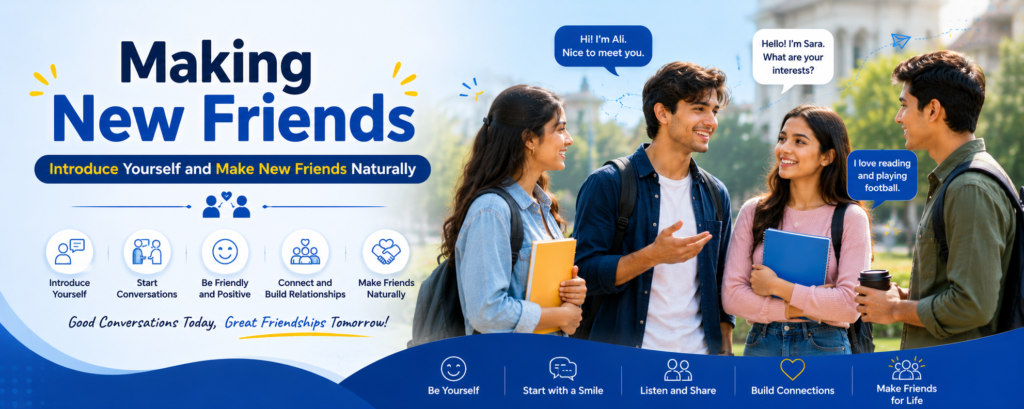
Complete Lesson: Making New Friends (Introduce Yourself & Make Friends Naturally)
Making new friends is one of the most useful and exciting parts of learning a new language. In this lesson, you will learn how to introduce yourself confidently, start conversations, ask questions, talk about your interests, and keep a conversation going naturally.
Each phrase includes an Urdu meaning to help you understand and remember easily.
Part 1: Basic Greetings to Start a Conversation
| English | Urdu Meaning |
|---|---|
| Hi! / Hello! | ہائے! / ہیلو! |
| Good morning/afternoon/evening | صبح/دوپہر/شام بخیر |
| How are you? | آپ کیسے ہیں؟ |
| I'm fine, thank you. And you? | میں ٹھیک ہوں، شکریہ۔ اور آپ؟ |
| Nice to meet you | آپ سے مل کر خوشی ہوئی |
| It's a pleasure to meet you | آپ سے مل کر اچھا لگا |
| Hi, I don't think we've met | ہائے، میرے خیال میں ہم پہلے نہیں ملے |
| Can I sit here? | کیا میں یہاں بیٹھ سکتا ہوں؟ |
| Excuse me, may I join you? | معاف کیجئے، کیا میں آپ کے ساتھ بیٹھ سکتا ہوں؟ |
A: Hi! I don't think we've met before.
B: Hi! No, I don't think so. My name is Sara.
A: Nice to meet you, Sara. I'm Ahmed.
Part 2: Introducing Yourself
Key Sentences
| English | Urdu Meaning |
|---|---|
| My name is... | میرا نام ... ہے |
| I am ... years old | میری عمر ... سال ہے |
| I am from... | میں ... سے ہوں |
| I live in... | میں ... میں رہتا/رہتی ہوں |
| I study at... | میں ... میں پڑھتا/پڑھتی ہوں |
| I work as a... | میں ... کے طور پر کام کرتا/کرتی ہوں |
| I am a student | میں طالب علم ہوں |
| This is my first time here | یہ میری پہلی بار یہاں آنا ہے |
"Hi, my name is Bilal. I am 20 years old, and I am from Lahore. I am currently studying computer science at university. In my free time, I like playing cricket and reading books. It's really nice to meet you!"
Part 3: Asking Questions to Get to Know Someone
| English | Urdu Meaning |
|---|---|
| What's your name? | آپ کا نام کیا ہے؟ |
| Where are you from? | آپ کہاں سے ہیں؟ |
| How old are you? | آپ کی عمر کیا ہے؟ |
| What do you do? | آپ کیا کام کرتے ہیں؟ |
| Do you study or work? | کیا آپ پڑھتے ہیں یا کام کرتے ہیں؟ |
| What are your hobbies? | آپ کے مشاغل کیا ہیں؟ |
| What do you like to do in your free time? | فارغ وقت میں آپ کیا کرنا پسند کرتے ہیں؟ |
| Do you have any siblings? | کیا آپ کے بہن بھائی ہیں؟ |
| What kind of music do you like? | آپ کو کس قسم کی موسیقی پسند ہے؟ |
| Have you lived here long? | کیا آپ یہاں کافی عرصے سے رہ رہے ہیں؟ |
Part 4: Talking About Hobbies and Interests
| English | Urdu Meaning |
|---|---|
| I like/love... | مجھے ... پسند ہے |
| I enjoy... | مجھے ... اچھا لگتا ہے |
| I'm interested in... | مجھے ... میں دلچسپی ہے |
| I'm a big fan of... | मुझे ... بہت پسند ہے |
| In my free time, I usually... | فارغ وقت میں، میں عام طور پر ... |
| I'm not really into... | مجھے ... میں زیادہ دلچسپی نہیں ہے |
Common Hobby Vocabulary: Reading, Playing cricket/football, Cooking, Painting, Watching movies, Listening to music, Traveling, Playing video games, Photography, Dancing, Singing, Gardening
A: What do you like to do in your free time?
B: I really enjoy reading books and watching movies. What about you?
A: I love playing football and listening to music.
Part 5: Keeping the Conversation Going (Small Talk)
| English | Urdu Meaning |
|---|---|
| That's interesting! | یہ دلچسپ ہے! |
| Really? Tell me more. | واقعی؟ مجھے مزید بتائیں۔ |
| I didn't know that! | مجھے یہ معلوم نہیں تھا! |
| That sounds fun! | یہ مزے کی بات لگتی ہے! |
| Me too! | مجھے بھی! |
| I feel the same way. | میں بھی ایسا ہی محسوس کرتا ہوں۔ |
| What about you? | آپ کے بارے میں کیا خیال ہے؟ |
| That's a great question. | یہ ایک اچھا سوال ہے۔ |
| I've never thought about that. | میں نے کبھی اس بارے میں نہیں سوچا۔ |
Part 6: Suggesting to Meet Again / Exchange Contact
| English | Urdu Meaning |
|---|---|
| Can I have your number? | کیا میں آپ کا نمبر لے سکتا ہوں؟ |
| Do you have social media? | کیا آپ سوشل میڈیا استعمال کرتے ہیں؟ |
| Let's stay in touch! | آئیں رابطے میں رہیں! |
| We should hang out sometime | ہمیں کبھی مل کر وقت گزارنا چاہیے |
| Would you like to grab a coffee sometime? | کیا آپ کبھی کافی پینے جانا پسند کریں گے؟ |
| It was great talking to you | آپ سے بات کر کے اچھا لگا |
| I hope to see you again soon | امید ہے جلد ملیں گے |
| Take care! | अपना خیال رکھیں! |
A: It was really nice talking to you today.
B: Yes, I enjoyed it too! Let's stay in touch.
A: Sure! Can I have your number?
B: Of course, here it is.
Part 7: Full Sample Conversation (Meeting Someone New)
A: Hi! Is this seat free?
B: Yes, please, go ahead.
A: Thanks! I'm Hassan, by the way.
B: Nice to meet you, Hassan. I'm Amna.
A: Nice to meet you too, Amna. Are you a student here?
B: Yes, I'm studying business. What about you?
A: I'm studying computer science. This is actually my first week here.
B: Oh really? Welcome! It gets easier after a while.
A: Thank you! What do you like to do for fun?
B: I love painting and reading. What about you?
A: I really enjoy playing football and watching movies.
B: That's cool! Maybe we can hang out sometime.
A: I'd love that! Can I get your number?
B: Sure, here you go.
A: Great, thanks! It was really nice meeting you.
B: You too! See you around.
Part 8: Tips for Making Friends Naturally
- Smile and make eye contact – This shows friendliness and openness.
- Start with something simple – A greeting or comment about the situation ("Nice weather today!") is an easy way to start talking.
- Ask open-ended questions – Questions like "What do you enjoy doing?" invite longer answers.
- Listen actively – Show real interest by nodding, reacting, and asking follow-up questions.
- Share about yourself too – Conversation is a two-way street; don't just ask questions, share your own experiences too.
- Be positive – People enjoy talking to someone who is friendly and upbeat.
- Don't be afraid of silence – Short pauses are normal in conversations; you don't need to fill every second with words.
- Follow up – If you exchange contact information, message them later to keep the friendship going.
Part 9: Common Mistakes to Avoid
| Mistake | Better Way |
|---|---|
| Only asking yes/no questions | Ask open-ended questions |
| Talking only about yourself | Balance talking and listening |
| Interrupting the other person | Wait for them to finish speaking |
| Being too formal all the time | Relax and use casual, friendly language |
| Forgetting their name | Repeat their name once to help remember it |
Part 10: Practice Exercises
Exercise 1: Fill in the blanks
- Hi, my ______ is Sara. (name/number)
- Where are you ______? (from/to)
- What do you ______ to do in your free time? (like/likes)
- It was ______ meeting you. (nice/nicely)
- Let's stay in ______! (touch/touching)
Exercise 2: Write your own self-introduction
Using the phrases from Part 2, write 4–5 sentences introducing yourself (name, age, where you're from, what you do, and one hobby).
Exercise 3: Create a short dialogue
Imagine you are meeting a new classmate. Write a short conversation (6–8 lines) where you both introduce yourselves and ask about hobbies.
Exercise 4: Role-play practice
- One person introduces themselves.
- The other asks 3 questions to know them better.
- Both suggest staying in touch at the end.
Part 11: Useful Vocabulary List (Quick Reference)
| English | Urdu Meaning |
|---|---|
| Introduce | تعارف کرانا |
| Stranger | اجنبی |
| Acquaintance | جان پہچان |
| Conversation | بات چیت |
| Comfortable | آرام دہ |
| Shy | شرمیلا |
| Confident | پراعتماد |
| Friendly | دوستانہ |
| Outgoing | ملنسار |
| Similar interests | ملتے جلتے شوق |
| Common ground | مشترکہ باتیں |
Summary
In this complete lesson, you learned how to:
- Greet someone and start a conversation
- Introduce yourself naturally with name, age, and background
- Ask good questions to get to know someone
- Talk about hobbies and interests
- Keep a conversation going with small talk
- Exchange contact information and suggest meeting again
- Follow tips to make friends naturally and avoid common mistakes
Practice tip: Try introducing yourself out loud every day, and role-play conversations with friends or family. The more you practice speaking, the more natural and confident you will become at making new friends in English!