
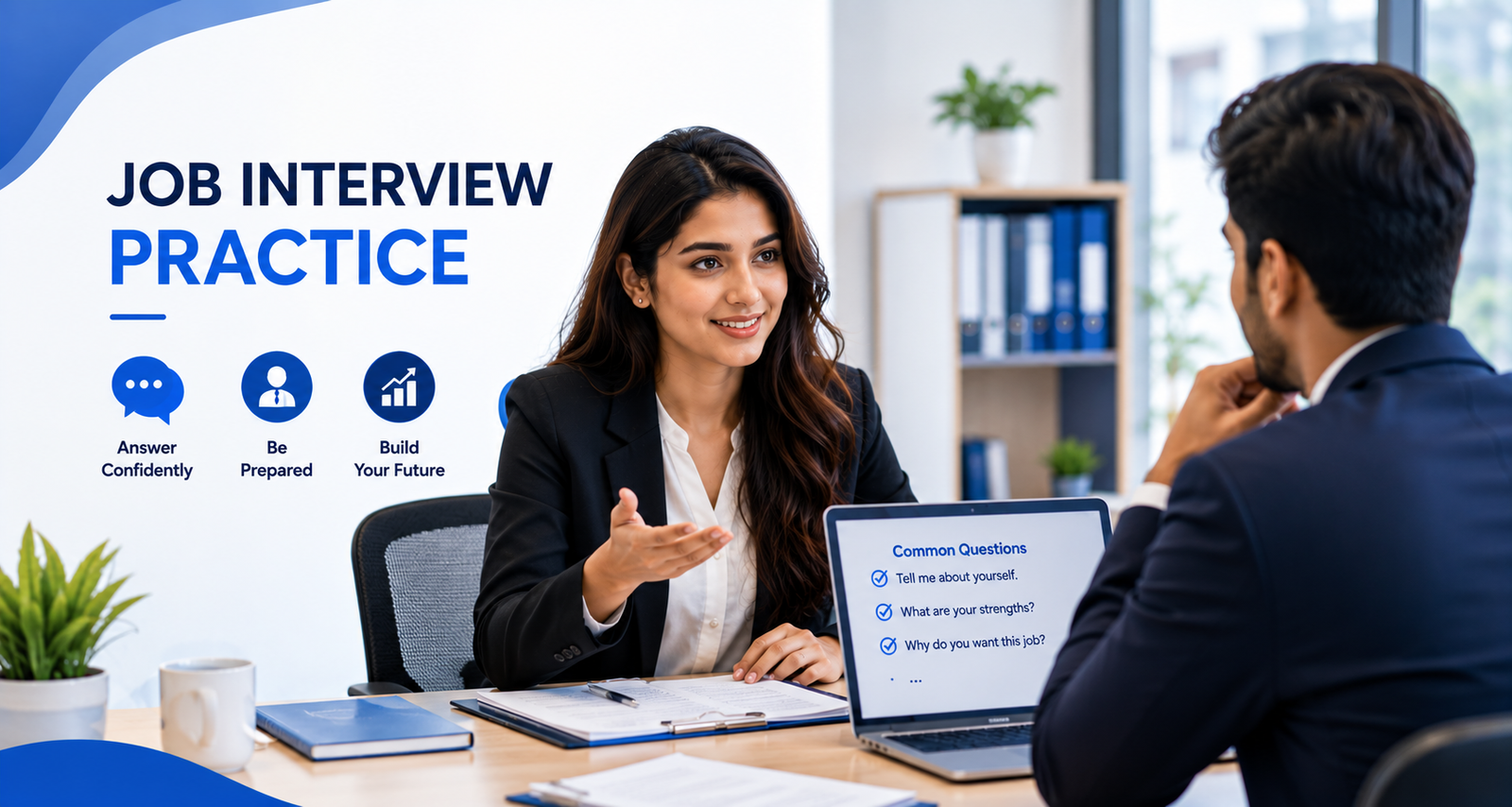
Mastering Job Interview Practice
Learn how to answer common interview questions with confidence, structure your answers professionally, and communicate your skills clearly in English.
This lesson will teach you the structural frameworks, professional vocabulary, and confidence-building techniques needed to answer common interview questions with poise and clarity.
The Golden Rule: The STAR Method
When interviewers ask behavioral questions such as "Tell me about a time when..." or "Describe a challenging situation at work," they do not want a generic answer. They want a story.
The most powerful framework for answering these questions is the STAR Method.
Situation
Set the scene. Explain where you were working and describe the context in one or two clear sentences.
Task
Explain the specific problem, goal, or challenge you had to deal with.
Action
Explain the specific steps you took. Use strong action verbs such as managed, designed, resolved, and coordinated.
Result
Explain the positive outcome. Use numbers, measurable improvements, or concrete feedback whenever possible.
Tackling the Most Common Interview Questions
This is almost always the first question asked. It is an icebreaker, but it is also your first chance to present your professional brand.
Do not recite your entire life story. Instead, use the Present–Past–Future Formula.
Present
Where are you right now, and what is your current role?
Past
What one or two key experiences or achievements brought you to your current position?
Future
Why are you excited about this specific opportunity?
"For the past three years, I’ve been working as a project coordinator, where I manage cross-functional teams and streamline our scheduling processes. Before that, I spent two years in customer relations, which taught me how to handle high-pressure situations effectively. While I’ve loved my current role and the systems I've helped build, I’m looking for an opportunity to bring my organizational skills to a fast-growing company like yours, which is why I’m so excited about this position."
Avoid cliché answers such as "I'm a perfectionist" or "I work too hard."
Interviewers want to see self-awareness. Choose a real, non-fatal professional weakness and explain what you are actively doing to improve it.
"In the past, I used to struggle with delegating tasks because I wanted to make sure everything was done a certain way. However, I realized that this was slowing down our team's overall progress. Over the last year, I’ve been working hard on trusting my team members, setting clearer initial guidelines, and checking in milestone-by-milestone instead of micromanaging. It has made our workflow much smoother and freed up my time for higher-level planning."
This is your opportunity to connect your unique skills directly to the company's needs. Show that you have done your research.
"You should hire me because I bring a unique combination of technical project management experience and strong client communication skills. In my last role, I successfully reduced project delivery times by twenty percent using agile frameworks. I know your company is currently expanding its digital operations, and I am confident that I can step in, adapt quickly, and help your team hit its efficiency targets from day one."
Professional Vocabulary and Phrase Bank
Using polished, professional vocabulary elevates your spoken English from casual to professional-level communication.
Showing Initiative
"I took the initiative to..." "I spearheaded a project that..." "I proactively identified a gap in our process and..."Describing Problem-Solving
"We faced a tight deadline, but by prioritizing tasks efficiently, we managed to..." "I stepped in to mediate the situation and found a compromise that..."Highlighting Results
"As a direct result of this strategy, we saw a..." "This ultimately led to a significant increase in..."Body Language and Virtual Interview Etiquette
How you present yourself physically or on camera sets the tone before you even speak.
01. Eye Contact and Posture
Sit up straight with your shoulders back. In an in-person interview, look the interviewer in the eye. During a virtual call, look directly into your camera lens when speaking.
02. The Pause Strategy
When asked a difficult question, do not immediately say "Umm..." Take a one-second pause to organize your thoughts.
"That’s a great question. Let me think about the best example to share..."
03. Active Listening
Nod slightly while the interviewer is talking to show engagement, and take brief notes if necessary.
💡 Professional Interview Tip
- Keep your shoulders relaxed and maintain confident posture.
- Avoid speaking too quickly when answering difficult questions.
- Pause briefly before giving an important answer.
- Maintain natural eye contact without staring.
- Keep your answers focused and avoid unnecessary details.
Practice Exercise: Mock Interview Simulation
Build Your Interview Speaking Confidence
To build your muscle memory and fluency, try this practical interview exercise.
Pick either "Tell me about yourself" or a STAR-method behavioral question about a time you solved a problem.
Set a timer for 90 seconds. Turn on your phone camera, look at the lens, and answer the question out loud from start to finish without stopping.
Watch your video playback. Check whether you spoke at a steady, calm pace, avoided filler words such as "like" and "you know," and clearly explained your result.
🎯 Your Practice Checklist
- Did I speak clearly and confidently?
- Did I avoid unnecessary filler words?
- Did I use professional vocabulary?
- Did I structure my answer logically?
- Did I give a specific example?
- Did I clearly explain the result?
- Did I maintain a calm speaking pace?
Keep Practicing Your Interview English
How do you usually feel when preparing for an interview in English? Do you prefer to write down your answers word-for-word, or do you practice bullet points and speak naturally?