
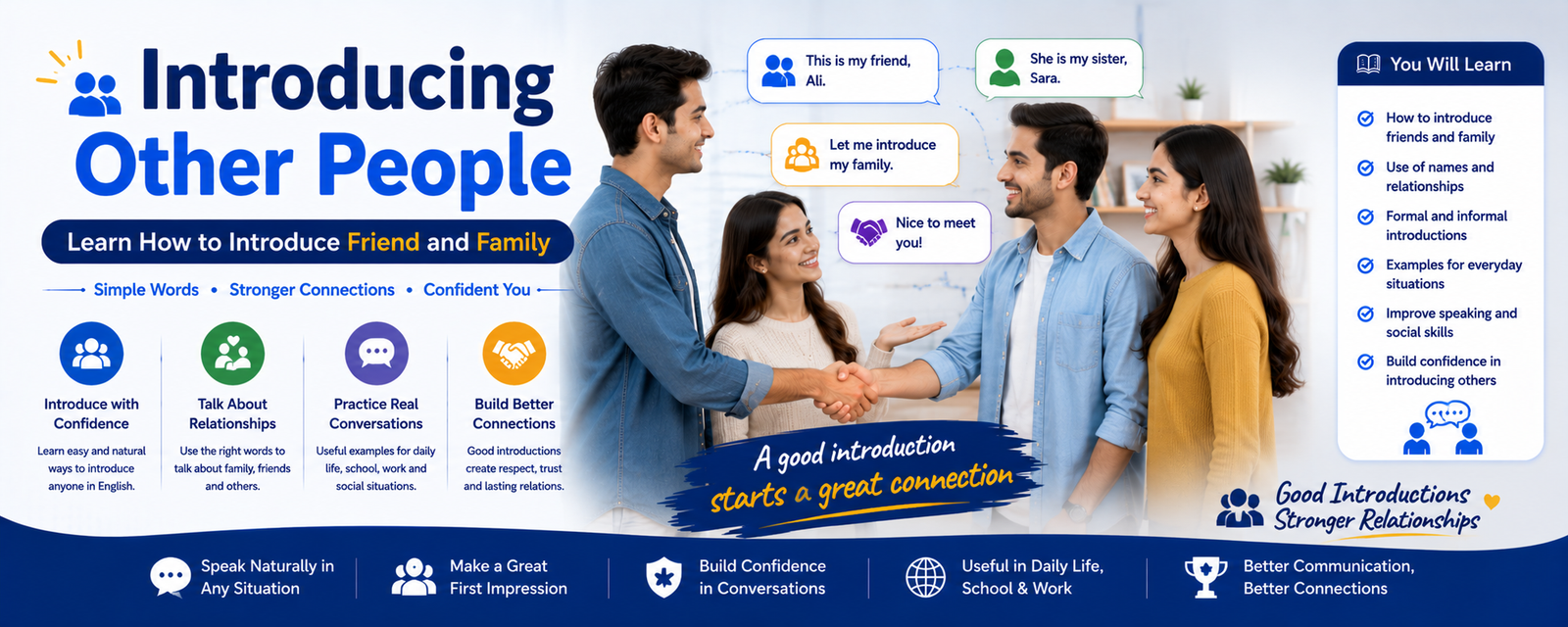
Introduce Other People: Learn How to Introduce Friends and Family
Introduction
Introducing people is an important communication skill in English. Whether you are introducing your best friend to your teacher, your brother to your neighbour, or your parents to your colleagues, knowing the right words helps you speak confidently and politely.
Many English learners can introduce themselves, but they often feel unsure when introducing other people. They may not know which expressions to use or how to make the introduction sound natural. The good news is that introducing others is easy once you learn a few simple sentence patterns.
In this lesson, you will learn how to introduce friends, family members, classmates, colleagues, and other people in different situations. You will also learn polite expressions, useful vocabulary, and practical examples that you can use in everyday conversations.
Learning Objectives
After completing this lesson, you will be able to:
- Introduce friends and family members confidently.
- Use polite English expressions in formal and informal situations.
- Start conversations naturally after introducing someone.
- Speak with confidence in school, work, and social gatherings.
- Avoid common mistakes when introducing people.
Why Is Introducing Other People Important?
Introducing people helps create new relationships. It makes conversations easier and helps everyone feel comfortable. A good introduction shows respect and good manners. Whether you are at school, in the office, at a family event, or meeting new neighbours, this skill is useful in everyday life.
Imagine your friend visits your home for the first time. Your parents have never met your friend before. Instead of saying nothing, you can politely introduce them. This makes everyone feel welcome and starts a friendly conversation.
The same thing happens at work. If your manager meets your new colleague, introducing them properly creates a professional and positive impression.
Basic Sentence Patterns
English has several simple sentence patterns for introducing other people. These expressions are used every day by native speakers.
Common Expressions
- This is my friend, Ali.
- I'd like you to meet my sister, Sara.
- Let me introduce my brother.
- Please meet my parents.
- Have you met my cousin?
- This is my English teacher.
- I'd like to introduce my colleague.
These expressions are polite, natural, and suitable for most situations. You can use them at school, at work, during family gatherings, or when meeting someone for the first time.
Introducing Friends
When introducing friends, use friendly and relaxed language. Informal introductions are common among classmates and close friends.
Example
Ahmed: Hi, Mary.
Mary: Hello!
Ahmed: This is my friend, Bilal.
Bilal: Nice to meet you.
Mary: Nice to meet you too.
This is one of the easiest and most common ways to introduce two friends to each other.
Introducing Family Members
When introducing family members, simply replace the person's name with the correct family relationship.
Examples
- This is my mother.
- This is my father.
- This is my younger brother.
- This is my older sister.
- I'd like you to meet my grandparents.
- Please meet my uncle.
- This is my cousin, Hamza.
These expressions are useful when relatives meet your friends, teachers, neighbours, or colleagues for the first time.
Useful Vocabulary
| Word | Meaning |
|---|---|
| Friend | A person you know well and like. |
| Neighbour | A person living near your home. |
| Colleague | A person you work with. |
| Classmate | A student in the same class. |
| Cousin | The child of your aunt or uncle. |
| Relative | A member of your family. |
Key Point
Always smile, make eye contact, and speak clearly when introducing people. A polite introduction creates a positive first impression and helps everyone feel comfortable.
Continue to Part 2
In the next part, you will learn formal and informal introductions, useful phrases, real-life conversations, and practical examples that you can use every day.
Formal and Informal Introductions
The way you introduce people depends on the situation. Sometimes you are talking to close friends, while other times you are introducing someone to a teacher, manager, customer, or guest. Learning the difference between formal and informal introductions will help you sound more natural and polite.
Informal Introductions
Informal introductions are used with friends, classmates, cousins, neighbours, and people you know well.
Examples
- Hey, this is my friend, Ali.
- Meet my brother, Ahmed.
- This is my cousin, Sara.
- Have you met my best friend?
- This is my classmate, Hamza.
Formal Introductions
Formal introductions are more polite and are suitable for business meetings, schools, offices, interviews, and special occasions.
Examples
- I'd like you to meet Mr. Ahmed.
- Please allow me to introduce my manager.
- May I introduce my colleague, Ms. Sara?
- It's a pleasure to introduce my teacher.
- Please meet our guest today.
Useful Expressions for Introducing Others
Native English speakers often use simple and polite expressions when introducing people. Memorising these expressions will help you communicate confidently.
Common Expressions
- This is my friend...
- I'd like you to meet...
- Please meet...
- Let me introduce...
- Have you met...?
- I'd like to introduce you to...
- May I introduce...?
- It's my pleasure to introduce...
Real-Life Conversation 1
Ali: Hi, Fatima.
Fatima: Hello, Ali.
Ali: I'd like you to meet my friend, Bilal.
Bilal: Nice to meet you.
Fatima: Nice to meet you too.
Ali: Bilal is my university classmate.
Fatima: That's great. Welcome!
Real-Life Conversation 2
Father: This is my colleague, Mr. Khan.
Son: Nice to meet you, Mr. Khan.
Mr. Khan: Nice to meet you too.
Father: My son is learning English.
Mr. Khan: That's wonderful. Keep practising every day.
Introducing Family Members at a Party
Imagine your friend visits your home for dinner. You can introduce your family members politely using simple English sentences.
You: Welcome to my home.
You: This is my father.
You: This is my mother.
You: This is my younger sister.
You: This is my older brother.
Friend: Nice to meet everyone.
Family: Nice to meet you too.
Introducing a New Employee
In offices and workplaces, introductions are usually more formal.
Manager: Good morning, everyone.
Manager: I'd like to introduce our new team member, Mr. Ahmed.
Ahmed: Thank you. It's nice to meet you all.
Team: Welcome to the team.
Tips for Better Introductions
- Smile while introducing people.
- Speak clearly and confidently.
- Use the person's correct name.
- Be polite and respectful.
- Maintain eye contact.
- Give a little information about the person if appropriate.
- Allow both people to greet each other after the introduction.
Practice Activity
Read the situations below and think about how you would introduce the people.
- Introduce your best friend to your English teacher.
- Introduce your sister to your classmates.
- Introduce your parents to your neighbour.
- Introduce your manager to a new employee.
- Introduce your cousin to your friends.
Try speaking each introduction aloud. Practising with real-life situations will help you become more confident.
Continue to Part 3
In Part 3, you will learn common mistakes, speaking practice, exercises, quiz questions, FAQs, and a complete lesson summary to improve your confidence when introducing other people in English.
Common Mistakes to Avoid
Many English learners make small mistakes when introducing other people. These mistakes can make your English sound unnatural. Learning the correct expressions will help you communicate more confidently.
| Incorrect | Correct |
|---|---|
| He is my friend Ali, meet. | This is my friend, Ali. |
| Meet to my brother. | Meet my brother. |
| I introduce you my teacher. | I'd like to introduce you to my teacher. |
| He my cousin. | He is my cousin. |
| This my father. | This is my father. |
Remember to use complete sentences and always include the verb "is" when needed.
Speaking Practice
Read the following sentences aloud several times. Focus on clear pronunciation and natural speaking.
- This is my best friend, Ali.
- I'd like you to meet my sister.
- Please meet my parents.
- Have you met my English teacher?
- This is my colleague, Mr. Ahmed.
- I'd like to introduce my cousin, Sara.
- Let me introduce my neighbour.
- It's a pleasure to introduce my manager.
Practise these sentences every day until they become natural. The more you speak, the more confident you will become.
Practice Exercise
Complete the following sentences.
- This is ________ friend, Ali.
- I'd like you to ________ my brother.
- Please ________ my parents.
- Have you ________ my teacher?
- This is my ________, Sara.
Answers
- my
- meet
- meet
- met
- sister (or cousin)
Mini Quiz
Choose the correct answer.
1. Which sentence is the most polite?
- A. Meet my boss.
- B. I'd like you to meet my boss.
- C. My boss here.
2. Which sentence is correct?
- A. This my brother.
- B. This is my brother.
- C. This are my brother.
3. Which expression is commonly used to introduce someone?
- A. Goodbye.
- B. Let me introduce...
- C. Excuse me.
4. Formal introductions are mostly used in:
- A. Business meetings
- B. Schools
- C. Interviews
- D. All of the above
5. What should you do while introducing people?
- A. Smile
- B. Speak clearly
- C. Make eye contact
- D. All of the above
Daily Speaking Challenge
Today, introduce at least three people in English.
- Introduce one family member.
- Introduce one friend.
- Introduce one teacher or colleague.
If no one is available, practise in front of a mirror. Speaking aloud every day is one of the fastest ways to improve your English.
Lesson Summary
In this lesson, you learned how to introduce friends, family members, classmates, teachers, colleagues, and other people using simple and polite English expressions. You also learned the difference between formal and informal introductions, practised useful conversations, discovered common mistakes, and completed speaking exercises.
Introducing people is an important communication skill that you will use in everyday life. The more you practise these expressions, the more natural and confident your English will become.
Frequently Asked Questions (FAQ)
How do I introduce my friend in English?
You can say, "This is my friend, Ali." or "I'd like you to meet my friend."
How do I introduce my family?
Use simple sentences such as "This is my mother.", "This is my father.", or "Please meet my sister."
What is the difference between formal and informal introductions?
Formal introductions are used in workplaces, schools, meetings, and professional situations. Informal introductions are used with friends and family.
How can I improve my speaking?
Practise introducing different people every day, speak aloud, listen to native speakers, and use these expressions in real conversations whenever possible.
Final Thoughts
Every confident English speaker started with simple conversations. Learning how to introduce other people is a small skill that makes a big difference in daily communication. Keep practising these expressions, use them whenever you meet new people, and don't be afraid to speak. Confidence comes from practice, and every conversation helps you improve.
Keep learning, keep practising, and continue your English journey with THE ENGLISH PK.