
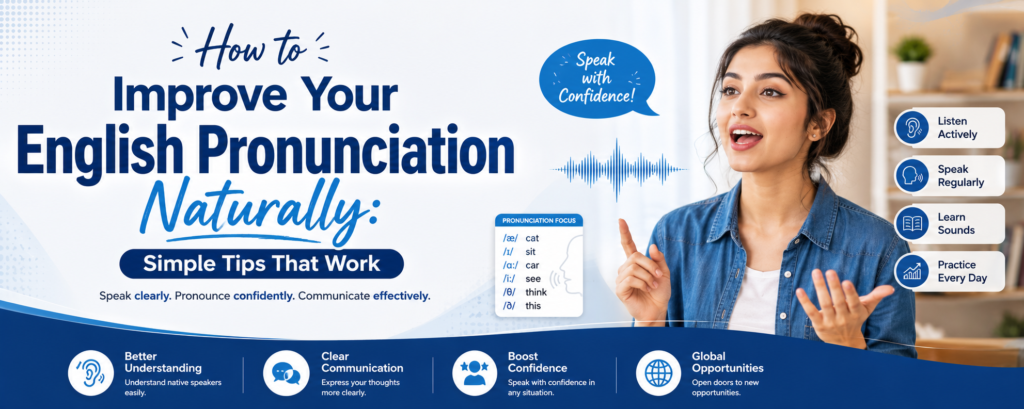
How to Improve Your English Pronunciation Naturally
Simple Tips That Work
If you've ever known the right grammar, the right vocabulary, and still hesitated before speaking, you're not alone. A huge number of English learners can read fluently and write well-structured sentences, but freeze up the moment they need to say something out loud. Usually it isn't a lack of knowledge. It's pronunciation anxiety: the worry that people won't understand you, or that you'll say a word "wrong."
Here's the good news. If you're looking into how to improve English pronunciation, you don't need to aim for perfection. You don't need to erase your accent or sound like you grew up somewhere else. What you need is clarity: speech that's easy for other people to follow, spoken with a comfortable, natural rhythm. That's a realistic goal, and it's one you can work toward steadily, a little bit at a time.
What Does Good English Pronunciation Actually Mean?
A lot of learners assume good pronunciation means sounding British, American, or Australian. It doesn't. Plenty of confident, highly effective English speakers around the world have accents shaped by their first language, and that's completely fine. Accent is not the same thing as clarity.
What actually makes speech easy to understand comes down to a handful of things:
- Clear sounds: pronouncing consonants and vowels distinctly enough that words don't blur into each other.
- Correct word stress: putting emphasis on the right syllable, since English relies heavily on this for meaning.
- Natural rhythm: the rise and fall of stressed and unstressed syllables, rather than flat, robotic delivery.
- Appropriate pauses: breaking sentences into natural chunks instead of rushing everything together.
- Understandable speech: the actual test that matters, which is whether a listener can follow you without straining.
- Confidence: hesitant, quiet speech is often harder to understand than speech with a strong accent.
If you can check most of those boxes, you already have good pronunciation, even if it doesn't sound "native." That's a reassuring place to start.
How to Improve Your English Pronunciation Naturally
None of the methods below require special equipment, expensive apps, or a coach sitting next to you. They just require a bit of consistency.
- Listen before you speak. Before trying to say a new word or phrase, listen to it a few times first. Notice how the syllables connect, where the speaker pauses, and which words get more emphasis. Speaking is much easier when your ear already knows what the sentence should sound like.
- Stop pronouncing every word the way it's spelled. English spelling is notoriously inconsistent. Words like comfortable, Wednesday, and island don't sound the way their spelling suggests; several letters are barely pronounced or silent altogether. You don't need to memorize a dictionary of exceptions, just stay aware that spelling isn't always a reliable guide.
- Learn word stress. Stress the wrong syllable, and a word can become genuinely hard to recognize, even if every sound is technically correct. For example, record is stressed differently depending on whether it's a noun (REcord) or a verb (reCORD). Paying attention to stress patterns like this makes a noticeable difference in how clearly you're understood.
- Practise the sounds that are difficult for you. Not every learner struggles with the same sounds; it depends on your first language. Some learners find the th sound tricky, others struggle with distinguishing l and r, or short vowels like the difference between ship and sheep. Figure out your specific difficulties instead of practising everything equally, and focus your energy there.
- Use the listen and repeat method. This is simple and genuinely effective: listen to a short sentence, pause, repeat it out loud, compare your version to the original, then repeat again. For example, take a sentence like "I haven't decided yet." Listen to how it flows, then try to match that rhythm rather than saying each word separately.
- Record yourself speaking. This can feel uncomfortable at first, but it's one of the fastest ways to notice patterns, such as unclear sounds, hesitations, or words you consistently stress incorrectly. You're not doing this to judge yourself harshly; you're doing it to notice, adjust, and move on.
- Practise short sentences, not isolated sounds only. Saying a sound correctly on its own doesn't always transfer to full sentences. Try practising in context: "Can you help me with this?" or "I'll call you back later." Full sentences train your mouth and rhythm together, which is closer to real conversation.
- Read aloud. Spend five to ten minutes a day reading a paragraph, a short article, or even a page from a book out loud. This builds comfort producing English sounds in a low pressure setting, without needing a conversation partner.
- Learn English through listening. Podcasts, YouTube videos, interviews, or shows with clear dialogue all help train your ear for natural rhythm. The goal isn't to imitate every feature of a particular accent, it's to absorb how real speech actually flows, with its pauses, contractions, and stress patterns.
- Practise consistently. Ten focused minutes a day will get you further than a single two hour session once a month. Pronunciation is a physical skill as much as a mental one, and physical skills improve through repetition, not cramming.
Common English Pronunciation Mistakes
A few patterns show up again and again among learners, and being aware of them can save you a lot of frustration.
- Pronouncing every written letter: try instead to focus on how the word actually sounds when spoken naturally, not how it's spelled.
- Giving every syllable equal stress: instead, identify the one stressed syllable in each word and let the others soften slightly.
- Speaking too quickly: slowing down, even a little, usually improves clarity more than any other single change.
- Avoiding difficult words: swapping out challenging words for easier synonyms limits your growth; practise the hard ones directly instead.
- Confusing similar sounds: pairs like ship/sheep or think/sink are worth isolating and practising side by side.
- Focusing too much on accent instead of clarity: chasing a specific accent often distracts from the more useful goal of simply being understood.
None of these mean anything is wrong with how you speak. They're just common patterns, and once you're aware of them, they're easy to work on.
A Simple 15-Minute English Pronunciation Routine
If you want a structure to follow, here's a routine you can repeat daily:
| Time | Activity |
|---|---|
| 5 minutes | Listen to natural English, such as a podcast clip, a short video, or a conversation. |
| 5 minutes | Repeat short sentences out loud, comparing your rhythm to what you heard. |
| 3 minutes | Read a short paragraph aloud from a book, article, or website. |
| 2 minutes | Record yourself saying a few sentences, then listen back. |
Fifteen minutes doesn't feel like much, but done consistently over weeks, it adds up to real, noticeable improvement.
Should You Try to Change Your Accent?
Not necessarily. Your accent is part of how you speak, and it doesn't need to disappear for you to communicate well. Millions of confident English speakers worldwide have accents shaped by their first language, and it doesn't hold them back.
What matters more is clarity, meaning how easy you are to understand, rather than sounding like you're from a particular country.
That said, exposing yourself to different English accents (American, British, Australian, Indian, Nigerian, and others) is genuinely useful, because it trains your ear to understand a wider range of speakers, which is a valuable skill in itself.
How Long Does It Take to Improve English Pronunciation?
There's no single answer, and anyone who promises a fixed timeline is probably overselling something.
Progress depends on:
- Your current pronunciation level
- How much you practise
- How consistent you are
- Your listening habits
- The specific sounds or patterns you personally find difficult
Some learners notice small improvements within a few weeks of regular practice. Others take longer, especially if their first language is very different from English in terms of sounds and rhythm.
What matters most isn't speed, it's consistency. Pronunciation tends to improve gradually, in small, sometimes unnoticeable steps, rather than all at once.
Frequently Asked Questions (FAQs)
How can I improve my English pronunciation at home?
Listen to natural English daily, repeat short sentences out loud, read aloud for a few minutes, and record yourself occasionally to track your progress. None of this requires special equipment, just consistency.
What is the best way to practise English pronunciation?
The listen and repeat method tends to work well for most learners: listen to a sentence, pause, repeat it, then compare your version to the original. Practising in full sentences rather than isolated sounds also helps more.
How can I speak English more clearly?
Focus on word stress, slow down slightly, and pause naturally between phrases instead of rushing everything together. Clarity comes more from rhythm and stress than from getting every single sound perfect.
Should I copy a British or American accent?
You don't have to. Focus on being clear and understandable rather than copying a specific accent. Your natural accent can stay exactly as it is.
How can I improve my pronunciation if I don't have a speaking partner?
Reading aloud, listening to natural English content, and recording yourself are all effective ways to practise alone. A speaking partner helps, but it isn't required to make real progress.
Final Thoughts
You don't need a perfect accent to speak English well. Clear pronunciation matters far more than sounding native, and that's a goal within everyone's reach.
Listening and speaking work best together: the more naturally spoken English you take in, the more naturally you'll be able to produce it yourself.
Start small. Fifteen minutes a day, practised consistently, will do more for your pronunciation than any shortcut.
And remember, mistakes aren't a sign you're failing. They're simply part of how this skill is built.