
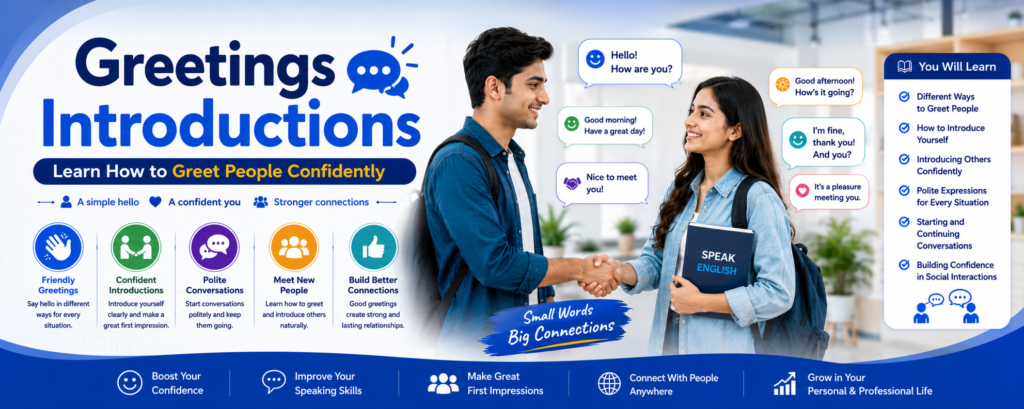
Greetings and Introductions in English
Master the foundational skills of natural and confident English conversations.
Why This Lesson Matters
Every conversation in English — whether it's a job interview, a first day at school, meeting a new neighbor, or starting a business call — begins the same way: with a greeting and an introduction. If you get this part right, you sound confident and natural. If you get it wrong or skip it, even great English later in the conversation can feel awkward. This lesson will teach you exactly how native speakers greet people and introduce themselves and others, in a simple, practical way.
Part 1: What is a Greeting?
A greeting is the first thing you say when you meet someone. It can change depending on:
- Time of day (morning, afternoon, evening)
- Formality (talking to your boss vs. talking to a friend)
- Relationship (stranger, coworker, close friend, family)
Common Greeting Words
- Hello
- Hi
- Hey
- Good morning
- Good afternoon
- Good evening
- Greetings (very formal, used in writing)
Part 2: What is an Introduction?
An introduction is when you tell someone your name (or someone else's name) for the first time. There are two types:
- Self-introduction – introducing yourself
- Introducing others – introducing one person to another
Key Phrases for Self-Introduction
- My name is...
- I'm...
- I'd like to introduce myself.
- Let me introduce myself.
Key Phrases for Introducing Others
- This is...
- I'd like you to meet...
- Let me introduce you to...
- Have you met...?
Part 3: Formal vs. Informal Greetings and Introductions
| Situation | Informal | Formal |
|---|---|---|
| Greeting | Hey! What's up? | Good morning, how are you? |
| Introducing yourself | Hi, I'm Ali. | Good afternoon, my name is Ali Khan. |
| Asking someone's name | What's your name? | May I ask your name, please? |
| Response to introduction | Nice to meet you! | It's a pleasure to meet you. |
| Saying goodbye | See ya! | It was nice meeting you. Goodbye. |
Part 4: Structure of a Good Introduction Conversation
A natural introduction usually follows this pattern:
- Greeting → "Hello!"
- Name → "My name is Sara."
- Small extra detail (optional) → "I'm new here." / "I work in marketing."
- Question back → "What's your name?"
- Polite closing → "Nice to meet you."
Part 5: 30 Practical Examples
Below are 30 real, everyday examples of greetings and introductions — a mix of formal and informal situations, so you can use the right one at the right time.
Part 6: Common Mistakes to Avoid
- ❌ "My name is called Ali." → ✅ "My name is Ali." (or "I'm called Ali.")
- ❌ "I am Ali, and you?" (too blunt) → ✅ "I'm Ali. And you? / What's your name?"
- ❌ Using "Good night" as a greeting → ✅ Use only when leaving/going to sleep.
- ❌ Skipping "Nice to meet you" after an introduction — it's considered impolite to skip this in English.
- ❌ Overusing "Hi" in formal settings like interviews — use "Good morning/afternoon" instead.
Part 7: Practice Task
Try writing 5 of your own introduction sentences:
- One for meeting a new classmate
- One for a job interview
- One for introducing your friend to your family
- One for answering a phone call at work
- One for meeting your teacher on the first day
This kind of daily practice is the fastest way to make greetings and introductions feel natural in English.
Quick Summary
- Greetings change based on time and formality.
- Introductions have two types: self-introduction and introducing others.
- Always follow up an introduction with "Nice to meet you" or a similar polite phrase.
- Practice both formal and informal styles so you're ready for any situation.
Greetings & Introductions
A complete lesson plan to master basic English greetings, personal introductions, and conversation skills.
Lesson Objectives
By the end of this lesson, students will be able to:
- Greet people appropriately in different situations (formal and informal)
- Introduce themselves and others
- Ask and answer basic personal questions (name, where you're from, how you're doing)
- Use polite expressions when meeting someone for the first time
1. Warm-Up
Start the class with a simple question: "How many ways can you say hello in English?"
Let students shout out whatever comes to mind — Hi, Hello, Hey, What's up, Good morning. Write them all on the board without correcting anything yet. This gets students talking right away and shows them how much they may already know.
2. Vocabulary: Common Greetings
Formal Greetings
Used with strangers, at work, or with people older than you.
- Good morning / Good afternoon / Good evening
- How do you do?
- It's a pleasure to meet you.
- Nice to meet you.
Informal Greetings
Used with friends, family, or people your own age.
- Hi / Hey / Hiya
- What's up?
- How's it going?
- Long time no see!
3. Vocabulary: Responding to Greetings
When someone asks "How are you?", students often freeze or just say "fine" every single time. Give them variety:
| Feeling | Response |
|---|---|
| Great | I'm doing great, thanks! |
| Okay | Not bad, thanks. And you? |
| Tired | I'm a bit tired today. |
| Busy | Pretty busy, but good! |
4. Introducing Yourself
Teach the basic structure with a simple model dialogue:
B: Nice to meet you, Sara. I'm Ahmed.
A: Nice to meet you too, Ahmed. Where are you from?
B: I'm from Lahore. And you?
A: I'm from Karachi.
Key phrases to highlight:
- I'm... / My name is...
- Nice to meet you.
- Where are you from?
- I'm from...
- What do you do?
5. Introducing Someone Else
Sometimes we introduce a friend or colleague to another person. Teach this pattern:
"This is my friend, John. John, this is Maria."
Practice phrases:
- Let me introduce you to...
- Have you two met?
- This is...
6. Grammar Focus: Question Words for Introductions
| Question | Example Answer |
|---|---|
| What's your name? | My name is Aisha. |
| Where are you from? | I'm from Islamabad. |
| What do you do? | I'm a student / teacher / engineer. |
| How old are you? | I'm 22 years old. (use carefully — not always polite in every culture!) |
7. Speaking Practice: Role-Play Activity
Pair up students. Give each pair a card with one of these situations:
- Meeting a new classmate on the first day of school.
- Meeting your friend's parents for the first time.
- Meeting a coworker at a new job.
- Bumping into an old friend you haven't seen in years.
Ask each pair to act out a short 1-minute conversation using at least three phrases from today's lesson. Walk around the room and listen — don't interrupt during the role-play, but note down common mistakes to review afterward.
8. Common Mistakes to Watch For
- Saying "I am fine" flatly every time — encourage natural variety.
- Confusing "How are you?" with "How old are you?"
- Forgetting to ask a follow-up question (conversations should go both ways!).
- Overusing "How do you do?" in casual settings — this phrase is quite formal and a bit old-fashioned.
9. Wrap-Up Activity: Mingle and Meet
Have students stand up and walk around the room. Give them 5 minutes to introduce themselves to at least three different classmates using the phrases from today's lesson. This is a fun way to end the class on an active, low-pressure note.
10. Homework
Ask students to write a short dialogue (6–8 lines) where they introduce themselves to a new neighbor. They should include:
- A greeting
- Their name
- Where they're from
- One follow-up question