
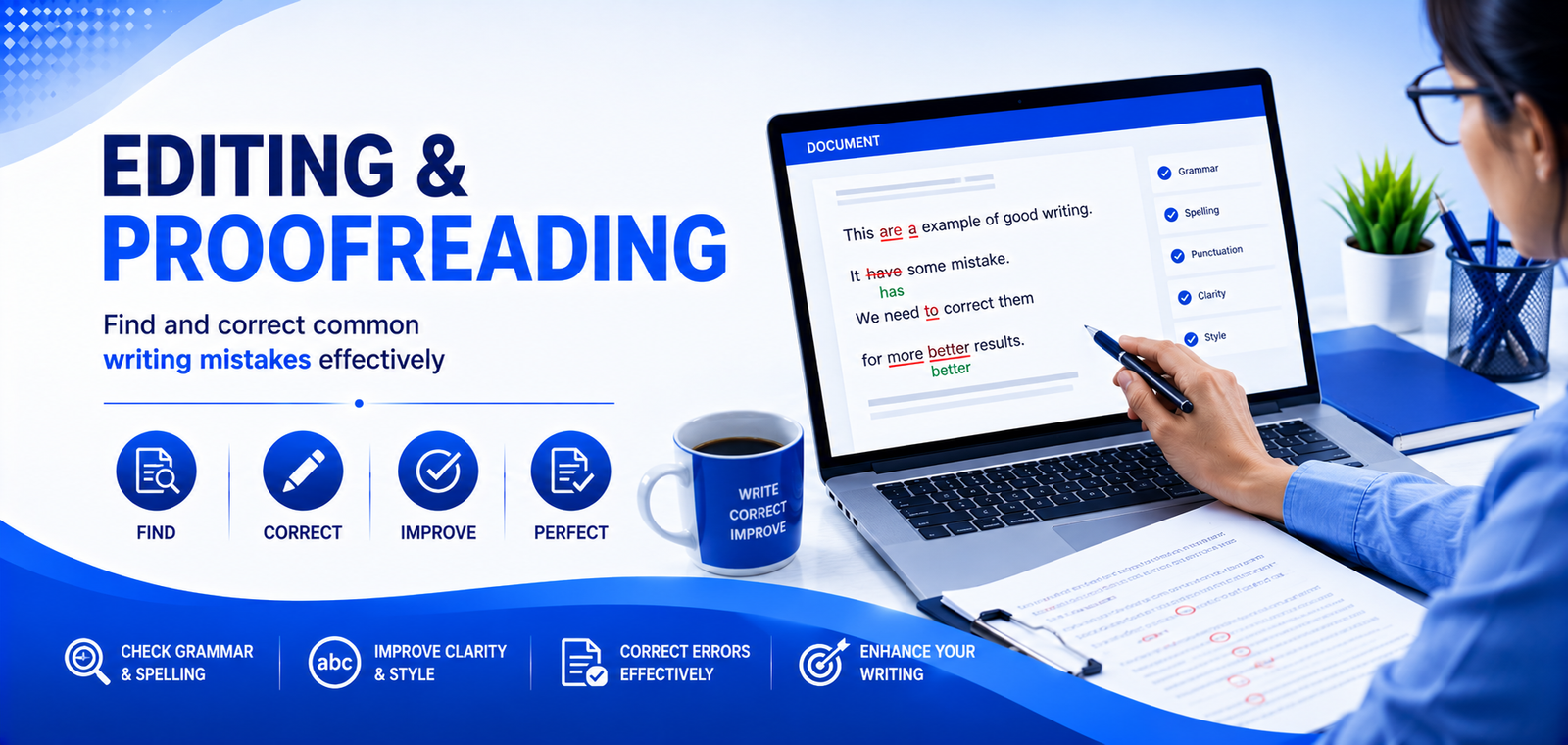
Mastering Editing & Proofreading
Transform your first draft into clear, polished, and professional writing with a systematic approach to editing, revision, and proofreading.
At an intermediate level, writing a good first draft is only half the battle. Professional writers, content creators, and business leaders know that the true magic happens during the revision process. Writing is an act of creation, but editing and proofreading are acts of refinement. Transforming a messy, sprawling draft into a polished, authoritative piece of communication requires a systematic approach, a sharp eye for mechanical errors, and the willingness to cut unnecessary words.
Editing vs. Proofreading
Macro-Editing
Focus on the big picture: structure, flow, argument logic, tone, clarity, and overall organization.
Does the introduction hook the reader? Are the paragraphs in the most logical order? Did I wander off-topic?
Micro-Editing
Focus on sentence-level craftsmanship, including word choice, syntax variety, active voice, and eliminating redundancy.
Can this sentence be shortened? Is there a more precise verb? Are words or phrases repeated?
Proofreading
Focus on mechanical perfection: spelling, grammar, punctuation, typos, and formatting consistency.
Proofreading should happen last, after structural and line edits are complete.
The Multi-Pass Revision Workflow
| Pass | Revision Focus | What to Look For |
|---|---|---|
| Pass 1 | Structural Pass | Rearranging paragraphs, cutting irrelevant sections, strengthening thesis alignment, and checking logical flow. |
| Pass 2 | Clarity & Style | Replacing weak verbs, changing passive voice to active voice, and trimming unnecessary words. |
| Pass 3 | Mechanical Proofread | Fixing spelling errors, checking apostrophes, comma splices, capitalization, and grammar. |
| Pass 4 | Format & Final Polish | Checking headings, bullet-point consistency, formatting, and completing a final read-aloud. |
Common Intermediate Writing Mistakes
Passive Voice Overload
Hiding who or what performs an action can make writing feel lifeless. Use active voice when it improves clarity.
Passive: "The report was finished by the team on Friday."
Active: "The team finished the report on Friday."
Comma Splices & Run-on Sentences
Two independent clauses should not be joined with only a comma. Use a period, semicolon, or coordinating conjunction.
Incorrect: "The data was inconclusive, we need to run another test."
Correct: "The data was inconclusive; therefore, we need to run another test."
Wordiness & Redundancy
Avoid using several words when one precise word can communicate the same meaning more effectively.
Wordy: "At this point in time, due to the fact that..."
Concise: "Currently, because..."
Dangling & Misplaced Modifiers
Place descriptive phrases close to the noun they describe to prevent confusing or unintended meanings.
Confusing: "Walking through the office, the fire alarm suddenly went off."
Clear: "As I was walking through the office, the fire alarm suddenly went off."
Pro-Tips for Bulletproof Proofreading
Change the Medium
Print your document or change the font, size, or background. Visual disruption forces your brain to examine the text differently.
Read Aloud
Read your writing word-for-word. Awkward rhythm, missing words, and unclear sentences become much easier to detect.
Use Text-to-Speech
Hearing your writing can reveal clunky transitions, missing words, and awkward phrasing that your eyes may overlook.
Final Editing Checklist
- Check the overall structure and logical flow.
- Make sure every paragraph supports the main purpose.
- Replace weak or vague verbs with precise language.
- Remove unnecessary words and repeated ideas.
- Check grammar, spelling, punctuation, and capitalization.
- Review headings, lists, spacing, and formatting consistency.
- Read the final version aloud before publishing.
Master Your Revision Process
Think Big
Check structure, purpose, audience, organization, and overall flow.
Improve Sentences
Strengthen verbs, simplify sentences, and remove unnecessary wording.
Proofread Carefully
Look for grammar, spelling, punctuation, capitalization, and typos.
Polish the Presentation
Review formatting, headings, lists, spacing, and readability.
Ready to Improve Your Writing?
Choose a piece of writing and apply the multi-pass editing framework. Start with structure, refine your sentences, and finish with a careful proofreading pass.