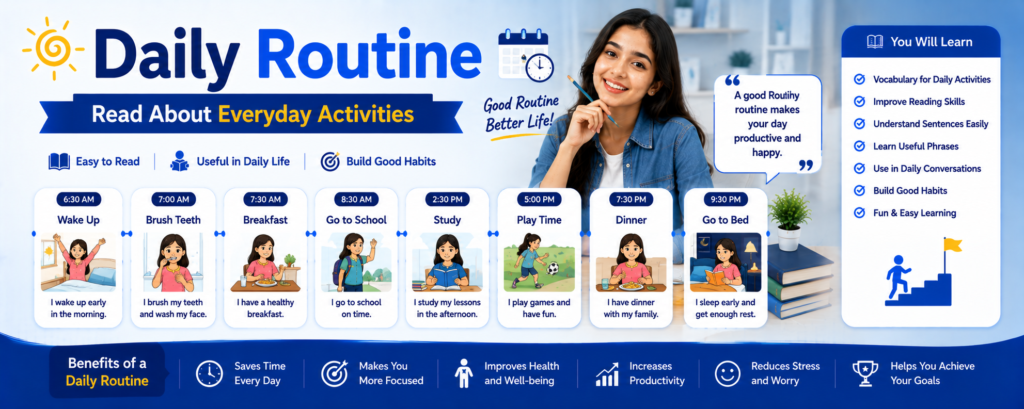
Daily Routine English Lesson | The English PK
English Speaking & Vocabulary Lesson

The Rhythm of Everyday Life

Master the vocabulary and grammatical structures used to describe daily routines, morning habits, work and study, household chores, evening activities, frequency, and complete everyday narratives.

Phase 1

Introduction: The Rhythm of Everyday Life

Our lives are defined by repetition, rhythm, and routine. Every single day, billions of people across the globe wake up, prepare for the day, engage in professional or educational pursuits, nourish their bodies, and wind down for rest. Mastering the vocabulary and grammatical structures of a daily routine is one of the most critical milestones in English language acquisition. It allows you to describe your lifestyle, make plans, share personal stories, and connect with others on a fundamental human level.

This comprehensive, long-format lesson is written entirely in English to immerse you fully in the language. We will systematically explore morning habits, professional and academic activities, household chores, evening relaxation, and advanced narrative descriptions of daily life. Let us dive into the everyday language of human action.

Phase 2

Phase 1: Waking Up and Morning Hygiene

The morning routine sets the psychological and physical tone for the entire day. These foundational actions describe the transition from sleep to wakefulness and personal grooming.

Wake up: To stop sleeping and become conscious. (e.g., "I wake up at six o'clock.")
Get out of bed: To physically rise from your bed after waking.
Stretch: To extend your limbs and muscles to wake up your body.
Take a shower: To wash your body standing under a spray of water. (Also: take a bath)
Brush your teeth: To clean your teeth using a toothbrush and toothpaste.
Wash your face: To clean your face with water and soap or cleanser.
Comb / Brush hair: To tidy and style your hair.
Get dressed: To put on your clothes for the day.
Shave: To remove facial hair with a razor (common grooming habit).
Apply skincare: To put on lotion, moisturizer, or sunscreen.
Detailed Linguistic Analysis

Morning hygiene activities are typically expressed using the Simple Present Tense because they describe habitual routines. Notice the reflexive or direct object pairings: you wash your face, brush your teeth, and get dressed. In English grammar, possessive adjectives (my, your, his, her) automatically attach to body parts and personal items during routine descriptions rather than definite articles.

Phase 3

Phase 2: Breakfast and Morning Nutrition

Fueling the body with food and warm beverages is a universal ritual that provides the necessary energy for the day ahead.

Eat breakfast: To consume the first meal of the day.
Drink coffee / tea: To consume a hot caffeinated beverage in the morning.
Prepare food: To cook or assemble a meal in the kitchen.
Boil water: To heat water until it reaches its boiling point for tea or oatmeal.
Pour cereal: To empty dry cereal into a bowl and add milk.
Toast bread: To brown slices of bread in a toaster.
Pack lunch: To prepare a midday meal to take to work or school.
Clear the table: To remove dishes and food items after eating.
Load the dishwasher: To place used breakfast dishes into the cleaning machine.
Check the news: To read current events online or on paper while eating.
Detailed Linguistic Analysis

When describing meal preparation, English uses precise action verbs (boil, pour, toast, pack). This phase also introduces common phrasal combinations and collocation patterns. For example, we say "drink coffee" or "have breakfast" (using have as a synonym for consuming a meal). Mastering these collocations makes your English sound natural and effortless.

Phase 4

Phase 3: Commuting and Leaving the House

Once the morning preparations are complete, individuals leave their domestic sanctuaries to travel to workplaces, schools, or public spaces.

Leave the house: To exit your home to begin your commute.
Lock the door: To secure your home with a key or deadbolt before leaving.
Catch the bus: To board public transportation.
Drive to work: To operate a personal automobile to reach your workplace.
Take the train / subway: To utilize rail transport for commuting.
Walk to school: To travel on foot to an educational institution.
Check traffic: To look at maps or news apps for road congestion.
Listen to a podcast: To enjoy audio entertainment or education during a commute.
Arrive at the office: To reach your destination workplace.
Clock in: To record the exact time you begin your workday.
Detailed Linguistic Analysis

Transportation prepositions are a crucial grammatical feature in this phase. In English, we use "by" when talking about modes of transport generally (by car, by bus, by train), but we use "in" for cars (in a car) and "on" for public transit where you can stand up and walk (on a bus, on a train, on a plane). Additionally, verbs like leave, arrive, and reach have distinct directional rules regarding prepositions.

Phase 5

Phase 4: Professional and Academic Duties

The core hours of the day are typically dedicated to labor, career advancement, academic study, and targeted productivity.

Attend a meeting: To participate in a formal discussion with colleagues.
Answer emails: To read and reply to electronic messages from clients or coworkers.
Write a report: To compile data and analysis into a professional document.
Take a break: To pause work for rest, stretching, or fresh air.
Eat lunch: To consume your midday meal around noon or 1:00 PM.
Collaborate with peers: To work together with others on a shared project.
Study for an exam: To review academic materials and textbooks.
Attend a lecture: To listen to an instructor present educational content.
Take notes: To write down key points during a class or meeting.
Complete an assignment: To finish required schoolwork or tasks.
Detailed Linguistic Analysis

Productivity vocabulary relies heavily on action verbs paired with direct objects (answer emails, write a report, attend a meeting). When describing workplace schedules, native speakers frequently use prepositional time markers such as "at" for exact clock times (at 9:00 AM), "in" for parts of the day (in the morning, in the afternoon), and "during" for events spanning a duration (during the meeting).

Phase 6

Phase 5: Afternoon Transition and Errands

The transition from midday productivity to the late afternoon often involves wrapping up tasks, running errands, or engaging in physical wellness.

Finish work: To complete your professional duties for the day.
Leave the office: To depart from your workplace.
Run errands: To make short trips to complete necessary tasks (e.g., post office, bank).
Grocery shop: To purchase food and household supplies at a supermarket.
Go to the gym: To visit a facility for physical exercise and weight training.
Work out: To engage in physical exercise or sports training.
Pick up children: To collect your kids from school or daycare.
Check mail: To retrieve physical letters from your mailbox.
Walk the dog: To take a pet canine outside for exercise and relief.
Return home: To arrive back at your residential house or apartment.
Detailed Linguistic Analysis

Notice the use of phrasal verbs and idiomatic phrases in this phase, such as "run errands" and "work out." A phrasal verb combines a main verb with an adverb or preposition to create an entirely new semantic meaning. Integrating these natural expressions elevates your conversational fluency far beyond literal, dictionary-definition translations.

Phase 7

Phase 6: Evening Meal and Domestic Chores

Returning home marks the shift from public obligations to private domestic life, involving dinner preparation and household maintenance.

Cook dinner: To prepare the final and often largest meal of the evening.
Eat dinner: To consume the evening meal with family or housemates.
Wash the dishes: To clean plates, pots, cutlery, and pans after eating.
Take out the trash: To carry household garbage bins outside to the curb.
Do laundry: To wash, dry, and fold dirty clothes.
Iron clothes: To smooth out wrinkles in garments using a hot iron.
Water the plants: To pour water on indoor or outdoor garden vegetation.
Clean the kitchen: To wipe down countertops, sweep floors, and tidy up.
Prep for tomorrow: To lay out clothes or pack bags for the next day.
Lock up the house: To secure all doors and windows before sleep.
Detailed Linguistic Analysis

Household chores frequently utilize the verb "do" (do laundry, do the dishes), although regional variations or alternative verbs (wash, clean) are also common. Grammatically, when describing a sequence of evening events, transition words like then, after that, next, and meanwhile become vital connective tissue that links sentences into a smooth chronological narrative.

Phase 8

Phase 7: Evening Relaxation and Leisure

Once chores are finished, the evening opens up space for relaxation, entertainment, family bonding, and winding down the nervous system.

Watch television: To view shows, movies, or broadcasts on a screen.
Read a book: To enjoy a novel, biography, or educational text.
Browse the internet: To surf websites, read articles, or check social media.
Listen to music: To enjoy soothing audio tracks or albums.
Spend time with family: To talk, laugh, and bond with household members.
Hobby time: To engage in personal interests like painting, writing, or crafting.
Catch up on shows: To watch recorded or streaming television series.
Meditate: To sit quietly and practice mental mindfulness.
Stretch or do yoga: To engage in gentle evening physical relaxation.
Dim the lights: To lower artificial lighting to signal the approach of sleep.
Detailed Linguistic Analysis

Leisure activities often employ continuous or habitual structures. Notice how adjectives and adverbs add sensory detail to relaxation (soothing audio, quietly, gentle relaxation). When speaking about habits of leisure, native English speakers often use frequency adverbs like always, usually, often, sometimes, or rarely placed right before the main verb (e.g., "I usually read a book before bed").

Phase 9

Phase 8: Bedtime Routine and Preparation for Sleep

The final hours of the day prepare the human body for restorative rest, marking the closing loop of the twenty-four-hour cycle.

Brush teeth: To clean teeth for a second time before sleeping.
Wash face: To remove the dirt and makeup accumulated during the day.
Change into pajamas: To put on comfortable sleeping garments.
Set the alarm: To program your phone or clock to ring in the morning.
Charge your phone: To plug your mobile device into a power outlet overnight.
Turn off the lights: To extinguish room illumination.
Get into bed: To lie down under the blankets.
Read a bedtime story: To read briefly before closing your eyes.
Fall asleep: To drift off into unconscious rest.
Dream: To experience mental images and narratives during sleep.
Detailed Linguistic Analysis

The bedtime routine marks a transition into passive verbs and restful states (fall asleep, drift off, rest). Pay close attention to phrasal verbs like "turn off" (extinguish lights or electronics) and "get into" (enter bed). Using these particle combinations correctly is a hallmark of natural English phrasing.

Phase 10

Phase 9: Frequency Adverbs and Time Connectors

To talk fluently about a daily routine, you must master the words that indicate how often and when actions happen. These words give structural flow to your descriptions.

Always: 100% of the time (e.g., "I always drink water in the morning.")
Usually: 80–90% of the time (e.g., "I usually leave by 8:00 AM.")
Often / Frequently: 50–70% of the time (e.g., "I often check my email.")
Sometimes: 30–50% of the time (e.g., "I sometimes skip breakfast.")
Rarely / Seldom: 10–20% of the time (e.g., "I rarely watch TV.")
Never: 0% of the time (e.g., "I never drink coffee at night.")
First: Indicates the starting action of a sequence.
Then / Next: Indicates subsequent actions in chronological order.
After that: Bridges two consecutive events smoothly.
Finally: Marks the concluding action of a sequence or day.
Detailed Linguistic Analysis

Frequency adverbs occupy a very specific grammatical slot in English sentences: they go before main verbs (like always eat, usually work), but they go after the verb to be (like I am always early, She is usually tired). Meanwhile, sequential connectors (First, Then, Next, Finally) typically start sentences followed by a comma, acting as signposts for the listener or reader.

Phase 11

Phase 10: Narrative Integration (A Complete Day in the Life)

To conclude our lesson, we integrate all the vocabulary, grammar rules, frequency adverbs, and chronological connectors into a flowing narrative text that portrays a complete daily routine from dawn until dusk.

Text Passage:
Every weekday, my daily routine follows a predictable and comforting rhythm. I always wake up at 6:30 AM, stretch for a few minutes, and get out of bed. First, I take a refreshing shower, brush my teeth, and get dressed in professional attire. Next, I go to the kitchen to boil water for tea and prepare a light breakfast. Usually, I check my emails while eating to preview the workday ahead. At 8:00 AM, I leave the house, lock the door, and catch the train to the office. During the core hours of the day, I attend meetings, collaborate with colleagues, and write reports. After that, I finish work around 5:00 PM, run errands at the grocery store, and return home. In the evening, I cook dinner with my family, wash the dishes, and relax by reading a book or listening to music. Finally, at 10:30 PM, I set my alarm, turn off the lights, and fall asleep, ready to repeat the peaceful cycle the next morning.
Detailed Linguistic Analysis

This final passage demonstrates the ultimate synthesis of our ten-phase lesson. By combining simple present tense verbs, frequency adverbs (always, usually), time prepositions (at 6:30 AM, in the evening), sequential connectors (First, Next, After that, Finally), and everyday action vocabulary, you create a rich, cohesive, and perfectly natural English narrative about daily life.

Scroll to Top