
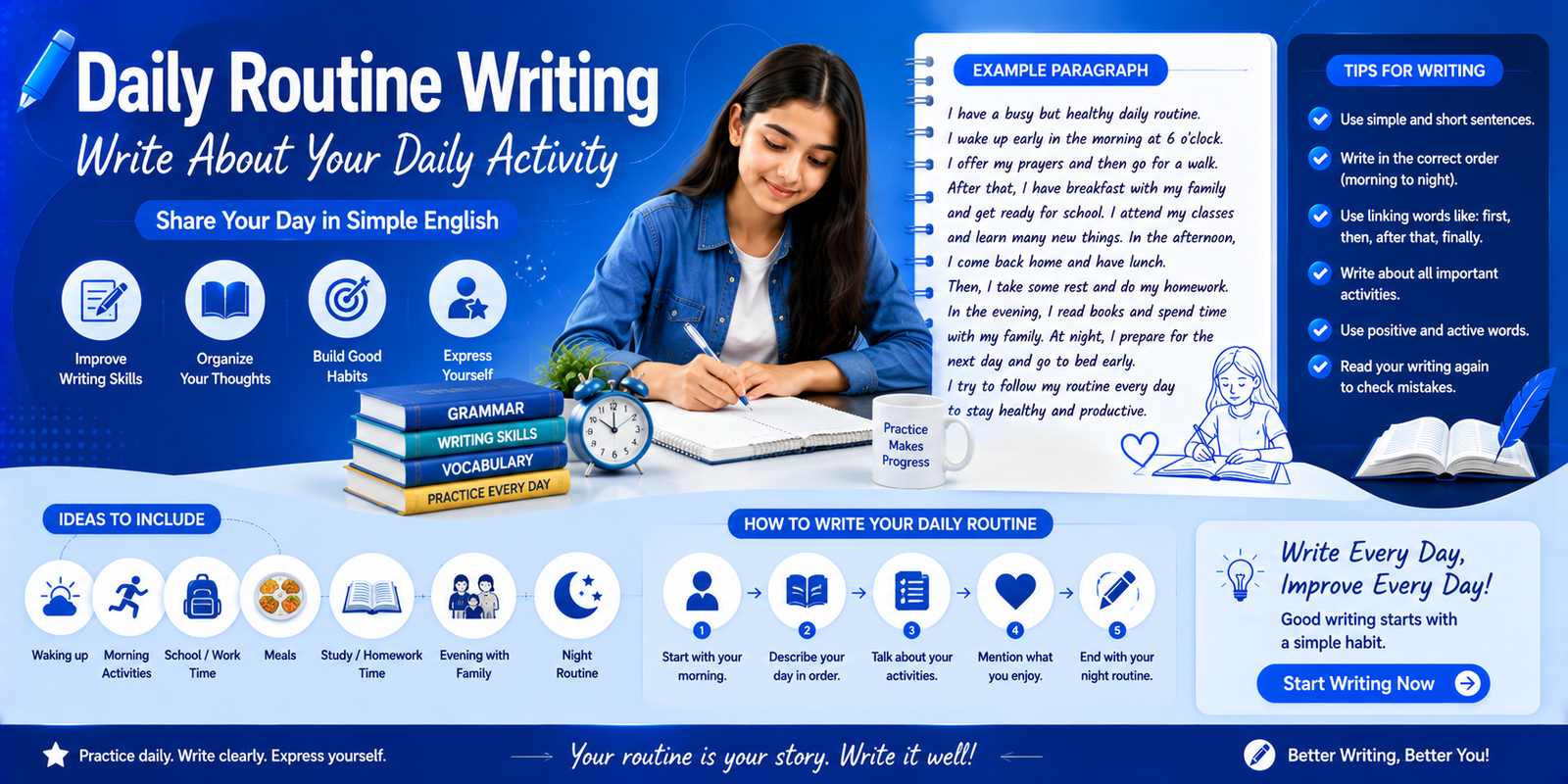
Daily Routine Writing
Describing Your Day Using Simple, Clear, and Meaningful English
Introduction
One of the most practical and frequently used skills in everyday English communication is the ability to describe your daily routine. Whether you are speaking to a new friend, writing a journal entry, sharing your lifestyle on a blog or website profile, or answering an interview question, talking about what you do every day is essential.
When writing about your daily routine, the secret to clarity lies in using short, meaningful sentences and the Present Simple tense because daily routines are habits, facts, and repeated actions.
🎯 Main Focus
Learn how to describe your everyday activities in a clear, natural, and organized way.
📝 Grammar Focus
Practice the Present Simple tense when talking about habits and repeated actions.
This comprehensive lesson covers essential time-transition vocabulary, core sentence structures, step-by-step paragraph construction, and multiple variations to help you write a natural and engaging account of your daily life in English.
Essential Time-Transition Vocabulary
To make your daily routine flow smoothly from morning to night, you need transition words and phrases that show the order of events. Without these, your sentences will feel disconnected.
🌅 A. Morning Transitions
- First of all / To start with: Used right after waking up.
- Early in the morning: For actions happening at dawn or right after waking.
- Then / Next: To move to the next sequential action.
- After that: To show completion of one task before starting another.
🌇 B. Afternoon and Evening Transitions
- In the afternoon / Around noon: For midday activities.
- Later on / Afterwards: To bridge mid-day and evening tasks.
- In the evening: For post-work or post-school relaxation.
- Finally / Before going to bed: For concluding your day.
Core Sentence Patterns for Daily Routines
Daily routine writing relies heavily on the Present Simple tense. Remember that when using third-person singular (he, she, it), you add an -s or -es to the verb.
For writing about your own day, use the first-person pronoun I.
🌅 Pattern A: Waking Up and Morning Grooming
☕ Pattern B: Meals and Commuting
💻 Pattern C: Work, Study, and Productivity
🌙 Pattern D: Evening Relaxation and Sleep
Step-by-Step Construction: Building the Paragraph
Let us build a complete daily routine paragraph step-by-step. We will follow a chronological timeline: Morning → Afternoon → Evening → Night .
The Morning Routine
Breakfast and Starting Work
The Afternoon Schedule
Evening and Bedtime Routine
"I usually wake up early at 6:00 AM. After getting out of bed, I freshen up, drink a glass of water, and take a quick morning walk to stay active. At 7:30 AM, I enjoy a healthy breakfast with my family. Afterward, I sit at my desk, check my daily schedule, and begin my work as a digital creator and educator. I spend my afternoon focused on important tasks, such as writing English lessons, building website features, and responding to messages. At 1:30 PM, I take a break for lunch and rest for a short while. In the evening, I wrap up my work and spend quality time with my family. Before going to bed around 10:30 PM, I read a few pages of a book to relax my mind."
Different Lifestyles and Variations
Your daily routine depends entirely on your lifestyle. Here are two alternative examples showing how to adapt your writing.
A. The Student Routine
"My day begins at 6:30 AM on weekdays. I get dressed in my school uniform, eat a quick breakfast, and catch the bus to school. Classes run from 8:00 AM until 2:00 PM. When I return home, I eat lunch, take a brief nap, and spend my evening completing my homework and studying for upcoming exams."
B. The Weekend Routine
"Weekends are much more relaxed for me. I usually wake up a bit later, around 8:00 AM. Instead of working, I spend my time pursuing personal hobbies, cleaning my room, meeting up with friends, or going out for a nice dinner. It is a wonderful way to recharge for the coming week."
Quick Reference Checklist
Before you finalize your daily routine text, review it against these essential guidelines:
Example: I work, I eat, I sleep.
First, then, after that, in the evening.
Avoid overly complex or tangled clauses.
Check sentence beginnings and proper full stops.
Practical Practice Exercise
Use the template below to draft your own personal daily routine in your notebook or text editor.
📝 My Daily Routine Template
🎯 Conclusion
Writing about your daily routine is an exceptional exercise in English sentence structure, time management vocabulary, and present-tense consistency. By breaking your day down into clear phases—morning, afternoon, and evening—you can craft a smooth, engaging paragraph that vividly describes your everyday life. Practice writing your schedule today, and watch your fluency grow!