
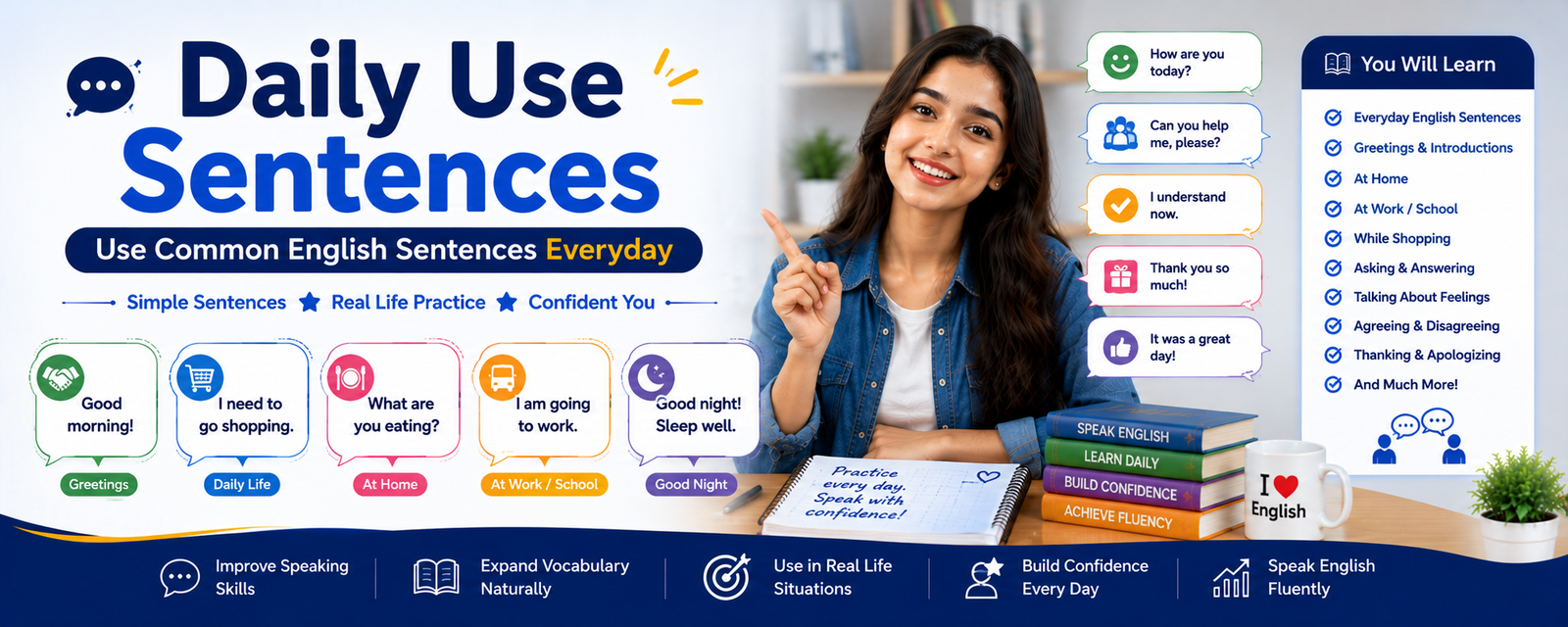
Daily Use Sentences
In this lesson, you'll learn the most common English sentences used in everyday life. Practice useful expressions for greetings, conversations, shopping, school, work, travel, and daily situations to improve your spoken English naturally and confidently.
Duration
Approximately 20 Minutes
Lesson Goal
Learn and confidently use common English sentences in everyday conversations.
Skill Focus
Speaking, Listening & Everyday Communication
Real-Life Use
Home, school, office, shopping, travel, restaurants, and social conversations.
What You'll Learn
100+ useful English sentences for daily situations with practical examples.
Difficulty Level
Beginner Friendly with simple, natural, and easy-to-understand English.
Daily Use Sentences
What Are Daily Use Sentences?
Daily use sentences are simple English sentences that people use in everyday conversations. These sentences help us communicate naturally in different situations such as at home, school, college, the workplace, shopping malls, restaurants, hospitals, airports, and while traveling. Learning daily use sentences is one of the fastest ways to improve your spoken English because they are used repeatedly in real-life situations.
Many English learners spend years studying grammar rules and memorizing vocabulary, but they still struggle to speak English fluently. The main reason is that they do not practice the sentences that native speakers use every day. Instead of translating from your native language, learning complete English sentences helps you think and speak more naturally.
Whether you are a beginner or an intermediate learner, mastering daily use sentences will increase your confidence and help you communicate more effectively in personal, academic, and professional situations.
Good morning! How are you today?
Can you help me, please?
Thank you very much.
You're welcome.
Have a wonderful day.
Why Should You Learn Daily Use Sentences?
Learning English through daily use sentences is much more practical than memorizing isolated words. Every sentence teaches vocabulary, grammar, pronunciation, and sentence structure at the same time. This makes learning easier and more enjoyable.
When you practice useful English sentences every day, your brain starts recognizing common patterns. As a result, you begin speaking English more quickly and naturally without translating every sentence.
Benefits of Learning Daily Use Sentences
- Improve spoken English naturally.
- Build confidence in conversations.
- Learn practical vocabulary.
- Understand sentence patterns.
- Speak more fluently.
- Reduce hesitation while speaking.
- Improve listening skills.
- Communicate confidently with others.
- Prepare for interviews and presentations.
- Use English in everyday life.
Where Can You Use Daily Use Sentences?
Daily use sentences are useful almost everywhere. From morning until night, we use hundreds of simple English sentences without even realizing it. Learning these expressions helps you communicate comfortably in different situations.
| Situation | Examples |
|---|---|
| Home | Good morning. Breakfast is ready. |
| School | May I come in? |
| Office | Can we start the meeting? |
| Shopping | How much does this cost? |
| Restaurant | I'd like to order food. |
| Travel | Where is the nearest bus stop? |
| Hospital | I need to see a doctor. |
Categories of Daily Use Sentences
Instead of trying to learn hundreds of random sentences, it is better to study them by category. This makes learning organized and helps you remember sentences more easily.
Common Categories
- Greetings
- Introducing Yourself
- Asking Questions
- Home Conversations
- School English
- Office Communication
- Shopping Sentences
- Restaurant English
- Travel English
- Telephone Conversations
- Emergency Expressions
- Daily Routine Sentences
Study one category every day instead of trying to memorize everything at once. Daily practice helps you remember sentences for a longer time.
Most Common Daily Use Sentences
The following sentences are among the most frequently used English expressions. You will hear these in homes, schools, workplaces, and public places every day.
| English Sentence | When to Use |
|---|---|
| Good morning. | Greeting someone in the morning. |
| How are you? | Starting a conversation. |
| I'm fine, thank you. | Responding politely. |
| What's your name? | Meeting someone new. |
| Nice to meet you. | First meeting. |
| Please sit down. | Inviting someone to sit. |
| Excuse me. | Getting someone's attention. |
| Thank you very much. | Showing gratitude. |
| You're welcome. | Replying politely. |
| Have a nice day. | Ending a conversation. |
Tips to Learn Daily Use Sentences Faster
Learning daily use sentences does not require special talent. It simply requires regular practice and consistency. The more you use English in real conversations, the faster you improve.
- Practice every day.
- Read sentences aloud.
- Listen to native speakers.
- Use new sentences in conversations.
- Keep a notebook of useful expressions.
- Watch English videos with subtitles.
- Speak in front of a mirror.
- Record your voice.
- Review old sentences regularly.
- Don't be afraid of making mistakes.
Daily Practice Challenge
Learn five new sentences every day and use them in real conversations. In just one month, you'll know more than 150 useful English sentences that you can confidently use in everyday life.
Common Mistakes Beginners Make
Many learners translate directly from their native language instead of thinking in English. Others memorize sentences without practicing them. The best way to become fluent is to understand the meaning of each sentence and use it naturally in different situations.
- Translating every sentence.
- Learning without speaking.
- Ignoring pronunciation.
- Not practicing daily.
- Using difficult vocabulary unnecessarily.
Daily Use Sentences for Morning Conversations
The morning is the beginning of a new day, and we use many common English sentences to greet family members, friends, classmates, and colleagues. Learning these sentences will help you start conversations naturally and confidently.
Good morning.
Did you sleep well?
Have a great day.
Breakfast is ready.
Let's get started.
Are you ready for school?
Don't forget your bag.
See you later.
Daily Use Sentences at Home
Home is where we use English naturally with family members every day. These simple sentences are easy to remember because they are part of our daily routine.
| English Sentence | Usage |
|---|---|
| Can you help me? | Asking for help. |
| Please close the door. | Giving a polite request. |
| Dinner is ready. | Calling family members. |
| Where are my keys? | Looking for something. |
| I'm going out. | Leaving home. |
| I'll be back soon. | Telling someone you'll return. |
Useful Home Expressions
- Could you open the window?
- Please turn off the lights.
- It's time to eat.
- Let's clean the room.
- Can you answer the door?
- I'm watching television.
- Please be careful.
- Everything is ready.
Daily Use Sentences at School
Students use many English sentences every day in classrooms. Learning these expressions helps improve communication with teachers and classmates.
May I come in?
Can I ask a question?
I don't understand.
Could you explain it again?
May I borrow your pen?
I have completed my homework.
Thank you, teacher.
See you tomorrow.
| Situation | Sentence |
|---|---|
| Entering Class | May I come in? |
| Asking Permission | May I go outside? |
| Answering Teacher | Yes, I understand. |
| Leaving Class | Goodbye, teacher. |
Daily Use Sentences at the Office
Professional communication is important in every workplace. Speaking politely creates a positive impression and helps build better relationships with colleagues and clients.
Good morning, everyone.
Can we start the meeting?
I'll send you the report.
Please check your email.
Thank you for your support.
Let's discuss this later.
I appreciate your help.
Have a productive day.
Professional Communication Tips
- Be polite.
- Speak clearly.
- Use professional language.
- Listen carefully.
- Respect everyone's opinions.
Daily Use Sentences While Shopping
Shopping is one of the most common situations where English is used. These simple expressions help you communicate confidently with shopkeepers and sales staff.
| English Sentence | Purpose |
|---|---|
| How much is this? | Asking the price. |
| Can I try this on? | Trying clothes. |
| Do you have another size? | Requesting a different size. |
| I'll take this. | Buying something. |
| Can I pay by card? | Making payment. |
| Thank you. | Showing gratitude. |
Customer: Excuse me. How much is this shirt?
Shopkeeper: It's twenty dollars.
Customer: Do you have a larger size?
Shopkeeper: Yes, here you are.
Customer: Great. I'll take it.
Daily Use Sentences at a Restaurant
Restaurants are another place where useful English expressions are used every day. Learning these sentences makes ordering food much easier.
- A table for two, please.
- May I see the menu?
- I'd like to order.
- Could I have some water?
- The food is delicious.
- Can I have the bill, please?
- Thank you for your service.
- Have a nice day.
Practice Challenge
Choose ten sentences from each category and practice them aloud every day. Use them with your friends or family whenever possible. Speaking regularly is the fastest way to improve your English communication skills.
How to Remember Daily Use Sentences
Instead of memorizing hundreds of sentences at once, learn them step by step. Repeat each sentence several times, understand its meaning, and use it in real conversations. This method improves both fluency and confidence.
- Learn five new sentences daily.
- Review old sentences every week.
- Practice speaking with a partner.
- Watch English conversations.
- Think in English instead of translating.
- Use sentences in your daily routine.
- Record yourself speaking.
- Keep practicing consistently.
Daily Use Sentences for Traveling
Traveling is one of the best opportunities to practice English in real-life situations. Whether you are at an airport, railway station, hotel, or asking for directions, knowing common English sentences makes your journey easier and more enjoyable. These expressions help you communicate confidently with people from different countries.
Excuse me, where is the airport?
Can you help me, please?
How much is the ticket?
Which platform should I go to?
I have a reservation.
Could you show me the way?
Thank you for your help.
Have a safe journey.
| Situation | Useful Sentence |
|---|---|
| Airport | Where is the check-in counter? |
| Bus Station | When does the next bus leave? |
| Hotel | I have booked a room. |
| Taxi | Please take me to this address. |
| Asking Directions | Could you tell me how to get there? |
Daily Use Sentences on the Phone
Telephone conversations are different from face-to-face conversations because the other person cannot see your facial expressions or body language. Speaking politely and clearly is very important during phone calls.
Hello, this is Ali speaking.
May I speak to Mr. Ahmed?
Please hold for a moment.
I'll call you back later.
The line is not clear.
Could you repeat that, please?
Thank you for calling.
Have a nice day.
Daily Use Sentences at the Hospital
Knowing basic English sentences related to health and medical emergencies can be extremely helpful. These expressions are commonly used when visiting a doctor, hospital, or pharmacy.
| Situation | Sentence |
|---|---|
| Doctor | I need to see a doctor. |
| Reception | I have an appointment. |
| Medicine | Where is the pharmacy? |
| Pain | I don't feel well. |
| Emergency | Please call an ambulance. |
Doctor: How are you feeling today?
Patient: I have a headache.
Doctor: How long have you had it?
Patient: Since yesterday.
Doctor: I'll prescribe some medicine.
Daily Use Sentences at the Bank
Banks are another place where practical English is useful. Whether you want to open an account, deposit money, or ask for information, these common sentences will help you communicate confidently.
- I would like to open a bank account.
- I want to deposit some money.
- I would like to withdraw cash.
- Can you help me fill out this form?
- What documents do I need?
- Thank you for your assistance.
Daily Use Sentences in the Office
Professional communication plays an important role in every workplace. Speaking politely helps build trust and respect among colleagues and clients.
Could you send me the report?
Let's schedule a meeting.
I'll finish this task today.
Thank you for your support.
Please let me know if you need anything.
I appreciate your feedback.
Practice Dialogues
Dialogue 1 – At the Airport
Traveler: Excuse me, where is Gate 5?
Staff: Go straight and turn left.
Traveler: Thank you very much.
Staff: You're welcome.
Dialogue 2 – At a Restaurant
Customer: May I see the menu, please?
Waiter: Certainly. Here you are.
Customer: I'd like to order grilled chicken.
Waiter: Excellent choice.
Dialogue 3 – Phone Call
Ali: Hello, this is Ali speaking.
Ahmed: Hi Ali. How are you?
Ali: I'm doing well. Thank you.
Ahmed: Great. I'll see you tomorrow.
Tips to Speak Daily Use Sentences Naturally
- Practice speaking every day.
- Use English with friends.
- Watch English videos regularly.
- Listen carefully to native speakers.
- Learn sentences instead of individual words.
- Think in English.
- Repeat sentences aloud.
- Improve your pronunciation.
- Don't fear making mistakes.
- Stay confident and consistent.
Remember
Fluent English is built through daily practice. Learning just five useful sentences every day can completely transform your communication skills within a few months. Consistency is far more important than studying for many hours only once in a while.
Common Mistakes When Learning Daily Use Sentences
Many English learners spend months memorizing vocabulary but still find it difficult to speak naturally. The biggest reason is that they focus on individual words instead of complete sentences. Learning useful sentence patterns helps you communicate more confidently in real-life situations.
Avoiding common mistakes will help you improve your spoken English much faster.
| Common Mistake | Better Approach |
|---|---|
| Memorizing words only | Learn complete sentences. |
| Translating from your native language | Think directly in English. |
| Not practicing aloud | Speak every day. |
| Ignoring pronunciation | Listen and repeat. |
| Being afraid of mistakes | Practice confidently. |
| Studying without revision | Review sentences regularly. |
Remember, fluency comes through repetition. Every sentence you practice today becomes part of your natural English tomorrow.
30-Day Daily Practice Plan
A simple daily routine can significantly improve your speaking confidence. You don't need to study for many hours—just practice consistently.
| Daily Activity | Time |
|---|---|
| Learn 5 new sentences | 10 Minutes |
| Read aloud | 10 Minutes |
| Practice speaking | 15 Minutes |
| Listen to English conversations | 10 Minutes |
| Review old sentences | 10 Minutes |
Frequently Asked Questions (FAQs)
1. What are daily use sentences?
They are common English sentences used in everyday conversations.
2. Why are daily use sentences important?
They help you communicate naturally and improve your spoken English.
3. How many sentences should I learn every day?
Learning five to ten useful sentences daily is a great starting point.
4. Should I memorize or understand the sentences?
You should understand their meaning and practice using them in real conversations.
5. Can beginners learn daily use sentences?
Yes. They are one of the easiest and most effective ways to start speaking English.
6. How long does it take to improve?
With daily practice, most learners notice improvement within a few weeks.
7. Is pronunciation important?
Yes. Clear pronunciation helps people understand you more easily.
8. Can I use these sentences at work?
Absolutely. Many daily use sentences are suitable for professional communication.
9. What is the best way to remember them?
Practice them aloud, use them daily, and review them regularly.
10. How can I become fluent?
Stay consistent, practice speaking every day, and don't be afraid of making mistakes.
Key Takeaways
- Daily use sentences improve your spoken English faster than learning individual words.
- Practice speaking every day to build confidence.
- Learn complete sentence patterns instead of isolated vocabulary.
- Use English in real-life situations whenever possible.
- Review old sentences regularly to strengthen your memory.
- Focus on clear pronunciation and natural communication.
- Consistency is more important than studying for long hours occasionally.
Suggested Internal Links
- Greetings & Introductions
- Self Introduction
- Common English Phrases
- Basic English Conversation
- Everyday Vocabulary
- English Speaking Practice
- Question Words in English
- Polite Expressions
Suggested External Authority Sources
- Cambridge Dictionary
- Oxford Learner's Dictionaries
- BBC Learning English
- British Council Learn English
- Merriam-Webster Dictionary
Final Thoughts
Learning daily use English sentences is one of the smartest ways to become a confident English speaker. Every conversation you have begins with simple words and everyday expressions. By practicing useful sentences regularly, you train your brain to think in English instead of translating from your native language.
Start with just a few sentences each day. Repeat them aloud, use them with friends and family, and apply them in real-life situations. Over time, these small daily efforts will become natural habits, helping you speak English more fluently and confidently.
Remember, fluency is not about using difficult vocabulary. It is about communicating clearly, naturally, and confidently. Stay consistent, keep practicing, and enjoy your English learning journey.