
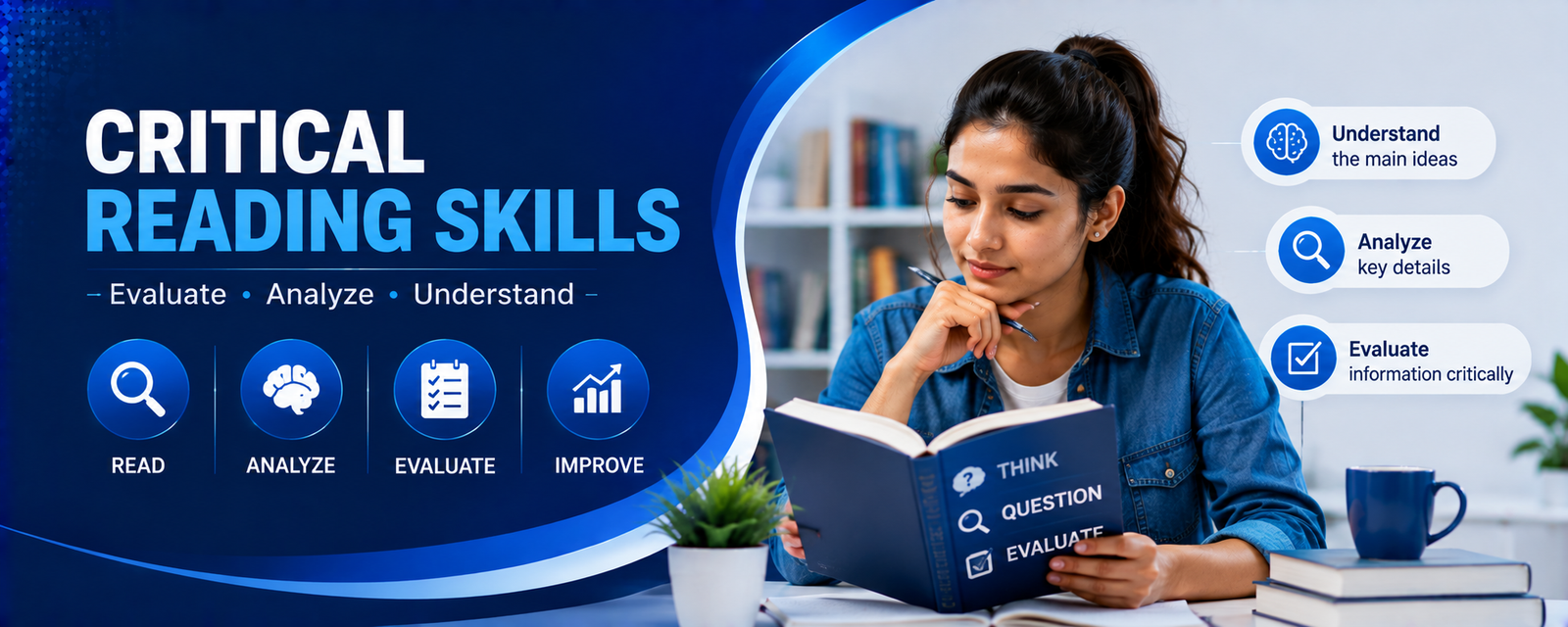
Critical Reading Skills
Evaluate information, recognize bias, analyze arguments, and develop stronger analytical reading skills.
Evaluating Information & Improving Analytical Reading
Welcome to your intermediate-level masterclass on Critical Reading. Critical reading goes beyond understanding words and summarizing a text. It means questioning assumptions, examining evidence, recognizing bias, and understanding how an author builds an argument.
Moving from Passive Reading to Critical Analysis
To read critically, shift your mindset from being a receiver of information to becoming an investigator of ideas.
Passive Reading
Absorbing text linearly, accepting assertions at face value, and focusing primarily on what the author is saying.
Critical Reading
Interrogating the text, evaluating evidence, questioning motives, and focusing on why and how the author constructs an argument.
Become an Investigator
Instead of immediately accepting information, ask questions about its evidence, purpose, reliability, assumptions, and conclusions.
Analysis
Break the text into its core components: thesis, claims, evidence, and counterarguments.
Evaluation
Assess the validity, relevance, quality, and sufficiency of the evidence.
Synthesis
Connect the author's ideas with your existing knowledge and other sources.
Dissecting the Anatomy of an Argument
Every persuasive text has an underlying structure. Critical readers learn to identify the elements supporting the author's conclusion.
The Main Thesis
The central claim or overarching argument the author wants the reader to accept.
Premises & Evidence
Supporting data, logical deductions, statistics, research findings, or expert testimony used to support the thesis.
Implicit Assumptions
Unspoken beliefs that the author takes for granted when constructing the argument.
Warrants
The logical bridges connecting evidence to a conclusion. Ask whether the evidence really supports the claim.
Evaluating Information and Detecting Bias
In an era of information overload, evaluating credibility is one of your strongest defenses against misinformation, propaganda, and flawed reasoning.
The CRAAP Test
Currency
Is the information current, or has newer research replaced it?
Relevance
Does the source directly address your question?
Authority
Who wrote it, and what expertise or credentials do they have?
Accuracy
Can the information be verified and supported by reliable sources?
Purpose
Was the text created to inform, persuade, entertain, or monetize?
Recognizing Bias & Framing
Confirmation Bias
Notice when a source selectively highlights information supporting an existing narrative while ignoring contradictory evidence.
Loaded Language
Watch for emotionally powerful words designed to influence the reader's reaction rather than present information neutrally.
Missing Context
Ask what has been left out. A statistic can be mathematically true while still creating a misleading impression without context.
Common Logical Fallacies to Watch For
Complex texts can contain weaknesses in reasoning. Learning common logical fallacies helps you identify arguments that sound convincing but lack proper support.
| Fallacy | Definition | Example |
|---|---|---|
| Straw Man | Misrepresenting another person's argument to make it easier to attack. | “We should upgrade public transit.” → “So you want to bankrupt the city building trains nobody will ride?” |
| Ad Hominem | Attacking the character or motives of the person making an argument instead of addressing the argument itself. | “Dr. Smith's climate report is wrong because she accepted a grant from an environmental fund.” |
| False Dilemma | Presenting only two options when several alternatives may actually exist. | “Either we cut all corporate regulations, or our economy will completely collapse.” |
| Slippery Slope | Claiming that a relatively small action will inevitably lead to a disastrous chain of events without sufficient evidence. | “If we allow cell phones in middle school classrooms, students will never learn to read books.” |
Practical Application: The Annotation Workflow
To master analytical reading, change the way you physically interact with a text. Do not simply read—mark important ideas, questions, evidence, and weaknesses.
Previewing
Scan the headings, introduction, and conclusion before reading every sentence. Build a mental map of the text.
Marginal Coding
Use a simple shorthand system while reading to identify questions, insights, evidence, and unfamiliar vocabulary.
Post-Reading Reconstruction
Close the text and write a three-sentence synthesis in your own words. Identify the author's goal, strongest evidence, and weakest point.
Your 3-Sentence Critical Reading Check
What was the author's goal? What was the strongest piece of evidence? Where did the argument fall short?
Ready to Read More Critically?
Apply these analytical frameworks to academic articles, opinion journalism, corporate reports, research papers, and other complex texts to become a more confident and thoughtful English reader.