
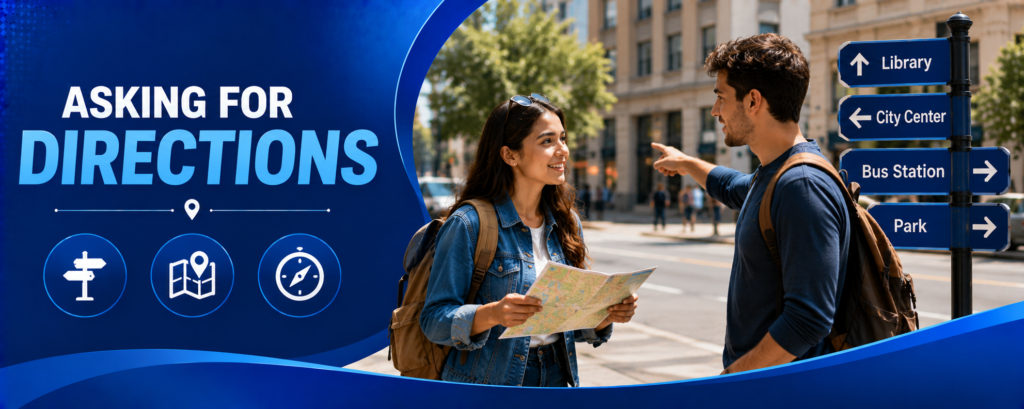
Beginner Mastery: Asking and Understanding Directions in English
How to Navigate Any City and Find Your Way with Absolute Confidence
Stepping out into a new city, exploring a bustling neighborhood, or visiting an English-speaking country for the very first time is an exhilarating adventure.
However, there is one moment that every traveler and language learner eventually faces: realizing you are not entirely sure where you are, or how to get to where you want to go. When you need help, the thought of walking up to a stranger and saying, "Excuse me..." can cause a sudden wave of hesitation. You might wonder: Will they speak too fast? Will I understand their answer? What if I take a wrong turn?
Here is the wonderful secret that will instantly calm your nerves: asking for and giving directions follows a predictable, polite script. People are almost always kind and eager to help lost travelers, and they use the same core set of directional words and phrases every single day.
This comprehensive masterclass is designed specifically for beginner English learners. We will break down how to politely approach strangers, master essential landmark and movement vocabulary, understand directional instructions, and practice real-world dialogues so you can navigate any city with absolute confidence.
1. The Anatomy of Asking for Directions
Navigating an unfamiliar area successfully involves a smooth four-step conversational flow:
- Phase 1: Polite Interruption: Getting someone's attention respectfully without startling them.
- Phase 2: Stating Your Destination: Clearly asking where a specific place, building, or landmark is located.
- Phase 3: Listening to Instructions: Understanding key directions like turn left, go straight, or walk past the park.
- Phase 4: Confirmation and Gratitude: Verifying you understood correctly and thanking your helper warmly.
2. Phase 1: Polite Interruption and Opening
Before you ask for anything, you must interrupt a stranger politely. Never walk up and start speaking immediately. Always use a soft greeting and an apologetic opener.
Essential Opening Phrases
- "Excuse me, hello! Do you speak English?" (Great if you are in a foreign country)
- "Excuse me, sorry to bother you."
- "Hello! Could you please help me for a moment?"
- "Pardon me, I am a bit lost."
Starting with "Excuse me" or "Pardon me" signals to the person that you are polite, friendly, and respectful of their time.
3. Phase 2: Stating Your Destination
Once you have their attention, state clearly what place you are looking for. Use simple sentence structures starting with "Where is..." or "How do I get to...".
Core Question Patterns
- "Excuse me, where is the nearest subway station?"
- "Could you tell me how to get to Central Park?"
- "I am looking for the main post office. Is it far from here?"
- "Where can I find a good coffee shop around here?"
4. Phase 3: Understanding Directional Instructions
When the person answers, they will give you instructions. To understand them, you need to master essential movement verbs, directional commands, and landmark vocabulary.
A. Movement and Action Verbs
- Go straight: Continue moving forward without turning.
- Turn left: Pivot or angle your body to the left side.
- Turn right: Pivot or angle your body to the right side.
- Walk past: Keep walking until you go beyond a specific building or object.
- Cross the street: Walk from one side of the road to the other safely.
B. Common Landmarks and City Words
- Traffic lights: The red, yellow, and green signal lights at an intersection.
- Intersection / Corner: Where two or more streets meet.
- Crosswalk: The painted striped lines on the road where pedestrians cross.
- Block: The distance between one street and the next.
- Opposite: Directly across from something.
- Next to / Beside: Directly beside something.
C. Distance Indicators
- It is right around the corner (It is very close)
- It is about a five-minute walk (It will take a short walk to reach it)
- It is too far to walk; you should take a bus (The distance is long)
5. Phase 4: Confirming and Saying Thank You
Before walking away, it is always smart to repeat the core direction back to the person to ensure you understood correctly.
Confirmation Phrases
- "So, I go straight, turn left at the traffic lights, and it is on my right. Is that correct?"
- "Just to make sure—turn right at the corner, walk one block, and it is beside the bank?"
Expressing Gratitude
- "Thank you so much for your help! Have a wonderful day."
- "I really appreciate it. Thanks again!"
6. Comprehensive Realistic Dialogues
Dialogue A: Finding a Coffee Shop in a Busy City
Tourist: "Excuse me, hello! Sorry to bother you."
Local Resident: "Hello! No problem at all. How can I help you?"
Tourist: "I am looking for a nice coffee shop around here. Do you know where one is?"
Local Resident: "Yes, absolutely! There is a fantastic cafe just two blocks away. Do you know the grand bookstore on the corner?"
Tourist: "Um, I am not sure. I just came from the train station."
Local Resident: "No worries. From here, walk straight down this street until you reach the traffic lights."
Tourist: "Okay, walk straight to the traffic lights. Got it."
Local Resident: "Right. Then, turn left at the traffic lights. Walk past the big hotel, and you will see the cafe right beside a flower shop. You cannot miss it!"
Tourist: "Wonderful! Turn left at the traffic lights, walk past the hotel, and it is beside the flower shop."
Local Resident: "Exactly! It is about a five-minute walk."
Tourist: "Thank you so much for your kindness. Have a great day!"
Local Resident: "You are very welcome! Enjoy your coffee. Goodbye!"
Dialogue B: Looking for a Subway Station
Traveler: "Pardon me, excuse me! Could you please help me?"
Passerby: "Sure! What do you need?"
Traveler: "I need to find the nearest subway station. My map is not working."
Passerby: "Ah, your phone battery probably died. The closest subway station is the Central Station. It is pretty close."
Traveler: "How do I get there from here?"
Passerby: "Walk down this block, and cross the street at the crosswalk. Then, take your first right."
Traveler: "Cross the street, and take my first right. Okay."
Passerby: "Walk straight for about three minutes. You will see a large bank on your left. The subway entrance is right opposite the bank, down some stairs."
Traveler: "Perfect! Cross the street, take a right, walk past the bank, and the entrance is opposite it."
Passerby: "Spot on! You will be there in no time."
Traveler: "Thank you sincerely. You saved my day!"
Passerby: "Happy to help. Safe travels!"
7. Essential Directions Vocabulary Reference Table
| English Term | Part of Speech | Clear Definition / Meaning | Practical Example Sentence |
|---|---|---|---|
| Straight ahead | Adverbial Phrase | Continuing forward in a direct line without turning. | "Walk straight ahead for two blocks." |
| Turn left / right | Verb Phrase | Changing your walking direction to the left or right side. | "Turn right at the grocery store." |
| Intersection | Noun | The point where two or more roads cross each other. | "Wait for the green light at the intersection." |
| Crosswalk | Noun | Designated lines on the street for pedestrians to cross. | "Always use the crosswalk to cross safely." |
| Block | Noun | The solid section of a city between two connecting streets. | "My hotel is just one block down." |
| Opposite | Preposition | Located directly across from something else. | "The post office is opposite the library." |
| Landmark | Noun | A prominent, easily recognizable building or object. | "Use the clock tower as your main landmark." |
| Lost | Adjective | Unable to find your way or your destination. | "Excuse me, I think I am lost." |
8. Practical Speaking Strategies for Beginners
1. Speak Slowly and Clearly
Take a deep breath and speak at a calm, steady pace. Clear pronunciation matters much more than speed.
2. Show Your Map or Phone
Point to your phone screen or a paper map and ask: "Excuse me, how do I walk to this location?" Visual aids bridge language gaps instantly.
3. Repeat Instructions Back
Always repeat directions in your own words ("So, turn left at the bank?") to confirm understanding and allow correction.
4. Practice Solo Role-Play
Rehearse physical movements and phrases out loud to train your brain to respond automatically when outside.
9. Comprehensive Practice Exercise
Personalized Navigation Script Exercise
Scenario: Imagine you are standing outside your home or office, and a tourist asks you how to walk to the nearest grocery store or park. Write a 4-step conversational script containing:
- The Polite Opening: How you respond when someone says "Excuse me".
- The Starting Point: Where the person is starting from.
- The Directions: At least three clear movement instructions (e.g., go straight, turn left, walk past a landmark).
- The Conclusion: How you wish them a good trip and say goodbye.
Conclusion
Asking for and understanding directions in English is no longer a stressful hurdle; it is an exciting way to explore the world and connect with people. By mastering polite opening phrases, learning essential movement verbs and landmarks, repeating instructions back to your helper, and maintaining a calm, confident attitude, you can navigate any city on earth with absolute ease. Keep your sentences short and clear, practice your dialogues out loud, and enjoy exploring every new path you take!