
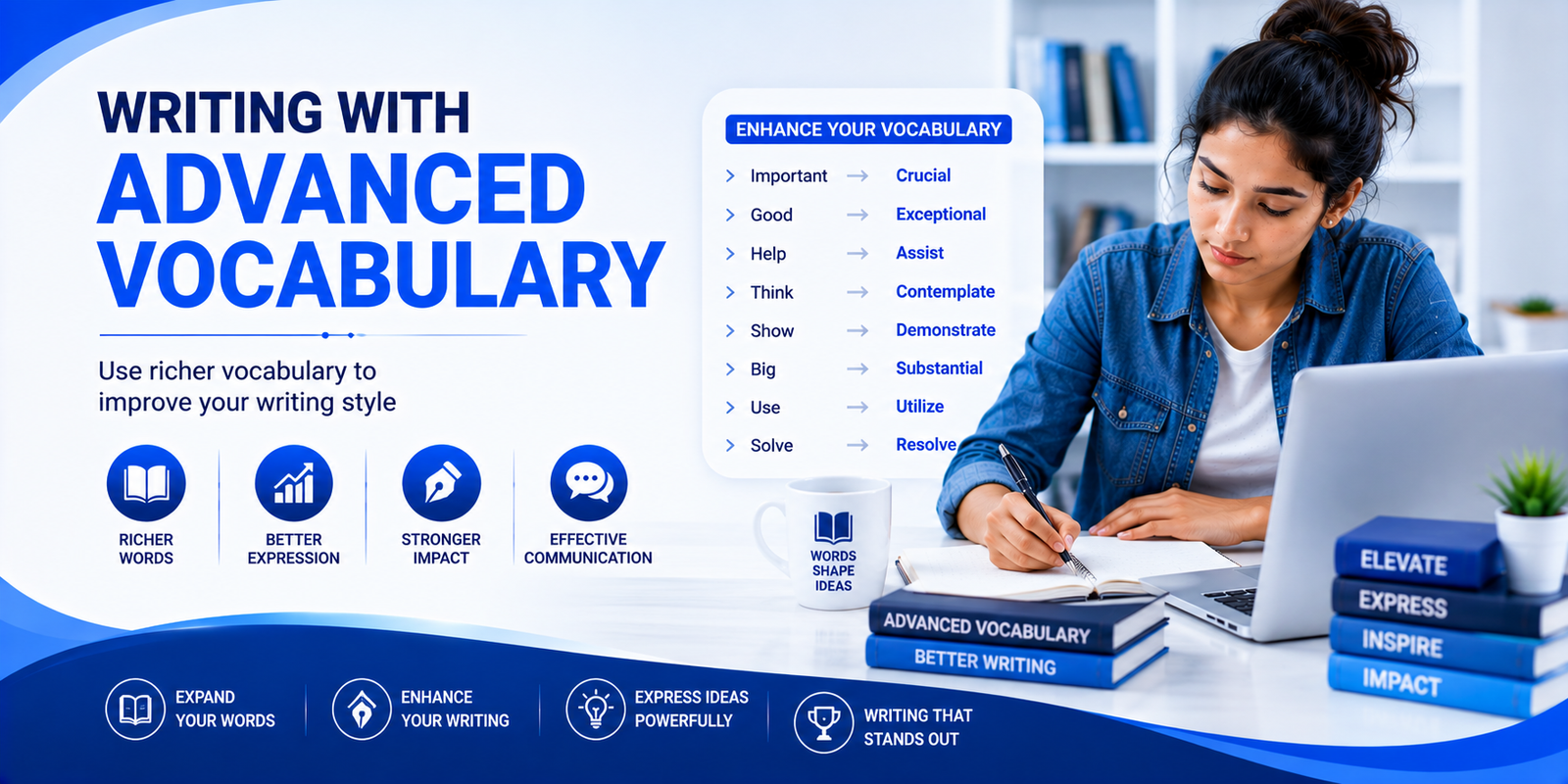
Elevating Your Prose with Advanced Vocabulary
Learn how to use advanced vocabulary with precision, nuance, and impact to create clearer, richer, and more authoritative writing.
Vocabulary Is More Than Difficult Words
Strong vocabulary is not about sounding complicated. It is about choosing the exact word that communicates your meaning clearly and effectively.
The Philosophy of Advanced Vocabulary
Professional writers focus on precision, active vocabulary, and subtle differences in meaning.
Precision Over Pompousness
Advanced writing should prioritize clarity. A simple word used accurately is stronger than a complex word used incorrectly.
The sudden shift in teaching methods confused the students.
Passive vs. Active Vocabulary
Passive vocabulary includes words you recognize. Active vocabulary consists of words you can naturally use in speaking and writing.
Move useful words from recognition into everyday communication.
Shades of Nuance
Similar words can carry very different emotional meanings. Understanding connotation helps you select the right expression.
Thrifty suggests smart spending; stingy suggests unwillingness to spend.
Upgrade Your Core Verbs
Strong verbs make writing more precise and reduce dependence on weak adverbs and vague expressions.
Eliminate Weak Intensifiers
Instead of relying on “very,” choose one precise adjective that carries the meaning more powerfully.
| Weak Phrase | Advanced Alternative | Contextual Example |
|---|---|---|
| Very tired | Exhausted, fatigued, drained | After the twelve-hour shift, she felt utterly drained. |
| Very angry | Livid, indignant, incensed | The client was incensed by the billing error. |
| Very smart | Astute, discerning, brilliant | His astute analysis caught the discrepancy. |
| Very clear | Explicit, lucid, unambiguous | The manager provided lucid instructions. |
| Very bad | Detrimental, deplorable, pernicious | The policy had a pernicious effect on morale. |
Expand Noun & Adjective Precision
Use precise abstract nouns and descriptive adjectives to express complex ideas with greater authority.
Ambiguity
Uncertainty or lack of clarity in meaning or intention.
Pragmatism
A practical approach based on realistic outcomes rather than theory.
Catalyst
Something that causes or accelerates significant change.
Meticulous
Showing great attention to detail and accuracy.
Ubiquitous
Present, appearing, or found almost everywhere.
Ephemeral
Existing or lasting for only a short period of time.
“Advanced vocabulary should make your ideas more precise — not make your writing harder to understand.”
Core principle of effective vocabulary developmentThe Vocabulary Integration Workflow
Don't simply memorize advanced words. Integrate them into your active vocabulary through repeated, meaningful use.
Encounter & Contextualize
Study advanced words in real sentences and observe how they interact with surrounding language.
Keep a Lexical Journal
Record the word, definition, part of speech, and your own original sentence.
Follow the Rule of Three
Use each new word three times in different contexts within 48 hours.
Edit for Balance
Avoid the thesaurus trap. Combine precise vocabulary with natural, straightforward language.
Put Your New Vocabulary Into Practice
Take a paragraph you have already written and replace basic, repetitive vocabulary with precise and meaningful alternatives.
Start Writing Practice →