
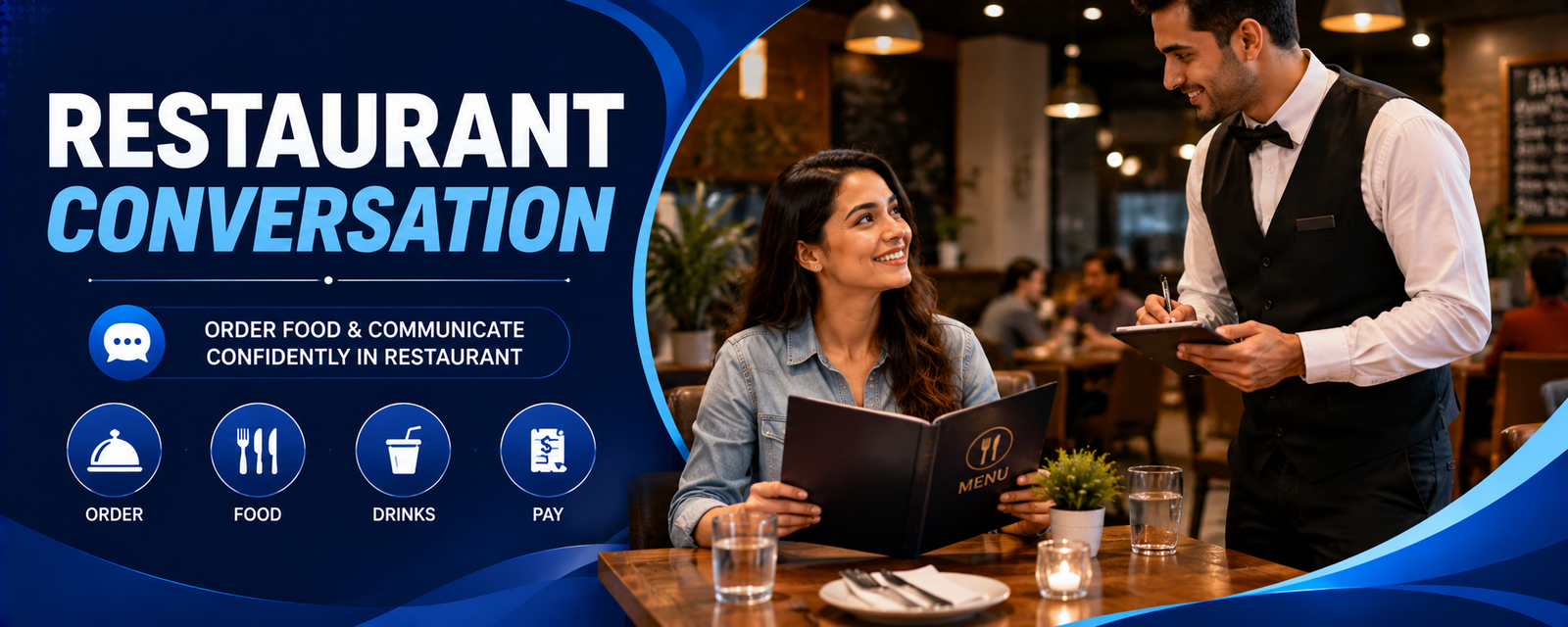
Beginner Mastery: Restaurant Conversations in English
How to Order Food and Communicate Confidently in Any Restaurant
Walking into a restaurant in an English-speaking environment is one of the most exciting experiences for a language learner. Delicious food, warm lighting, and the sounds of friendly conversation surround you.
However, when the waiter hands you the menu and asks, "Are you ready to order?", you might feel a sudden rush of nerves. You may wonder: What if I mispronounce a word? What if I don't understand the waiter's question? How do I ask for the bill?
Here is the wonderful secret that will instantly relax you: restaurant conversations follow a predictable, friendly script. Waiters ask the same questions every single day, and customers use the same polite phrases. By mastering a core toolkit of short sentences, polite expressions, and step-by-step dialogue flows, you can walk into any restaurant and dine with absolute confidence.
This comprehensive masterclass is designed specifically for beginner English learners. We will break down your dining experience from the moment you step through the door to the final payment, complete with essential vocabulary, realistic role-play dialogues, and practical speaking tips.
1. The Four Phases of a Restaurant Dining Experience
A smooth restaurant visit flows through four chronological phases. Knowing what happens in each phase helps you stay calm, prepared, and in control:
- Phase 1: Arrival and Seating: Entering, greeting the host, asking for a table, and reviewing the menu.
- Phase 2: Ordering Food and Drinks: Interacting with the waiter, stating your choices, and making polite requests.
- Phase 3: During the Meal: Handling needs during dining, asking for extra items, or expressing satisfaction.
- Phase 4: Paying and Leaving: Asking for the bill, choosing payment methods, tipping, and parting pleasantries.
2. Phase 1: Arrival, Seating, and Reviewing the Menu
When you first enter a restaurant, you will usually be greeted by a host or hostess at the front desk.
A. Greeting the Host and Getting a Table
Host: "Hello! Welcome to our restaurant. Table for how many?"
You (For one person): "Hello! Just a table for one, please."
You (For two or more): "Hi there. A table for two, please."
Host: "Right this way, please. Here is your menu. Your waiter will be with you shortly."
You: "Thank you very much."
B. Asking About the Menu
Once you sit down, you will open your menu. If you have questions about the dishes, use these simple phrases:
- "Excuse me, what do you recommend?"
- "Is this dish spicy?"
- "Do you have vegetarian options?"
3. Phase 2: Ordering Food and Drinks
When you know what you want, close your menu slightly or place it on the table. This is a visual signal to the waiter that you are ready.
A. The Waiter's Opening Question
Waiter: "Good evening! Are you ready to order, or do you need a few more minutes?"
You (If ready): "Yes, we are ready to order, thank you."
You (If not ready): "Could we have two more minutes, please?"
B. Placing Your Order
Use polite opening phrases like "I would like..." or "Could I have..." followed by your food and drink choices:
- "I would like a glass of iced tea, please."
- "For my main course, I would like the grilled chicken with rice."
- "Could I have a side salad, please?"
- "My friend would like the vegetable soup."
C. Dietary Preferences and Special Requests
- "Could you please put the dressing on the side?"
- "I am allergic to nuts. Does this dish contain any nuts?"
- "No ice in my drink, please."
4. Phase 3: During the Meal
Once your food arrives, polite communication ensures a pleasant dining experience.
A. When Food is Served
Waiter: "Here is your grilled chicken and iced tea. Enjoy your meal!"
You: "Thank you very much!"
B. Asking for Extra Items
- "Excuse me? Could I please have some extra napkins?"
- "Could you please bring us some more drinking water?"
- "May I have some ketchup, please?"
C. Complimenting the Food
- "The food is delicious, thank you!"
- "Everything tastes wonderful."
5. Phase 4: Paying and Leaving (The Bill)
When you finish eating, you will need to ask for the bill (also called the check in American English).
A. Asking for the Bill
Waiter: "How was everything? Would you like to see the dessert menu?"
You: "No dessert, thank you. Could we have the bill, please?" OR "Check, please."
B. Paying the Bill
- Waiter: "Here is your bill. It comes to $32.50."
- You (Paying by card): "I will pay by card, please. Do you take contactless payment?"
- You (Paying by cash): "Here is forty dollars. Keep the change." (Or: "Keep the change" means you are giving the remaining amount as a tip to the waiter).
C. Saying Goodbye
Waiter: "Thank you so much for dining with us. Have a wonderful evening!"
You: "Thank you! The service was great. Goodbye!"
6. Comprehensive Realistic Dialogues
Dialogue A: Dinner for Two at a Casual Restaurant
Host: "Good evening! Welcome to Green Leaf Cafe. Table for how many?"
Customer 1: "Good evening! A table for two, please."
Host: "Right this way, please. Here are your menus. Your server will be with you in a moment."
Customer 1: "Thank you."
Waiter: "Hello! How are you both doing today? Are you ready to order drinks, or do you need a bit more time?"
Customer 1: "We are ready, thank you. I would like a glass of fresh lemonade."
Customer 2: "And I would like a bottle of sparkling water, please."
Waiter: "Certainly. Lemonade and sparkling water. And for your main dishes?"
Customer 1: "I will have the mushroom pasta, please."
Customer 2: "I would like the grilled beef burger with fries. Can I get the fries without extra salt?"
Waiter: "No problem at all—fries without extra salt. I will put those orders in right away."
Waiter: "Here is your mushroom pasta and your beef burger. Enjoy your meal!"
Customer 1: "Thank you so much! It looks and smells wonderful."
Waiter: "How was everything? Would you like to look at our dessert menu?"
Customer 2: "Everything was delicious, thank you. We are too full for dessert, though. Could we have the check, please?"
Waiter: "Of course! Here is your bill. It is $42.00 total."
Customer 1: "We will pay by card. Here is my credit card."
Waiter: "Thank you. Just tap your card right here on the terminal. All set! Here is your receipt. Thank you for visiting Green Leaf Cafe. Have a wonderful night!"
Customer 2: "Thank you! Great service. Goodbye!"
Dialogue B: Ordering Coffee and a Sandwich at a Counter Service Cafe
Cashier / Barista: "Good morning! Welcome to Morning Glow Coffee. What can I get started for you today?"
Customer: "Good morning! Could I please have a medium latte with oat milk?"
Cashier: "A medium oat milk latte. Anything to eat with that?"
Customer: "Yes, please. I would like a turkey and cheese sandwich."
Cashier: "Would you like that sandwich heated up?"
Customer: "Yes, please warm it up."
Cashier: "Got it. That will be $11.25. Cash or card?"
Customer: "I will pay by card."
Cashier: "Tap right on the screen. Perfect. Your drink will be ready at the pickup counter in just a minute, and we will call your name for the sandwich."
Customer: "Thank you so much!"
Cashier: "You are very welcome! Next in line, please..."
7. Essential Restaurant Vocabulary Reference Table
| English Term | Part of Speech | Clear Definition / Meaning | Practical Example Sentence |
|---|---|---|---|
| Menu | Noun | A list of food and drink options available at the restaurant. | "Could you please hand me the menu?" |
| Server / Waiter | Noun | The staff member who takes your order and brings your food. | "Our waiter was very kind and attentive." |
| Appetizer / Starter | Noun | A small dish eaten before the main meal. | "Let's order vegetable soup as an appetizer." |
| Main Course | Noun | The primary, largest dish of a meal. | "What are you ordering for your main course?" |
| Bill / Check | Noun | The written statement showing the total cost of your meal. | "Could we have the bill, please?" |
| Tip | Noun | Extra money given to the server to thank them for good service. | "We left a fifteen percent tip on the table." |
| Reservation | Noun | Booking a table in advance for a specific time. | "We have a table reservation for four people." |
| Allergy | Noun | A medical reaction to certain types of food ingredients. | "I have a severe peanut allergy." |
8. Practical Speaking Strategies for Beginners
1. Use Polite Question Openers
Always begin your requests with soft, polite phrasing such as "Could I please...", "I would like...", or "Excuse me." Politeness builds instant goodwill.
2. Point to the Menu if Needed
If unsure how to pronounce a foreign dish name, smile, point directly at it, and say: "I would like to try this one, please."
3. Do Not Rush
Take your time reading the menu. If the waiter approaches early, simply say with a smile: "We need two more minutes, thank you!"
4. Practice Solo Role-Play
Practice both sides of the conversation in your room out loud to train your brain to speak smoothly without hesitation.
9. Comprehensive Practice Exercise
Personalized Restaurant Script Exercise
Scenario: Imagine you are sitting at a cozy restaurant ordering your favorite meal and drink. Write a 4-step conversational script containing:
- The Greeting: How you respond when the waiter asks for your table size.
- The Drink Order: How you ask for your favorite beverage.
- The Main Course: How you order your favorite food dish.
- The Bill: How you ask for the check and say goodbye politely.
Conclusion
Ordering food in English is no longer a stressful hurdle; it is a delicious, highly structured, and rewarding way to practice your communication skills in the real world. By mastering polite greetings, clear ordering phrases, simple requests during your meal, and confident checkout habits, you can dine at any restaurant on earth with absolute ease. Keep your sentences short and clear, practice your dialogues out loud, and enjoy speaking English every time you share a meal!