
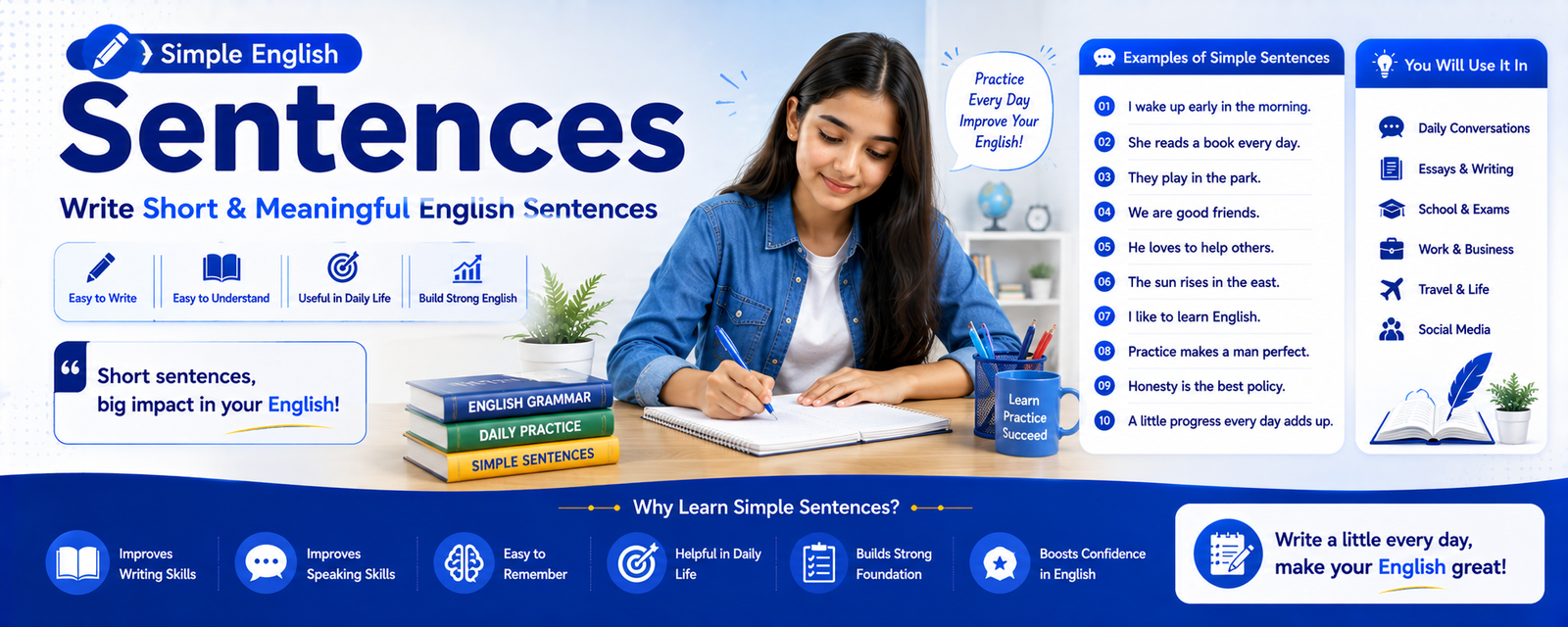
Simple English Sentences
Learn how to build clear, simple, and meaningful English sentences. This lesson will help you understand sentence structure, use strong verbs, maintain correct word order, and communicate your ideas with confidence.
Introduction to Simplicity
Mastering a language does not require using long, complicated words or winding, endless sentences. In fact, some of the most powerful communication in the world relies on short, clear, and direct sentences.
When you keep your sentences simple, your ideas become easier to understand and your communication becomes more confident and natural.
Clear Communication
Your message is instantly understood. There is less room for confusion or misunderstanding.
Fewer Grammar Mistakes
Shorter structures are easier to manage correctly, especially for English learners.
More Confidence
You can express your thoughts smoothly without getting stuck on complicated sentence structures.
The Core Anatomy of a Simple Sentence
Every basic English sentence revolves around a single core idea. At its absolute minimum, a simple sentence requires two things:
Subject
Who or what the sentence is about. The subject is usually the doer or topic of the sentence.
Verb
What the subject is doing or the state of being described in the sentence.
Examples
Subject: Birds | Verb: fly
Subject: She | Verb: reads
Subject: I | Verb: am | Complement: happy
Essential Sentence Patterns
To keep your sentences short and meaningful, rely on these four foundational English sentence patterns.
Subject + Verb
An action done by someone or something.
Dogs bark.
Subject + Verb + Object
An action directed toward something.
He drinks water.
Subject + Verb + Adjective
Describing a subject's state.
The sky is blue.
Subject + Verb + Noun / Place
Identifying what or where something is.
She is a teacher.
We are here.
Categories of Short, Meaningful Sentences
Build a mental library of useful English sentences by practicing them according to everyday situations.
A. Daily Routines & Actions
B. Expressing Feelings & States
C. Giving Simple Commands
D. Asking Questions
Rules for Writing Meaningful Short Sentences
Writing short sentences does not mean writing random words. Every short sentence must carry clear meaning. Follow these important rules.
Focus on Action Verbs
Strong verbs carry the weight of the sentence, so you do not need unnecessary extra words.
He walked with a lot of speed.
He ran.
Cut Unnecessary Adjectives and Adverbs
If a descriptive word does not add real value, remove it. Keep your sentence clean and direct.
The very bright yellow sun is shining brightly today.
The sun shines bright.
Keep Word Order Strict
English relies heavily on word order. For basic sentences, use the Subject-Verb-Object structure for clarity.
Apple eats the boy.
The boy eats the apple.
Practical Practice Exercises
Test your understanding by practicing how to build short, meaningful English sentences.
Exercise 1: Convert Long to Short
Rewrite the following long sentence into a short, meaningful English sentence.
Due to the fact that it was raining heavily outside, John decided to bring his umbrella along with him.
It rained, so John took his umbrella.
Exercise 2: Identify the Core Parts
Analyze the following sentence:
The cat
sleeps
A state of rest belonging to the feline.
Quick Speaking Practice
Read these sentences aloud several times. Focus on clear pronunciation, natural rhythm, and confidence.
Conclusion
Simple English sentences are the bricks and mortar of fluent communication. By practicing short structures, prioritizing strong verbs, and keeping your ideas direct, you will speak and write with greater clarity and confidence.
Keep your sentences simple. Keep your ideas clear. Keep practicing every day.