
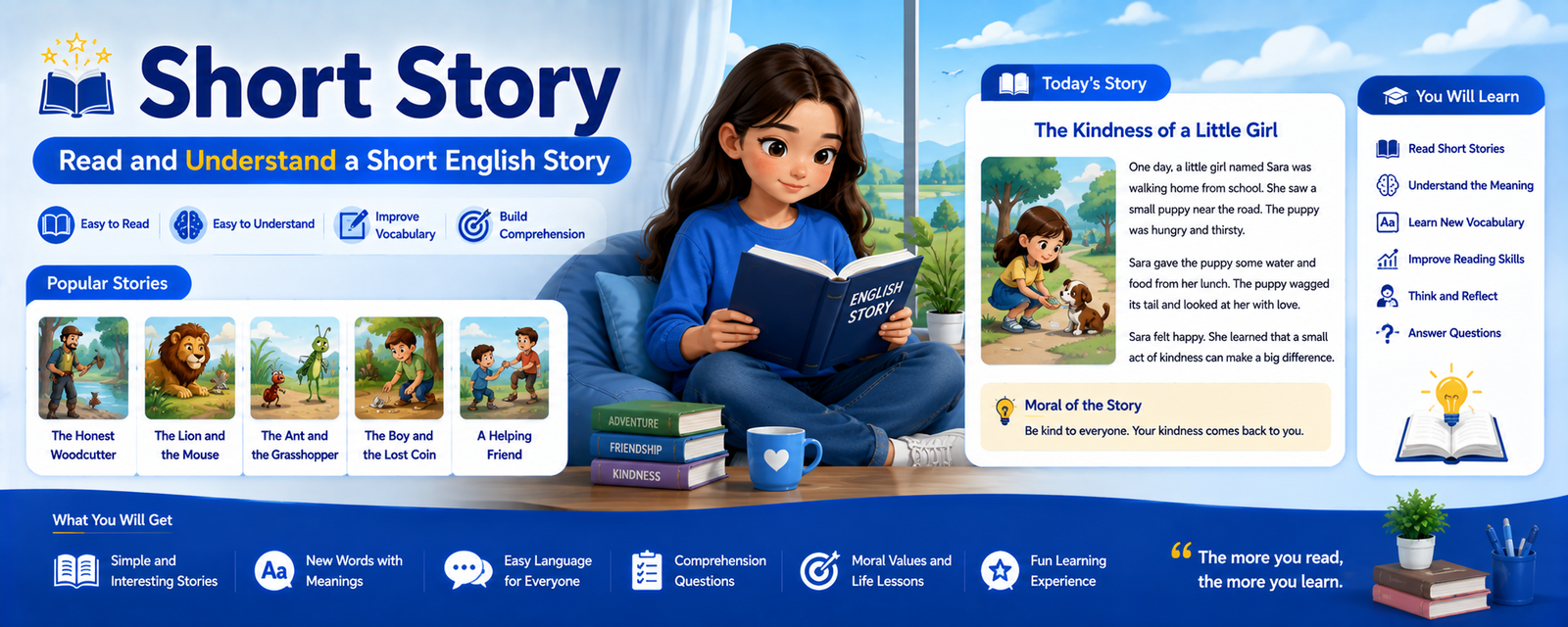
Reading and Understanding Short English Stories
Develop active reading skills, understand stories in context, build vocabulary, analyze characters and plot, and discover deeper meaning through practical English short stories.
Lesson Overview & Objectives
This lesson is designed for intermediate English language learners who want to improve their ability to read, understand, analyze, and interpret short English stories.
Target Audience
Intermediate English Language Learners
Duration
60 Minutes
Core Objective
Build active reading strategies for comprehension, analysis, and deeper understanding.
Key Skills
Vocabulary acquisition, plot analysis, character identification, and inferential comprehension.
The Power of Short Stories
This allows learners to focus intensely on linguistic nuances,
authorial tone, and structural devices without getting overwhelmed
by length.
Reading short stories not only builds vocabulary in context but
also improves grammar intuition by exposing the learner to natural
sentence structures and varied tenses.
Step-by-Step Reading Framework
To master a short story, readers should approach the text using a three-phase strategy: Pre-Reading, During Reading, and Post-Reading.
Phase A: Pre-Reading
Before diving into the text, prime your brain to make the reading process smoother and more engaging.
- Examine the Title and Cover Art: What expectations does the title set? Is it mysterious, joyful, or melancholic?
- Scan for Keywords: Look quickly through the text for unfamiliar words or names. Try to guess their meanings from surrounding context clues.
- Activate Prior Knowledge: Ask yourself what you already know about the story's setting, era, or themes.
Phase B: During Reading
Never read passively. Treat reading as a dialogue between you and the author.
- Annotation: Underline key sentences, highlight unknown vocabulary, and write brief margin notes summarizing paragraphs.
- Visualization: Picture the settings, character expressions, and actions in your mind's eye like a cinematic scene.
- Predicting: Pause at critical moments and ask: "What will happen next?"
Phase C: Post-Reading
Once you finish the final sentence, step back to synthesize the complete experience.
- Summarization: Can you explain the plot in three to five sentences?
- Theme Extraction: What is the underlying message or moral of the story?
- Critical Evaluation: Did you enjoy it? Why or why not?
Practical Demonstration: Guided Analysis
Let us apply this framework to a micro-fiction story as an example.
The Last Train
Arthur hurried down the cobblestone platform, his heavy
leather suitcase scraping against his knee. The station
clock read 11:58 PM.
He had spent ten years working in the city, chasing a
fortune that always seemed just out of reach, missing
birthdays, quiet mornings, and the rolling green hills
of his childhood village.
As the distant whistle of the midnight train echoed through
the foggy night, Arthur looked down at the one-way ticket
in his trembling hand.
He smiled, turned around, and walked back toward the exit
into the cool autumn air.
He didn't need the train anymore.
Analysis Breakdown
Common Literary Elements to Watch For
When reading English short stories, paying attention to these literary devices will deepen your comprehension.
Plot Structure
The sequence of events: Exposition → Rising Action → Climax → Falling Action → Resolution.
Symbolism
Objects or elements that represent larger concepts, such as the suitcase representing Arthur's burdens or ambitions.
Tone and Mood
Tone represents the author's attitude toward the subject, while mood represents the atmosphere created for the reader.
Irony
A contrast between expectation and reality, such as buying a ticket to leave only to realize that staying is the true departure from unhappiness.
Exercises for Mastery
To test your understanding of any short story, complete these three activities.
The Vocabulary Matrix
Select five unfamiliar words from the story, write down their dictionary definitions, and create an original sentence for each.
Character Sketch
Write a short paragraph describing a character's internal motivations, fears, and growth throughout the narrative.
Alternative Ending
Rewrite the final paragraph of the story to change the outcome, maintaining the author's original tone and style.