Weather English Lesson | The English PK
English Speaking & Vocabulary Lesson

The Universal Language of the Skies

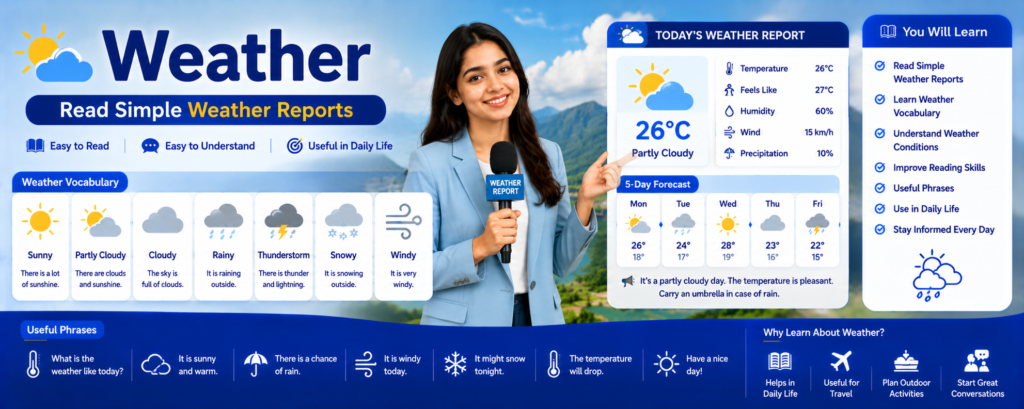
Learn practical English for weather vocabulary, temperatures, atmospheric conditions, forecasts, severe weather, idioms, and real-world weather reports.

Phase 1

Introduction: The Universal Language of the Skies

Weather is perhaps the most universally discussed topic in human history. Whether you are planning your morning commute, deciding what clothes to pack for a journey, or simply breaking the ice in a casual conversation, talking about the weather is a daily social habit across the globe. Mastering weather vocabulary and reading simple weather reports allows you to understand meteorological forecasts, interpret temperature scales, and describe atmospheric conditions with precision and ease.

This comprehensive, long-format lesson is written entirely in English to immerse you fully in the language. We will systematically explore temperature metrics, atmospheric conditions, precipitation types, wind dynamics, severe weather phenomena, forecasting phrases, and realistic weather reports. Let us dive into the everyday language of the skies.

Phase 2

Phase 1: Temperature and Thermal Metrics

Temperature dictates how warm or cold our environment feels. Understanding thermal terminology is the first step in interpreting any weather report.

Temperature: A measure of how hot or cold the air is.
Celsius / Centigrade: The metric temperature scale used by most of the world (water freezes at 0 degrees and boils at 100 degrees).
Fahrenheit: The temperature scale primarily used in the United States (water freezes at 32 degrees and boils at 212 degrees).
Degree: The unit of measurement for temperature (e.g., "twenty degrees").
Hot / Warm: High temperatures that feel comfortable or intense.
Cool / Chilly: Low temperatures that feel fresh or moderately cold.
Cold / Freezing: Extreme low temperatures where water turns to ice.
Heatwave: A prolonged period of excessively hot weather.
Frost: A thin layer of ice crystals forming on surfaces when temperatures drop below freezing.
Thermometer: An instrument used to measure temperature.
Detailed Linguistic Analysis

When stating temperatures in English, we use the verb "to be" combined with the degree value and scale. For example, we say, "The temperature is twenty-two degrees Celsius" or "It is seventy-five degrees Fahrenheit." Notice how adjectives like chilly and freezing describe subjective physical sensations, while exact numbers provide objective meteorological data.

Phase 3

Phase 2: Basic Atmospheric Conditions (Sunny, Cloudy, Clear)

The visual appearance of the sky dictates the general character of the day. These foundational terms describe the amount of sunlight and cloud cover.

Sunny: Bright with direct sunlight; clear skies.
Clear: Free from clouds, mist, or haze.
Partly cloudy: A mix of sunshine and clouds.
Cloudy / Overcast: The sky is completely covered by clouds, blocking the sun.
Foggy: Thick clouds of water droplets near the ground reducing visibility.
Misty: Light fog characterized by fine water droplets in the air.
Hazy: Atmospheric obscurity caused by dust, smoke, or light mist.
Bright: Giving out or reflecting a lot of light.
Gloomy: Dark and poorly lit due to heavy clouds.
Sunrise / Sunset: The daily appearance and disappearance of the sun over the horizon.
Detailed Linguistic Analysis

When describing sky conditions in a sentence, English speakers typically use the pronoun "It" as an impersonal subject followed by the verb "is" and an adjective (It is sunny today, It is overcast). This grammatical construction is standard for weather reporting across all English-speaking regions.

Phase 4

Phase 3: Precipitation (Rain, Snow, and Storms)

Precipitation refers to any form of water falling from the clouds to the Earth's surface. Knowing these terms helps you decide whether to carry an umbrella.

Rain: Moisture falling in drops from clouds.
Drizzle: Very light, fine rain falling in tiny drops.
Shower: A brief, passing period of rain.
Downpour / Heavy rain: A sudden, heavy fall of rain.
Snow: Frozen precipitation falling in white ice crystals or flakes.
Sleet: A mixture of rain and snow falling together.
Hail: Frozen pellets of ice falling in severe storm conditions.
Thunderstorm: A storm accompanied by lightning and thunder.
Lightning: A sudden flash of bright electrical discharge in the sky.
Thunder: The loud rumbling sound caused by lightning.
Detailed Linguistic Analysis

Precipitation can function as both nouns and verbs. For example, you can say "It is raining" (Present Continuous verb tense describing an ongoing action) or "There is heavy rain* forecasted for this afternoon"* (Noun form). Understanding this morphological shift is essential when transitioning from casual observations to formal meteorological reports.

Phase 5

Phase 4: Wind and Atmospheric Pressure

Wind adds movement and physical force to the weather. Describing wind speed and direction requires specific vocabulary and descriptive modifiers.

Wind: The perceptible natural movement of the air.
Breeze: A gentle, light, and pleasant wind.
GUST: A brief, sudden rush of strong wind.
Gale: A very strong, powerful wind.
Storm: A violent disturbance of the atmosphere with strong winds.
Hurricane / Typhoon: A massive, rotating tropical storm with destructive winds.
Tornado: A violently rotating column of air touching the ground.
Windy: Weather characterized by strong or frequent winds.
Air pressure: The force exerted by the weight of the air above.
Forecast: A prediction of future weather conditions.
Detailed Linguistic Analysis

Adjectives ending in -y are frequently formed from noun bases in meteorology (wind becomes windy, cloud becomes cloudy, rain becomes rainy). These adjectives describe the prevailing atmospheric state of a given day. When describing wind direction, English uses directional prepositions, such as "A gentle breeze blowing from the north."

Phase 6

Phase 5: Seasonal Weather Patterns

Weather changes cyclically throughout the year. Each of the four seasons brings distinct temperature trends, precipitation types, and ecological transformations.

Spring: The season of transition after winter, marked by blooming flowers, mild temperatures, and April showers.
Summer: The warmest season of the year, characterized by long sunny days and high temperatures.
Autumn / Fall: The season when leaves change color and fall from trees, bringing cooler air and crisp mornings.
Winter: The coldest season, often bringing snow, frost, short daylight hours, and freezing temperatures.
Monsoon: A seasonal prevailing wind in South and Southeast Asia, bringing heavy rains.
Drought: A prolonged period of abnormally low rainfall leading to water shortages.
Flood: An overflow of water onto normally dry land caused by heavy rain.
Humid: Containing a high amount of moisture or water vapor in the air.
Arid: Excessively dry with little or no rainfall.
Climate: The long-term weather patterns typical of a specific region.
Detailed Linguistic Analysis

When discussing seasonal weather, English speakers use prepositions of time such as "in" (in the spring, in winter). Notice the distinction between weather (temporary, day-to-day atmospheric conditions) and climate (long-term regional patterns over decades), which is a common point of confusion for language learners.

Phase 7

Phase 6: Weather Instruments and Meteorology

Behind every weather report lies scientific observation. Meteorologists use specialized instruments and terminology to measure and predict atmospheric changes.

Meteorologist: A scientist who studies and forecasts the weather.
Barometer: An instrument measuring atmospheric pressure to forecast weather changes.
Anemometer: A device used for measuring wind speed.
Humidity: The concentration of water vapor present in the air.
Precipitation gauge: A tool measuring the amount of rain or snow fallen.
Satellite image: A photograph of the earth taken from space showing cloud patterns.
Radar: A system using radio waves to detect precipitation and storms.
Warning / Alert: An official notice advising the public of severe weather hazards.
Forecast model: A computer simulation used by scientists to predict future weather.
Visibility: The distance one can see clearly through the atmosphere.
Detailed Linguistic Analysis

Technical meteorological terms elevate your vocabulary from casual small talk to scientific literacy. Notice how nouns like meteorology and barometer derive from Greek roots, providing a consistent etymological framework that makes them easy to recognize across European languages.

Phase 8

Phase 7: Real-World Weather Report 1 (Morning Local Forecast)

Let us examine a typical morning weather report broadcast on radio or television, demonstrating standard reporting structure and phrasing.

Broadcaster: "Good morning! Let's take a look at your local forecast for today, Thursday, August thirteenth. We are waking up to a crisp and clear morning with a current temperature of twenty-two degrees Celsius. As we move into the late morning, skies will remain mostly sunny with light breezes coming from the east. By midday, expect temperatures to climb to a comfortable high of thirty-one degrees. There is zero chance of rain today, making it a perfect afternoon for outdoor activities. However, humidity is sitting at forty percent, so it will feel pleasantly warm rather than muggy. Enjoy the sunshine, and stay tuned for your weekend outlook!"
Detailed Linguistic Analysis

Weather reports follow a predictable chronological structure: current conditions, daytime progression, high/low temperature expectations, and precipitation probability. Notice the use of future time framing ("expect temperatures to climb," "There is zero chance of rain") to project conditions forward across the coming hours.

Phase 9

Phase 8: Real-World Weather Report 2 (Severe Weather Alert)

When severe weather approaches, reports shift tone to become urgent, instructive, and precautionary, utilizing specific safety terminology.

Broadcaster: "We interrupt our scheduled programming to bring you a special weather bulletin. The National Weather Service has issued a severe thunderstorm warning for the metropolitan area. Heavy downpours, frequent lightning, and gusts of wind reaching up to seventy kilometers per hour are currently sweeping across the western districts. Visibility on major highways has dropped significantly due to heavy fog and torrential rain. Residents are advised to stay indoors, secure loose outdoor objects, and avoid unnecessary travel until the storm system passes eastward by late evening. We will provide further updates every fifteen minutes."
Detailed Linguistic Analysis

Severe weather reports utilize imperative verbs (stay indoors, secure objects, avoid travel) and formal nouns (warning, bulletin, torrential rain) to convey urgency. Notice how adjectives like severe and torrential intensify the descriptive weight of the meteorological data, signaling potential danger to the listener.

Phase 10

Phase 9: Weather Idioms and Everyday Expressions

English is rich with colorful idiomatic expressions derived from weather phenomena. These phrases carry metaphorical meanings used widely in daily conversation.

Under the weather: Feeling slightly ill, sick, or unwell.
A storm is brewing: Trouble or conflict is approaching in the near future.
Save for a rainy day: To save money or resources for a time of future need.
Break the ice: To initiate conversation in a social setting to relieve tension.
Calm before the storm: A quiet, peaceful period immediately before a period of chaos or difficulty.
Right as rain: Feeling completely healthy, well, or correct.
Chase rainbows: To pursue illusory, unrealistic, or impossible goals.
Every cloud has a silver lining: Every difficult or negative situation has a hopeful or positive aspect.
Steal someone's thunder: To take the attention, praise, or credit away from someone else.
Fair-weather friend: A friend who is supportive only when things are easy and pleasant, disappearing during hardships.
Detailed Linguistic Analysis

Idiomatic expressions decouple weather terms from literal meteorological reporting, converting them into powerful cultural metaphors. For example, telling someone you are feeling "under the weather" has nothing to do with atmospheric pressure; it simply means you have a cold or feel fatigued. Recognizing these phrases allows you to interpret figurative speech smoothly.

Phase 11

Phase 10: Narrative Integration (Planning Around the Skies)

To conclude our lesson, we integrate all weather vocabulary, temperature metrics, reporting structures, and idiomatic expressions into a cohesive narrative text depicting a practical day shaped by meteorological conditions.

Waking up early on a brisk autumn morning, Jessica checked her smartphone app to review the daily forecast. The meteorologist predicted a clear and sunny morning with a starting temperature of fourteen degrees Celsius, though a chilly breeze reminded everyone that winter was approaching. Knowing that clouds and afternoon showers might roll in by three o'clock, Jessica grabbed her umbrella before leaving the house—making sure to save for a rainy day both literally and figuratively. By midday, the temperature peaked at a comfortable twenty-two degrees, proving that every cloud has a silver lining when outdoor plans proceed without disruption. Whether discussing a sudden heatwave or enjoying the calm before the storm, understanding the language of the weather ensures you are always prepared for whatever the skies may bring.
Text Passage:
Detailed Linguistic Analysis

This final passage demonstrates the seamless integration of temperature scales (fourteen degrees Celsius), sky conditions (clear, sunny, clouds), precipitation types (showers), seasonal context (autumn, winter), and idiomatic expressions (save for a rainy day, every cloud has a silver lining). By mastering these ten phases, you are fully equipped to read weather reports and discuss atmospheric conditions in fluent English with total confidence.

Scroll to Top