
The Language of Commerce and Consumer Exchange
Learn practical English for shopping, stores, prices, payments, returns, customer service, online shopping, and real-life consumer conversations.
Introduction: The Language of Commerce and Consumer Exchange
Shopping is one of the most universal practical activities in human society. Whether you are purchasing daily groceries, selecting new clothing, inquiring about prices, or returning a defective item, the ability to navigate commercial interactions in English is an essential life skill. Shopping conversations require politeness, clarity, specific vocabulary regarding quantities and currency, and an understanding of common transactional phrases between buyers and shop assistants.
This comprehensive, long-format lesson is written entirely in English to immerse you fully in the language. We will systematically explore store departments, polite inquiries, bargaining and pricing, payment methods, returns, and practical dialogues. Let us master the everyday language of consumer exchange.
Phase 1: Store Departments and Types of Shops
Before entering a conversation, you must know where to find specific goods. Different retail establishments and in-store sections carry distinct categories of merchandise.
When describing locations within a store, English uses prepositions of place. For example, items are located "in" an aisle or "on" a shelf (e.g., "The cereal is in aisle four, on the top shelf"). Recognizing these structural nouns helps you ask staff members precise questions when searching for merchandise.
Phase 2: Essential Shopping Verbs and Actions
The shopping process involves a specific set of physical actions and transactional verbs that describe the buyer's journey from browsing to purchasing.
Many shopping actions rely on phrasal verbs, which are verbs combined with particles like on, for, or back. For instance, "try on" requires separating the verb and particle when using a pronoun ("Try it on"), whereas "look for" keeps the particle attached to the verb ("I am looking for a jacket"). Mastering these verb patterns prevents common grammatical errors in conversation.
Phase 3: Polite Inquiries and Asking for Assistance
In customer service interactions, politeness is paramount. English speakers typically use modal verbs (could, would, can) to soften requests and make them sound courteous.
Notice how questions begin with polite modals like "Could you..." or "Do you have..." rather than direct demands. When asking about product availability, the phrase "in stock" refers to items currently available in the store, while "on sale" indicates items offered at a discounted price. These distinctions are vital for accurate communication with sales staff.
Phase 4: Prices, Currency, and Financial Terms
Understanding pricing, payment methods, and financial terminology ensures that transactions go smoothly without confusion over money.
When reading prices aloud in English, there are specific conventions. For example, $19.99 is pronounced "nineteen ninety-nine dollars" or "nineteen dollars and ninety-nine cents." When receiving paper money back from a cashier, the coins or bills returned are called "change" (e.g., "Here is your change and your receipt").
Phase 5: Common Shopping Dialogues (Clothing Store)
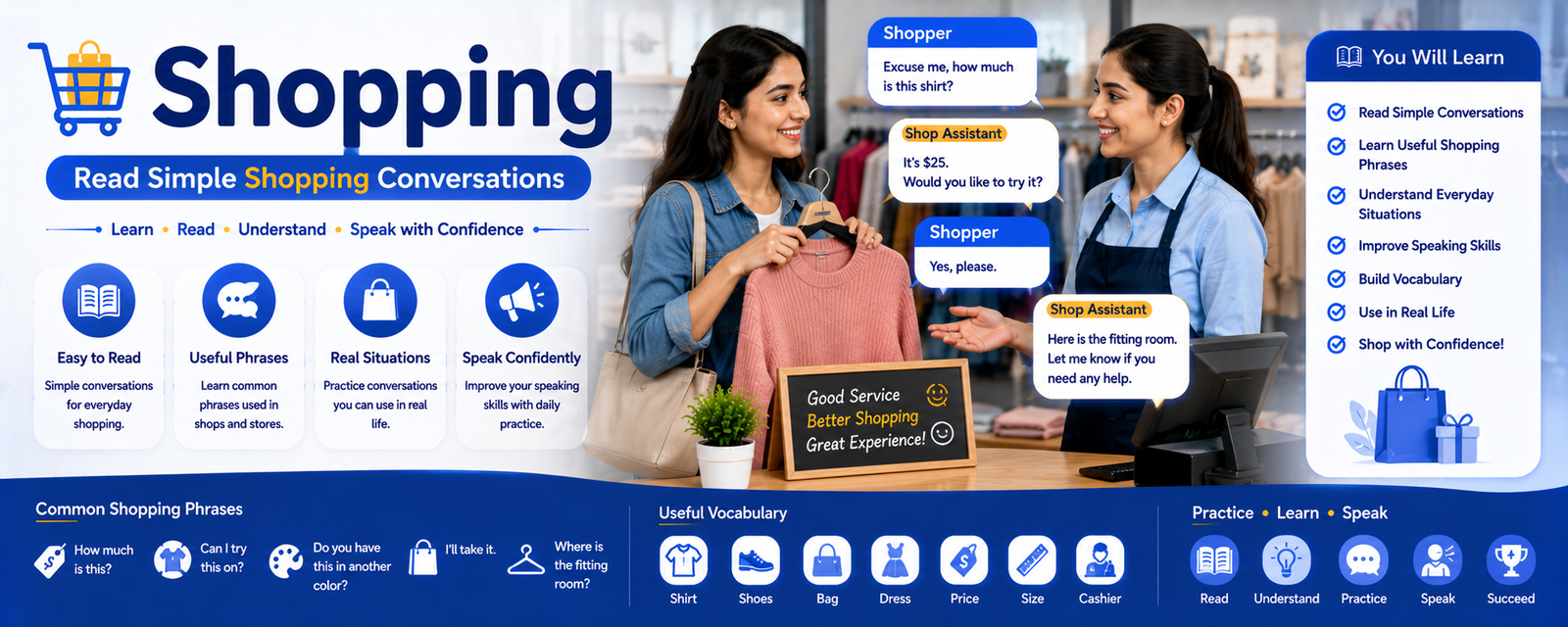
Let us examine a real-world dialogue between a customer and a shop assistant in a clothing boutique, demonstrating polite conversational flow.
This dialogue illustrates standard conversational pacing: greeting, offering assistance, stating preferences, trying on items, discussing price and discounts, completing payment, and offering a polite farewell. Notice how natural transitions and polite response markers ("Of course," "Yes, please") make the exchange smooth and welcoming.
Phase 6: Common Shopping Dialogues (Grocery Store)
Grocery shopping involves specific vocabulary related to weight, units, freshness, and section navigation. Here is a typical supermarket interaction.
Grocery interactions introduce terms like "produce section" (fresh fruits and vegetables) and packaging choices like "paper or plastic." Notice the polite conversational habit of the cashier asking, "Did you find everything you needed today?" This is a standard customer service formula in English-speaking retail environments.
Phase 7: Returns, Exchanges, and Customer Service
Sometimes purchases do not work out—an item might be defective, the wrong size, or simply unwanted. Knowing how to handle returns is an advanced practical skill.
When making a return, the grammatical structure usually involves modal verbs of desire or politeness ("I would like to return..."). Staff members will typically ask for proof of purchase using phrases like "Do you have the receipt?" Store policies distinguish between a full refund (money back), an exchange (swapping for another item), and store credit (a voucher to spend in the same shop later).
Phase 8: Shopping Idioms and Consumer Expressions
English contains many idiomatic expressions derived from shopping habits, retail culture, and consumer behavior.
Idioms transform literal retail concepts into colorful everyday expressions. For example, calling an item "a steal" does not imply criminality; it means the price is so low that buying it feels like getting away with a great deal. Recognizing these phrases allows you to understand cultural subtexts in casual conversations about spending and consumer habits.
Phase 9: Online Shopping Vocabulary
In the modern digital economy, a massive percentage of consumer transactions occur online. E-commerce vocabulary has become just as important as brick-and-mortar terminology.
Online shopping terms merge traditional retail vocabulary with computer technology. Notice how physical objects like carts and baskets are used metaphorically in software interfaces (shopping cart). Verbs like "add to cart," "proceed to checkout," and "track your package" are standard user-interface phrases encountered on every e-commerce platform worldwide.
Phase 10: Narrative Integration (The Saturday Shopping Trip)
To conclude our lesson, we integrate all the shopping vocabulary, polite inquiries, financial terms, and conversational patterns into a cohesive narrative text depicting a realistic consumer outing.
This final passage demonstrates the seamless integration of physical store vocabulary (clothing boutique, fitting room, checkout counter), action verbs (browse, pick up, try on), pricing concepts (on sale, discount), idiomatic expressions (a steal, break the bank), and chronological connectors (First). By mastering these ten phases, you are fully equipped to handle any shopping scenario in fluent English with total confidence.