
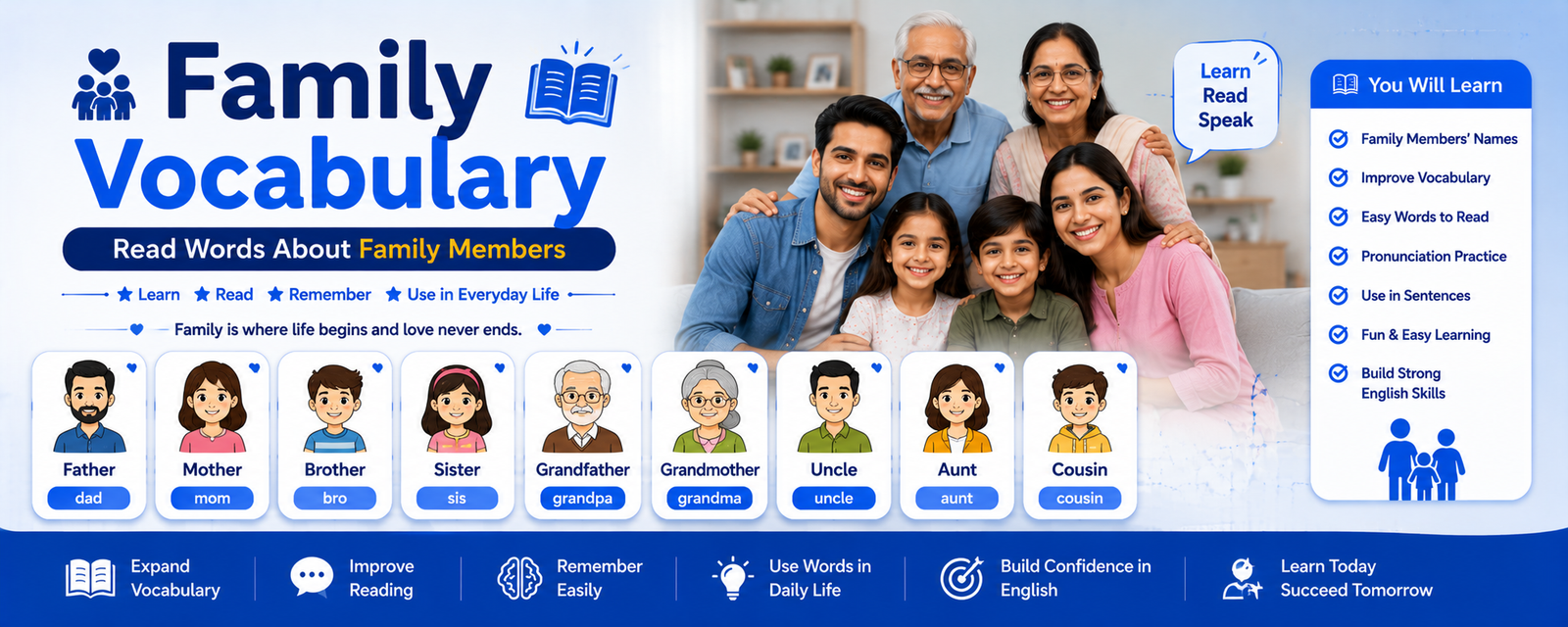
The Universal Language of Family
Master essential family vocabulary, relationships, household roles, life milestones, idioms, and advanced family expressions in English.
Introduction: The Universal Language of Family
Family is the primary social unit of human society. Across every culture, geography, and era, family relationships form the bedrock of emotional support, identity, and community structure. Mastering family vocabulary is one of the most essential steps when learning English because these words are used in daily conversations, biographical descriptions, legal documents, and cultural storytelling.
This comprehensive, long-format lesson is structured entirely in English to immerse you directly in the language. We will explore family relationships across multiple dimensions, ranging from immediate household members to extended lineages, legal ties, generational structures, and linguistic nuances. Let us dive deep into the intricate network of family vocabulary.
Phase 1: The Nuclear Family (Immediate Household)
The nuclear family consists of parents and children living together as a single household unit. These are the individuals you interact with most frequently in daily life.
Father: A male parent. (Informal: Dad, Daddy)
Mother: A female parent. (Informal: Mom, Mum, Mommy)
Parents: A mother and/or a father collectively.
Son: A male child in relation to his parents.
Daughter: A female child in relation to her parents.
Brother: A male sibling who shares one or both parents with you.
Sister: A female sibling who shares one or both parents with you.
Sibling: A gender-neutral term for a brother or sister.
Child: A young human being below the age of puberty, or an offspring of any age in relation to parents. (Plural: Children)
Only Child: A person who has no brothers or sisters.
In English, the distinction between gender in immediate family terms is absolute (father/mother, son/daughter, brother/sister). Notice the inclusive terms like parent and sibling, which allow speakers to refer to family members without specifying gender. The informal variations (Dad, Mom) are vastly more common in casual spoken English than their formal counterparts, which are typically reserved for formal writing or legal contexts.
Phase 2: The Extended Family (Beyond the Household)
Extended family includes relatives beyond the nuclear family unit, such as grandparents, aunts, uncles, and cousins. These individuals often live in separate households but share deep genetic and familial ties.
Grandfather: The father of your father or mother. (Informal: Grandpa, Granddad)
Grandmother: The mother of your father or mother. (Informal: Grandma, Granny)
Grandparents: The parents of your parents collectively.
Grandson: The son of your son or daughter.
Granddaughter: The daughter of your son or daughter.
Grandchildren: The children of your sons or daughters collectively.
Uncle: The brother of your parent, or the husband of your aunt.
Aunt: The sister of your parent, or the wife of your uncle.
Cousin: The child of your aunt or uncle.
Nephew: The son of your brother or sister.
Niece: The daughter of your brother or sister.
Extended family terms in English introduce wonderful layers of symmetry. For instance, the prefix grand- elevates a generation upward (parents to grandparents) or lowers a generation downward (children to grandchildren). Furthermore, the word cousin is entirely gender-neutral in English; a male or female cousin is referred to simply as "my cousin," unlike many other languages that specify gender or maternal/paternal lineage.
Phase 3: The Older Generation (Ancestry and Lineage)
Looking further back into your family tree reveals your ancestors, elders, and the historical lineage that precedes your existence.
Great-Grandfather: The father of your grandfather or grandmother.
Great-Grandmother: The mother of your grandfather or grandmother.
Great-Grandparents: The parents of your grandparents.
Ancestor: Any person from whom you are descended, usually more remote than a grandparent (e.g., great-great-grandparents).
Descendant: A person, typically a child, grandchild, or later relative, who continues a lineage.
Patriarch: The male head of a family, tribe, or lineage.
Matriarch: The female head of a family, tribe, or lineage.
Elder: An older member of a family or community, typically respected for age and wisdom.
Blood Relative: A person connected by shared biological ancestry rather than marriage or adoption.
Next of Kin: Your closest living blood relative or legal partner.
As we move backward through generations, English uses the modifier great- to add layers of ancestry (great-grandfather, great-great-grandmother). Terms like patriarch and matriarch elevate family vocabulary into sociology and anthropology, describing structural leadership within extended family networks. Understanding these terms helps articulate historical family trees and generational heritage accurately.
Phase 4: In-Laws (Family by Marriage)
When two people marry, their families become intertwined. The relatives acquired through marriage are called "in-laws" because their relationship is defined and protected by law rather than biology.
Father-in-law: The father of your spouse.
Mother-in-law: The mother of your spouse.
Parents-in-law: The parents of your spouse collectively.
Brother-in-law: The brother of your spouse, or the husband of your sister.
Sister-in-law: The sister of your spouse, or the wife of your brother.
Son-in-law: The husband of your daughter.
Daughter-in-law: The wife of your son.
Spouse: A husband or wife (gender-neutral legal term).
Bride: A woman on her wedding day or just before/after.
Groom: A man on his wedding day or just before/after.
The suffix -in-law is a brilliant morphological tool in English. It instantly converts a biological or marital term into a legal relationship. For example, taking your standard word for a family member (brother, mother, daughter) and appending -in-law clarifies that the connection exists through a wedding bond. This precise vocabulary prevents any ambiguity between genetic relatives and marital relatives.
Phase 5: Blended and Step-Family Relationships
Modern family structures often include blended families, where adults bring children from previous relationships into a new household, or where legal adoption creates permanent family bonds.
Stepfather: A man who is married to your mother, but is not your biological father.
Stepmother: A woman who is married to your father, but is not your biological mother.
Stepson: The son of your spouse from a previous relationship.
Stepdaughter: The daughter of your spouse from a previous relationship.
Stepbrother: The son of your stepparent or stepmother/stepfather.
Stepsister: The daughter of your stepparent or stepmother/stepfather.
Half-brother: A brother who shares only one biological parent with you (either mother or father).
Half-sister: A sister who shares only one biological parent with you (either mother or father).
Adopted Child: A child legally taken into a family as a permanent son or daughter.
Foster Family: A family that provides temporary care for children who cannot live with their biological parents.
It is crucial to distinguish between step- relations and half- relations. Step- relations occur strictly through marriage (no shared biological DNA), whereas half- relations occur when two individuals share exactly one biological parent. Furthermore, terms like adopted and foster describe the legal and social framework under which a family unit is formed, reflecting the diverse ways modern households are structured.
Phase 6: Marital Status and Romantic Partners
Before, during, and after formal family creation, individuals experience various stages of romantic partnership and marital status.
Single: Unmarried and not in a committed romantic relationship.
Engaged: Formally pledged or promised to be married.
Fiancé: A man to whom someone is engaged to be married.
Fiancée: A woman to whom someone is engaged to be married.
Married: United in legally recognized marriage.
Husband: A married man in relation to his spouse.
Wife: A married woman in relation to her spouse.
Divorced: Legally separated from a former spouse after a divorce.
Widowed: Having lost a spouse through death.
Widower / Widow: A man (widower) or woman (widow) whose spouse has died.
Romantic and marital vocabulary tracks the legal and social milestones of human relationships. Notice the distinct French-derived spellings for fiancé (male, with one 'e' at the end) and fiancée (female, with two 'e's). Additionally, terms like widower and widow carry specific gendered forms that specify the surviving partner after the tragic loss of a spouse.
Phase 7: Household Roles, Dynamics, and Responsibilities
Families operate as micro-communities with defined roles, caregiving responsibilities, and emotional dynamics that keep the household functioning.
Head of Household: The primary provider or person responsible for running the home.
Breadwinner: The member of the family who earns the primary income to support the household.
Caregiver: A person who provides care for someone else, such as an elderly parent or young child.
Dependent: A family member (usually a child or elderly relative) who relies on another for financial support.
Guardian: A person who has the legal authority and duty to care for another person, especially a child.
Next of Kin: The closest legal relative, often responsible for medical or legal decisions in emergencies.
Black Sheep: An idiomatic expression for an odd or disreputable member of a group, especially within a family.
Kinship: Blood relationship or shared cultural/familial ties.
Household: All the people living together in a single house or residential unit.
Family Reunion: A gathering of extended family members who have not seen each other in a long time.
This phase bridges basic family terminology with sociological and everyday idiomatic expressions. For example, calling someone the "black sheep" of the family is a classic English idiom used to describe an individual who differs significantly from the rest of the family's expectations or lifestyle. Terms like breadwinner and dependent highlight the economic interdependence that often characterizes family structures.
Phase 8: Family Life Cycle and Milestones
A family evolves over time through predictable life milestones, celebrations, transitions, and generational renewal.
Birth: The emergence of a baby from the body of its mother; the start of a new life.
Infancy: The earliest stage of childhood, from birth to one year of age.
Childhood: The period of human life between infancy and puberty.
Adolescence: The transitional phase of growth and development between childhood and adulthood.
Adulthood: The state or condition of being a fully grown, mature person.
Wedding: A ceremony where two people are united in marriage.
Anniversary: The recurring date of a past event, especially a wedding anniversary celebrated yearly.
Parenthood: The state of being a mother or father and raising children.
Retirement: The period in life when a person stops working, usually after reaching a certain age.
Legacy: Something handed down from an ancestor or predecessor, including values, stories, or property.
Tracking the family life cycle involves nouns that describe developmental periods (infancy, adolescence, adulthood) alongside milestone events (wedding, anniversary, retirement). Mastering these words allows you to construct chronological narratives about a person's life journey and their changing role within the broader family unit over decades.
Phase 9: Common Idioms and Expressions About Family
English is rich with idiomatic expressions rooted in family dynamics, blood ties, and generational traits. These phrases add color and depth to casual conversation.
Run in the family: A characteristic, talent, or trait that is shared by many members of a family (e.g., "Musical talent runs in the family").
Like father, like son: An expression used to say that a son's behavior or appearance closely resembles that of his father.
Chip off the old block: An idiom describing a child who resembles their parent in behavior, personality, or physical appearance.
Skeleton in the closet: A hidden, shameful secret kept within a family.
Bring home the bacon: To earn money to live on; to be the financial provider for the household.
Spare the rod and spoil the child: A traditional proverb suggesting that failure to discipline a child results in bad behavior.
Blood is thicker than water: An idiom meaning that family relationships and loyalties are stronger and more important than any other relationships.
The apple of someone's eye: Someone who is cherished above all others (often used by parents to describe a favorite child).
Keep it in the family: To keep business, assets, or secrets within the family circle rather than sharing with outsiders.
Family tree: A diagram showing the lineage and relationships of a family across multiple generations.
Idioms cannot be translated literally; their meaning is cultural and collective. Phrases like "chip off the old block" or "blood is thicker than water" encapsulate centuries of cultural observation regarding heredity, familial loyalty, and shared traits. Using these idioms correctly demonstrates an advanced grasp of natural English phrasing and cultural nuance.
Phase 10: Narrative Integration (The Comprehensive Family Portrait)
To conclude our lesson, we integrate all the vocabulary learned across the previous phases into a cohesive narrative text, demonstrating how these terms function together in real-world English prose.
Text Passage:
In a cozy suburban house, a closely-knit nuclear family gathers for a weekend dinner. The patriarch of the home, a retired grandfather, sits at the head of the table surrounded by his loving spouse and their children. Across the room, a blended family dynamic is visible: a stepfather and stepdaughter share laughter while sharing a meal with their half-brother. Outside, distant cousins arrive for a long-awaited family reunion, bringing joy, stories, and shared memories that prove how deeply kinship binds people together across generations. Whether talking about a talented breadwinner, a cherished nephew, or a funny family trait that runs in the family, the English vocabulary of family provides a powerful framework for expressing our deepest human connections.
This final phase proves that family vocabulary is not just a list of isolated definitions, but an interconnected web of terminology. By combining immediate household terms (nuclear family, children, spouse), extended relations (cousins, grandfather), legal/blended structures (stepfather, half-brother, blended family), and sociological concepts (patriarch, kinship, breadwinner), you can paint a complete, nuanced portrait of human relationships in fluent English.