
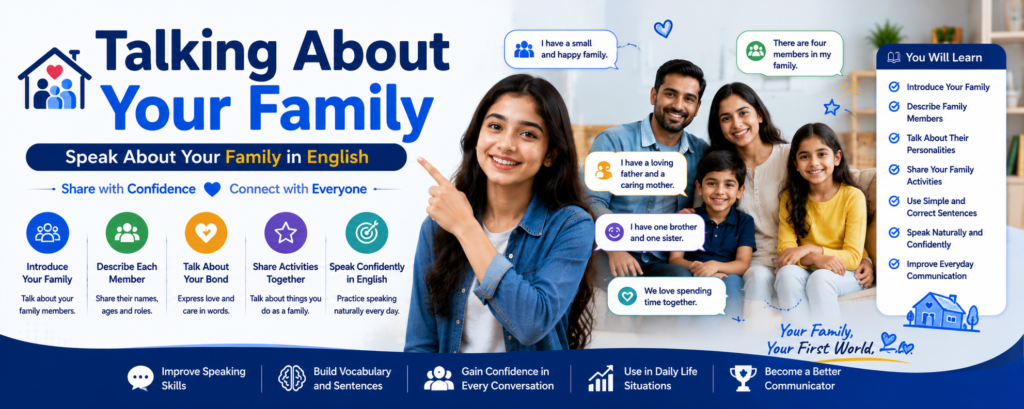
Expressing and Talking About Your Family in English
Build your vocabulary, sentence structures, descriptive skills, and confidence to talk about your family naturally in English.
Masterclass Introduction
Talking about your family is one of the most common, personal, and heartwarming topics in English conversation. Whether you are meeting someone new, writing an essay, or participating in a job interview small-talk session, being able to describe your family members with rich vocabulary, accurate grammatical structures, and emotional depth is an essential skill.
This comprehensive lesson covers everything from basic vocabulary to advanced narrative structures, giving you all the tools you need to speak about your family with total fluency and confidence.
Phase 1: Essential Family Vocabulary & Classifications
Before building sentences, you must master the terminology used to describe various family relationships in English.
Nuclear Family (Immediate Family)
- Parents: Father, Mother
-
Siblings:
Brother, Sister
Older brother/sister, Younger brother/sister - Spouse: Husband, Wife
- Children: Son, Daughter, Only child
Extended Family
- Grandparents: Grandfather (Grandpa), Grandmother (Grandma), Grandparents
- Grandchildren: Grandson, Granddaughter
- Aunts and Uncles: Aunt, Uncle
- Cousins: First cousin, Second cousin
- In-Laws: Father-in-law, Mother-in-law, Brother-in-law, Sister-in-law, Son-in-law, Daughter-in-law
- Step-Family: Stepfather, Stepmother, Stepbrother, Stepsister, Half-brother, Half-sister
Phase 2: Describing Personalities and Physical Traits
When speaking about your family, you want to go beyond simple labels like "He is nice" or "She is tall." Use vivid, descriptive adjectives to paint a clear mental picture for your listener.
Personality Traits
Ambitious
Having a strong desire for success or achievement.
Compassionate
Feeling or showing sympathy and concern for others.
Pragmatic
Dealing with things sensibly and realistically.
Reserved
Slow to reveal emotion or opinions.
Meticulous
Showing great attention to detail; very careful and precise.
Witty
Giving quick, inventive verbal humor.
Physical Traits & Appearance
Distinguished
Often used for older family members; having a respectable, dignified appearance.
Youthful
Looking young for one's age.
Expressive
Showing feelings clearly through face or gestures.
Phase 3: Sentence Structures & Core Phrases
To describe your family smoothly, organize your thoughts into four structural pillars: Size/Structure, Individual Descriptions, Family Dynamics, and Shared Traditions.
Family Structure
Explain the size and basic structure of your family.
Individual Profiles
Describe important family members and their personalities.
Family Dynamics
Explain relationships and how family members interact.
Traditions & Values
Share meaningful traditions, memories, and family values.
1. Describing Structure
"I am the youngest of three siblings, so I grew up in a very lively and competitive household."
"Ours is an extended family setup, meaning I live with my parents, my grandparents, and an uncle under one roof."
2. Describing Individual Members
"My mother is the emotional anchor of our home; her warmth and patience keep everyone grounded."
"My younger sister is currently pursuing her degree in architecture, and she has always been the creative visionary of the household."
3. Describing Dynamics & Relationships
"My relationship with my brother has evolved over the years; we used to fight constantly as kids, but now we are best friends."
Phase 4: Full Descriptive Models (Templates)
Here are three complete, beautifully structured models representing different family backgrounds and contexts. Use them as inspiration to craft your own personal story.
Model 1: The Close-Knit Nuclear Family
I come from a very close-knit and supportive family of four. My father is an engineer who taught me the value of hard work and analytical thinking, while my mother is a high school literature teacher who instilled in me a deep love for reading and continuous learning. I also have an older sister who works as a graphic designer in another city. Growing up, our house was always filled with books, debates, and laughter. Although my sister and I have moved out for our careers, our family bond remains unshakable. We have a family group chat that buzzes every single day, and we always gather for major holidays to cook together and catch up on life.
Model 2: The Large Extended Family
One of the defining aspects of my life is my large, vibrant extended family. I grew up in a household that included my parents, my paternal grandparents, and my younger brother. On weekends, our home would transform into a bustling hub because my aunts, uncles, and numerous cousins lived just down the street. My grandfather is the patriarch of the family—a wise man with endless stories about his past. My mother and aunts are incredible cooks, and family dinners are legendary affairs filled with lively discussions, teasing, and an overwhelming amount of food. Growing up surrounded by so many diverse personalities taught me how to communicate effectively, negotiate, and cherish deep-rooted connections.
Model 3: A Concise Introduction
I am an only child, and I grew up with just my mom, who is a retired accountant. Because it was just the two of us for most of my life, we developed a uniquely independent yet tightly bonded relationship. She is fiercely resilient and supported me through every ambition I pursued. Nowadays, even though we live busy lives, we share a Sunday tradition of video calling each other to cook our favorite family recipes side-by-side virtually.
Phase 5: Advanced Vocabulary & Idioms for Family
Elevate your English by incorporating native idioms and sophisticated phrases related to family.
Phase 6: Practice Exercise to Build Fluency
To master talking about your family, write out your own personal paragraph answering these four guiding questions.
Practice Tip: Speak your answers out loud in front of a mirror or record yourself on your phone to check your flow, pronunciation, and confidence.
Your Family Speaking Challenge
Use the vocabulary, sentence structures, and idioms from this lesson to create a 60 to 90 second description of your own family.
Focus on speaking naturally rather than memorizing every sentence. Describe your family structure, introduce individual members, explain your relationships, and finish with a meaningful tradition or family value.