
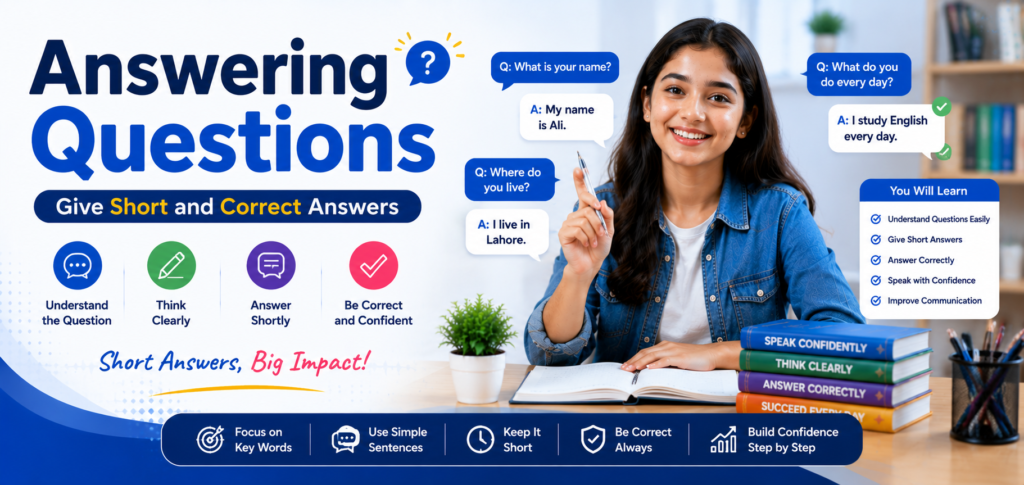
Sawal Ka Jawab Short Aur Correct Kaise Dein
Mastering the Art of Giving Short and Accurate Answers
1. Introduction
Jab koi humse sawal poochta hai, tab hum aksar do galtiyan karte hain:
- Bohot lamba jawab dete hain — jisse asal baat kho jati hai.
- Galat ya adhoora jawab dete hain — kyunki hum sawal ko poora samjhe bina hi bolna shuru kar dete hain.
✨ Achi Communication Ka Matlab: Sahi jawab, sahi length mein, sahi confidence ke saath.
Is lesson mein hum seekhenge:
- Short answers ki grammar aur structure
- Long answers vs short answers — kab kya use karein
- Sahi (correct) jawab dene ke liye sochne ka tareeqa
- Real-life examples aur practice
- Common mistakes jo log karte hain
2. Short Answers Kya Hote Hain?
English mein jab koi Yes/No question poochta hai, to uska jawab lamba sentence mein dena zaroori nahi hota. Ek short answer kaafi hota hai.
| Question | Short Answer |
|---|---|
| Do you speak English? | Yes, I do. / No, I don't. |
| Is she coming today? | Yes, she is. / No, she isn't. |
| Can you help me? | Yes, I can. / No, I can't. |
| Did you finish the work? | Yes, I did. / No, I didn't. |
| Are you free tomorrow? | Yes, I am. / No, I'm not. |
| Have you eaten? | Yes, I have. / No, I haven't. |
⭐ Golden Rule: Jo auxiliary verb sawal mein use hua hai (do/does/did/is/are/can/have), wahi auxiliary verb jawab mein use hoga.
3. Short Answer Kyun Zaroori Hai?
- Time bachata hai: Dono logon ka time save hota hai.
- Clarity deta hai: Lamba jawab mein asal baat kho sakti hai.
- Confidence dikhata hai: Seedha aur clear jawab confident insan ki nishani hai.
- Natural lagta hai: Native English speakers zyadatar short answers hi use karte hain.
Comparison:
❌ Zyada lamba (Unnecessary): "Well, actually, yes, I think I do speak English, I mean I have been speaking it for quite some time now."
✅ Short aur Correct: "Yes, I do."
4. Wh- Questions Ke Liye Short Answers
Wh- questions (What, Where, When, Who, Why, How) ka jawab bhi zaroori nahi ke poora sentence ho. Sirf zaroori information dena kaafi hai.
| Question | Short Answer (Casual) |
|---|---|
| What's your name? | Ahmed. |
| Where do you live? | In Lahore. |
| When is the meeting? | At 3 PM. |
| Who is coming? | Sara and Ali. |
| How much does it cost? | 500 rupees. |
| Why are you late? | Traffic. |
Note: Formal situations mein (jaise interview, office) thoda poora sentence dena better hota hai (e.g., "What's your name?" → "My name is Ahmed.").
5. Correct Jawab Dene Ka Tareeqa (How to Answer Correctly)
Step 1: Sawal Ko Poora Suno
Jaldi mein jawab dene se pehle sawal ko dhyan se sunein taaki galat jawab na bane.
Step 2: Sawal Ka Type Pehchano
Sochein kya yeh Yes/No question hai ya Wh- question, taaki waisa hi jawab diya ja sake.
Step 3: Sirf Poocha Gaya Jawab Do
Extra information mat dein jab tak zaroori na ho. To-the-point baat rakhein.
Step 4: Pata Na Ho to Boliye
"I'm not sure" ya "I'll find out" bolein. Galat guess karne se behtar yeh hai.
Step 5: Double Check Karein (Zaroorat Ho To)
Agar sawal confusing ho to confirm kar lein: "Do you mean today or tomorrow?"
6. Kab Short Aur Kab Detailed Jawab Dena Chahiye
| Situation | Answer Type |
|---|---|
| Casual conversation | Short |
| Yes/No question | Short |
| Interview / Formal setting | Thoda detailed |
| Someone asks "why" or "how" | Thoda explanation zaroori |
| Exam ya test | Jitna poocha gaya utna hi |
| Meeting mein update dena | Short aur to-the-point |
📌 Rule of Thumb: Jawab utna hi lamba hona chahiye jitna sawal ko poora karne ke liye zaroori hai — na kam, na zyada.
7. Real-Life Examples
-
Office Meeting:
Q: "Is the report ready?"
✅ A: "Yes, it's ready. I'll send it by 5 PM." -
Interview:
Q: "Do you have experience in this field?"
✅ A: "Yes, I have three years of experience in marketing." -
Daily Conversation:
Q: "Are you coming to the party?"
✅ A: "Yes, I am. See you there!" -
Not Knowing the Answer:
Q: "What's the capital of Australia?"
✅ A: "I think it's Canberra, but let me confirm." -
Classroom:
Q: "What is 15 plus 20?"
✅ A: "35."
8. Common Mistakes Jo Avoid Karni Chahiye
- ❌ Sawal sune bina jawab dena
- ❌ Bohot zyada explanation dena jab zaroorat na ho
- ❌ "Yes" ya "No" ke baad context clear na karna jab zaroori ho
- ❌ Galat guess karna jab pata na ho
- ❌ Auxiliary verb match na karna (e.g., "Do you like it?" → "Yes, I am" ❌)
- ❌ Nervous hoke baat ghumana
9. Practice Exercise
Neeche diye gaye sawalon ka short aur correct jawab likhkar practice karein:
- Do you like coffee? → ______________________ (Ans: Yes, I do. / No, I don't.)
- Is it raining outside? → ______________________ (Ans: Yes, it is. / No, it isn't.)
- What's your favorite color? → ______________________ (Ans: Blue.)
- Can you swim? → ______________________ (Ans: Yes, I can. / No, I can't.)
- Where is the office located? → ______________________ (Ans: It's on Main Street.)
- Have you completed the assignment? → ______________________ (Ans: Yes, I have. / No, I haven't yet.)
10. Key Takeaways (Summary)
✔ Short answer ka matlab incomplete nahi,
balki to-the-point hota hai.
✔ Yes/No questions ka jawab:
Yes/No + Subject + Auxiliary Verb.
✔ Sawal ko poora sunein, phir jawab dein.
✔ Agar pata na ho, confidently "I'm not sure" boliye.
✔ Jawab utna hi lamba rakhein jitna zaroorat ho.
11. Daily Challenge
Aaj se jab bhi koi aapse sawal poochay, khud ko yeh 2 sawal poochein:
- Kya mera jawab sawal ke mutabiq sahi hai?
- Kya main isse aur short kar sakta hoon?
"Behtareen jawab woh nahi hota jo sabse lamba ho — behtareen jawab woh hota hai jo sahi ho aur seedha samajh aaye."