
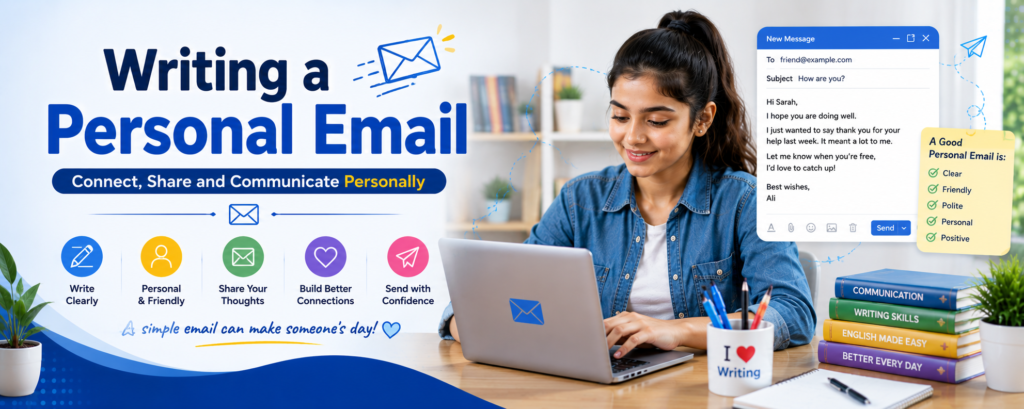
Complete Lesson: Writing Personal Emails (Write Simple Emails with Confidence)
Writing a personal email is an important everyday skill. Whether you are writing to a friend, family member, or someone you know, personal emails should sound natural, friendly, and simple. In this lesson, you will learn the structure of personal emails, common phrases, topic variations, full examples, and practice exercises.
Part 1: What Is a Personal Email?
A personal email is a message you write to someone you know — a friend, relative, or classmate — to share news, ask about their life, invite them somewhere, thank them, or simply stay in touch.
Personal emails are different from formal/business emails:
| Personal Email | Formal Email |
|---|---|
| Friendly and casual tone | Polite and professional tone |
| Uses simple, everyday words | Uses formal vocabulary |
| Can use short forms (I'm, don't) | Avoids short forms |
| Starts with "Hi" / "Hey" | Starts with "Dear Mr./Ms." |
This lesson focuses on personal emails only.
Part 2: Basic Structure of a Personal Email
Every personal email has these parts:
- Greeting – How you start the email
- Opening line – A friendly first sentence
- Main body – The main message/news/reason for writing
- Closing line – A final friendly sentence
- Sign-off – How you end the email
- Your name
Hi [Name],
[Opening line]
[Main message - 2 to 4 sentences]
[Closing line]
[Sign-off],
[Your name]
Part 3: Useful Phrases for Each Part
1. Greetings (Starting the Email)
| English | Urdu Meaning |
|---|---|
| Hi [Name], | ہائے [نام]، |
| Hey [Name], | ارے [نام]، |
| Dear [Name], | پیارے [نام]، |
| Hello [Name], | ہیلو [نام]، |
2. Opening Lines
| English | Urdu Meaning |
|---|---|
| How are you? | آپ کیسے ہیں؟ |
| How have you been? | آپ کیسے رہے؟ |
| I hope you are doing well. | امید ہے آپ ٹھیک ہوں گے۔ |
| It's been a while since we talked! | ہمیں بات کیے کافی عرصہ ہو گیا ہے! |
| I just wanted to write and say hi. | میں نے بس لکھ کر ہائے کہنا چاہا۔ |
| Sorry I haven't written in a while. | معذرت میں نے کافی عرصے سے نہیں لکھا۔ |
3. Sharing News / Main Message
| English | Urdu Meaning |
|---|---|
| I wanted to tell you that... | میں آپ کو بتانا چاہتا/چاہتی تھی کہ... |
| Guess what happened! | اندازہ لگائیں کیا ہوا! |
| I have some good news! | میرے پاس کچھ اچھی خبر ہے! |
| I have to share something with you. | मुझे آپ کے ساتھ کچھ شیئر کرنا ہے۔ |
| Things have been going well/not so well. | چیزیں اچھی/زیادہ اچھی نہیں چل رہیں۔ |
| I'm writing to ask about... | میں ... کے بارے میں پوچھنے کے لیے لکھ رہا/رہی ہوں |
| I wanted to invite you to... | میں آپ کو ... میں مدعو کرنا چاہتا/چاہتی تھی |
| Thank you so much for... | ... کے لیے بہت شکریہ |
| I'm really sorry about... | मुझे ... के लिए बहुत अफसोस है |
4. Closing Lines
| English | Urdu Meaning |
|---|---|
| Write back soon! | جلد جواب دیں! |
| I can't wait to hear from you. | آپ کا جواب سننے کا بے صبری سے انتظار ہے۔ |
| Let me know what you think. | मुझे बताएं آپ کیا سوچتے ہیں۔ |
| Take care! | अपना خیال رکھیں! |
| Talk to you soon. | جلد بات ہوگی। |
| Looking forward to seeing you. | آپ سے ملنے کا انتظار رہے گا۔ |
5. Sign-offs
| English | Urdu Meaning |
|---|---|
| Best, | نیک تمنائیں، |
| Take care, | خیال رکھیں، |
| Love, | محبت کے ساتھ، |
| Your friend, | آپ کا دوست، |
| See you soon, | جلد ملیں گے، |
| Warm regards, | نیک خواہشات کے ساتھ، |
Part 4: Full Example Email 1 — Sharing News with a Friend
Hi Sara,
How have you been? I hope everything is going well with you and your family.
I just wanted to share some exciting news with you — I got accepted into the university I applied to! I am so happy and a little nervous too. Classes start next month, so I have been busy preparing for it.
How is everything on your side? I would love to hear what's new with you.
Write back soon!
Best,
Ayesha
Part 5: Full Example Email 2 — Inviting a Friend
Hi Hamza,
I hope you're doing great! It's been a while since we hung out.
I wanted to invite you to my birthday party this Saturday at 5 PM. It will be at my house, and a few of our friends are coming too. There will be food, games, and music — it's going to be fun!
Let me know if you can make it. I would really love to see you there.
Take care,
Bilal
Part 6: Full Example Email 3 — Thank You Email
Hi Fatima,
I hope you're doing well. I just wanted to send you a quick email to say thank you for helping me move into my new apartment last weekend. It really made a big difference, and I couldn't have done it without you.
I really appreciate your kindness and support. Let's plan to get coffee soon so I can thank you properly!
Talk to you soon,
Zainab
Part 7: Full Example Email 4 — Apology Email
Hi Ahmed,
I'm really sorry I missed your call yesterday. I was busy with some work and completely forgot to check my phone until late in the evening.
I hope everything is okay. Please let me know if it was something important, and I will call you back as soon as possible.
Sorry again for the delay!
Best,
Usman
Part 8: Full Example Email 5 — Checking In / Catching Up
Hey Ali,
It's been a long time since we last talked, and I just wanted to check in and see how you're doing.
Life has been pretty busy for me lately — work, family, and trying to find some free time here and there! I've been thinking about you and wondering how everything is going on your end.
Let me know when you're free — I'd love to catch up properly, maybe over a call or coffee sometime.
Looking forward to hearing from you.
Warm regards,
Hassan
Part 9: Common Mistakes to Avoid
| Mistake | Better Way |
|---|---|
| Starting too formally ("Dear Sir") | Use "Hi [Name]" or "Hey [Name]" |
| Writing very long, complicated sentences | Keep sentences short and clear |
| Forgetting a closing line | Always end with a friendly sentence |
| Not asking about the other person | Show interest by asking a question |
| Being too stiff/robotic | Write like you're talking to a friend |
Part 10: Tips for Writing with Confidence
- Keep it simple: You don't need difficult words. Simple, clear sentences are best.
- Write like you speak: Imagine you are talking to the person in real life.
- Don't worry about perfect grammar: Focus on getting your message across clearly.
- Use short paragraphs: 2–4 sentences per paragraph is enough.
- Always ask a question: This encourages the person to reply.
- Read your email once before sending: Check if it sounds friendly and clear.
- Practice regularly: The more personal emails you write, the more natural it becomes.
Part 11: Practice Exercises
Exercise 1: Fill in the blanks
- ______ Sara, (Hi/Dear Sir)
- I hope you are ______ well. (doing/does)
- I wanted to ______ you to my party. (invite/inviting)
- ______ soon! (Write back/Writes back)
- Best, ______ (your name)
Exercise 2: Rearrange the email
Put these lines in the correct order to form a proper email:
- Take care, Bilal
- Hi Ahmed,
- Let me know if you're free this weekend to meet up.
- How have you been? I hope everything is going well.
- I just wanted to check in and see how you're doing.
Exercise 3: Write your own email
Choose one of these situations and write a complete personal email (6–8 sentences):
- Tell a friend about your exciting news (a new job, trip, or achievement).
- Invite a friend to an event (party, dinner, outing).
- Thank a family member for their help or a gift.
- Apologize to a friend for forgetting their birthday.
- Check in with an old friend you haven't talked to in a while.
Exercise 4: Improve the email
Rewrite this overly formal email to make it sound more personal and friendly:
"Dear Sir, I am writing to inform you that I would like to invite you to attend my birthday celebration. Kindly confirm your attendance at your earliest convenience."
Part 12: Quick Reference — Email Starter Phrases
| Situation | Starter Phrase |
|---|---|
| Sharing news | "I wanted to tell you that..." |
| Inviting someone | "I wanted to invite you to..." |
| Thanking someone | "I just wanted to say thank you for..." |
| Apologizing | "I'm really sorry about..." |
| Checking in | "It's been a while, so I wanted to see how you're doing." |
| Asking a favor | "I was wondering if you could help me with..." |
Summary
In this complete lesson, you learned the structure of personal emails, useful phrases for every section, reviewed 5 full example emails covering different everyday scenarios, identified common mistakes, and practiced exercises to build your confidence.
Practice tip: Try writing one short personal email every day — to a friend, imaginary pen pal, or even to yourself. The more you practice, the more natural and confident your writing will become!